.png)
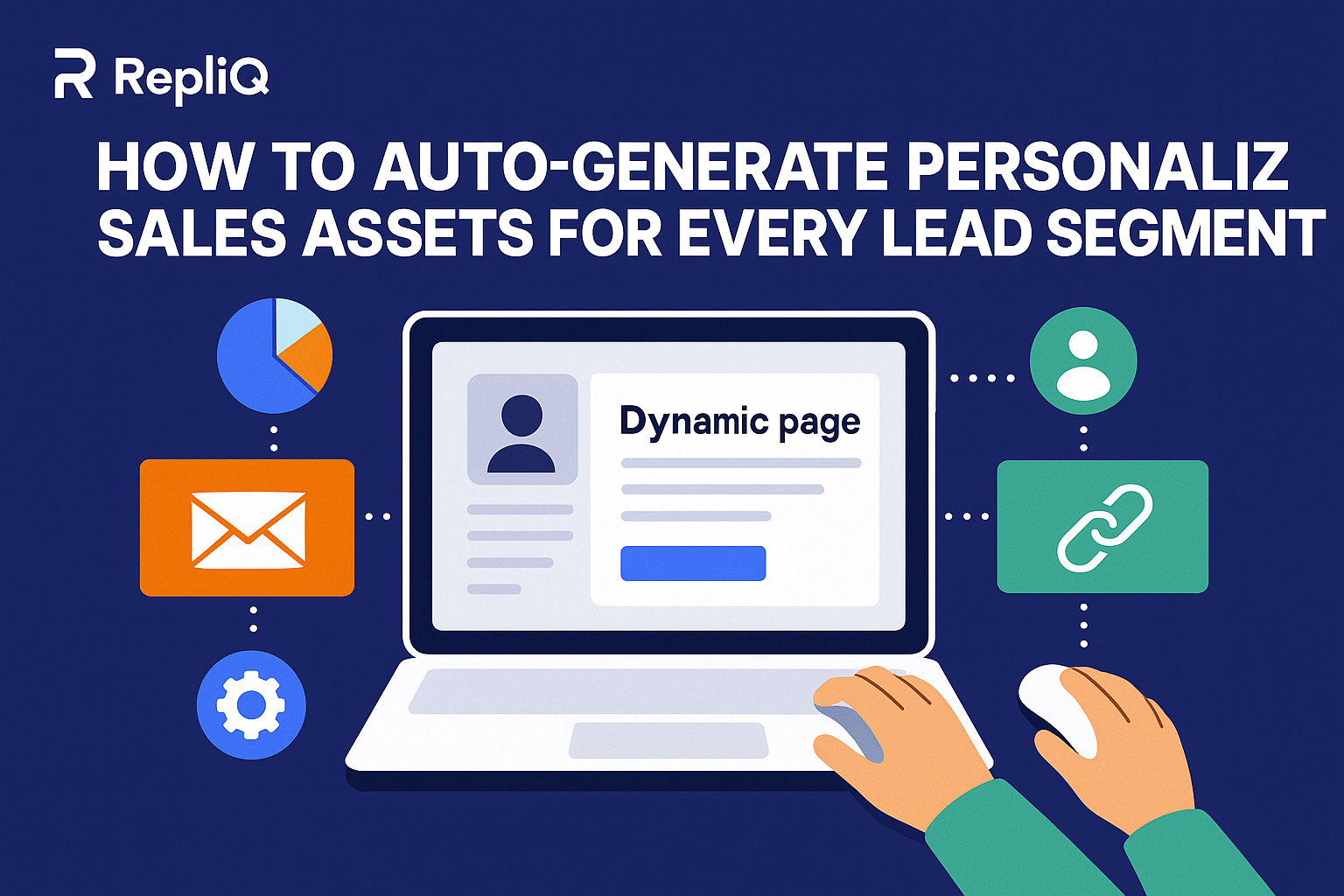
How to Auto‑Generate Personalized Sales Assets for Every Lead Segment (Advanced Guide)
The fundamental paradox of modern B2B sales is that while personalization is the only way to cut through the noise, it breaks the moment you try to scale it.
Most sales teams and agencies hit a ceiling: they can either send highly personalized outreach to a tiny list of prospects or send generic, template-based spam to thousands. Attempting to bridge this gap manually leads to burnout, inconsistent messaging, and operational bottlenecks.
This guide presents a third option: a segment‑first, fully automated framework for generating personalized sales assets across every channel. By connecting CRM data to advanced segmentation logic and automated asset generation, agencies can deliver hyper-relevant content—videos, images, and landing pages—without adding manual workload.
In this advanced guide, we will explore how to build an engine that moves from raw data to automated sales personalization, ensuring that your segmented outreach converts at an elite level. We will also discuss the role of tools like RepliQ, which serves as an advanced personalization engine, enabling agencies to deploy multi‑asset, AI-driven outreach that remains perfectly on-brand at scale.
Why Sales Personalization Breaks at Scale
The decline of manual personalization is rarely due to a lack of effort; it is a failure of infrastructure. When sales development representatives (SDRs) attempt to research and customize assets for hundreds of leads, three core fractures occur:
- Inconsistent Segmentation: Manual tagging in CRMs is prone to human error, leading to misaligned messaging (e.g., sending a "startup" offer to an enterprise client).
- Repetitive Asset Creation: Recording unique Loom videos or designing custom images for every prospect is mathematically impossible to scale beyond 20–30 leads per day.
- Data Alignment Gaps: Even with rich data, transferring insights from a CRM into a visual asset usually requires copy-pasting, which destroys workflow velocity.
For advanced B2B teams, the result is often a revert to generic outreach. However, generic blasting crushes conversion rates and damages domain reputation. The solution lies in trustworthy automation that respects rigorous standards. According to the NIST AI Risk Management Framework Roadmap, implementing principles of validity and reliability is essential for sustainable automation. Without a framework that ensures personalized sales assets are accurate and safe, scaling personalization becomes a liability rather than an asset.
How AI‑Driven Segmentation Powers Automated Personalization
True automation begins before a single email is drafted. It starts with how you slice your market. AI-driven segmentation moves beyond basic firmographics (Company Size, Industry) into behavioral clustering and micro-segments.
Modern AI models can analyze CRM-enriched attributes to create dynamic clusters—grouping leads not just by who they are, but by how they behave and what technology they use. This is the foundation of lead segmentation automation.
Academic research validates this shift. The SeqUDA‑Rec AI segmentation research demonstrates how sequential behavior-based segmentation significantly outperforms static profiling. By understanding the sequence of a lead's interactions or technology adoption, AI can assign them to a "high-intent" or "churn-risk" segment automatically.
Unlike competitors who rely on static lists, an AI-driven approach continuously updates segments. If a prospect installs a new technology or hires a specific role, they are automatically moved to a new segment, triggering a different personalization workflow. This ensures that the downstream asset generation is always contextually relevant.
Types of Sales Assets You Can Personalize Automatically
Once leads are segmented, the next step is generating the creative assets that will capture their attention. The highest conversion lift comes from moving beyond text-only emails into rich media.
With advanced engines, you can auto-generate the following personalized sales assets:
- Personalized Landing Pages: Unique URLs for every prospect featuring their logo, name, and a value proposition tailored to their specific pain points.
- Personalized Videos: AI-generated backgrounds that scroll through the prospect’s website or LinkedIn profile while a human voiceover delivers the pitch.
- Personalized Email Copy + Visual Assets: Images that dynamically insert the prospect’s name or website screenshot into a whiteboard or tablet screen.
- Segment‑Specific Product Demos: Interactive flows that highlight different features based on the lead's industry (e.g., showing "HIPAA Compliance" to healthcare leads vs. "Speed" to e-commerce leads).
This is where RepliQ excels. As a multi-asset personalization engine, RepliQ allows you to define rules for each segment and automatically generate thousands of unique videos and images that look manually created.
Recent studies support the efficacy of this approach. The SLM4Offer personalized marketing study highlights how Large Language Models (LLMs) and generative systems can optimize dynamic content generation to match user preferences, resulting in significantly higher engagement rates compared to static content.
Building an End‑to‑End Automated Personalized Outreach Workflow
To implement this, agencies need a robust architecture. Here is the blueprint for automated outreach workflows that integrate segment-based messaging without manual intervention.
Step 1: Data Extraction & Automated Segmentation
Your CRM (HubSpot, Salesforce) or data provider acts as the source of truth. Leads are enriched and filtered through automation rules (e.g., "If Industry = Fintech AND Tech Stack = Stripe, assign to Segment A").
Step 2: Auto-Generate Asset Variations
Data flows into the personalization engine. Using the rules defined in Step 1, the system generates specific assets. Segment A gets a video about payment integration; Segment B gets a landing page about compliance.
Step 3: Deployment Across Channels
The generated assets (links, images, GIFs) are pushed back into your sequencing tool (Smartlead, Instantly, Outreach). The AI-driven outreach campaign pulls the correct custom variable for each lead.
Step 4: Automate Iteration
The loop is closed by analyzing performance. Which segment engaged most with the video? Which ignored the image? This connects to the AI-driven automated A/B testing framework, which suggests that continuous, algorithmic testing of content variations allows for real-time optimization of personalization strategies.
Unlike typical manual stacks where A/B testing is a monthly "event," this workflow allows for daily, automated optimization based on live data.
For practical examples of how these workflows come together across different industries, explore RepliQ’s use cases to see multi-asset outreach in action.
Advanced Strategies for Multi‑Asset Personalization at Scale
Top-tier agencies are now deploying hyper-specific micro-segmentation combined with multi-channel harmony.
The strategy involves mapping segments to message frameworks and then to asset variations.
- The "Technographic" Strategy: If a prospect uses a competitor's tool, the automated asset is a comparison chart image showing your tool vs. theirs, embedded in an email leading to a personalized landing page that pre-fills the savings calculator.
- The "Role-Based" Strategy: A CTO receives a Loom-style video scrolling through API documentation. A VP of Sales receives a video scrolling through a revenue dashboard.
This contrasts sharply with competitors who only personalize one element, such as the email first line. True scale requires "Omnichannel Consistency"—where the email, the video thumbnail, and the landing page destination all tell the same personalized story automatically.
Case Studies & Real‑World Agency Workflows
Consider a B2B lead generation agency struggling with a 1.5% reply rate on generic cold emails. Their manual workflow allowed for only 50 "high-quality" emails per week per rep.
The Shift:
They implemented a segment-first automation workflow. They split their 10,000-lead database into 12 distinct micro-segments based on pain points (e.g., "Scaling Pains," "Compliance Issues," "Cost Reduction").
The Execution:
Using AI outreach automation, they generated 10,000 unique videos. Each video featured the prospect's website in the background. The script varied based on the segment.
The Result:
- Before: Generic campaign = 1.5% reply rate.
- After: Segmented assets = 8% reply rate.
- Workload: The operational hours required to manage the campaign dropped by 60%, as the asset creation was fully automated. This sales personalization case study validates that depth does not require manual breadth.
Tools & Tech Stack Recommendations for Segmented Personalization
To build this system, you need a stack that communicates seamlessly.
- Enrichment & CRM: (Clay, Apollo, HubSpot) – To gather data and define lead segmentation tools.
- Personalization Engine: (RepliQ) – To ingest data and output AI personalization tools like videos, images, and LPs at scale.
- Outreach Sequencer: (Smartlead, Instantly, Salesloft) – To deliver the emails and host the variables.
Architecture Note:
Advanced systems thinkers ensure that data flows centrally. Do not silo data in the sending tool. Process it upstream (Enrichment/Clay), generate the asset (RepliQ), and pass the final URL to the sender. This ensures that if you switch email providers, your assets and segments remain intact.
Future Trends & Expert Predictions in Automated Sales Personalization
The future of AI sales personalization trends is moving toward real-time, agentic workflows.
- Real-Time Personalization Engines: Shortly, assets will not just be pre-generated but will adapt in real-time. If a prospect clicks a link at 9 AM, the landing page might display a specific case study. If they return at 5 PM, it might display a "book a meeting" calendar, recognizing increased intent.
- AI Agents: Autonomous agents will soon handle the entire loop—detecting a new lead, researching them, generating a video, sending the email, and handling the initial reply—without human oversight.
- Micro-Segment Clusters: We will move away from "lists" entirely, treating every single lead as a segment of one, with fully unique value propositions generated on the fly.
Conclusion
The era of choosing between "scale" and "personalization" is over. By implementing the blueprint outlined above—CRM data extraction, AI-driven segmentation, automated asset generation, and intelligent delivery—you can achieve both simultaneously.
This segmented outreach workflow allows agencies and sales teams to produce automated sales personalization that feels bespoke to the recipient but runs on autopilot for the sender. The key differentiator is the multi-asset approach: going beyond text to deliver videos, images, and pages that prove you understand the prospect's business.
If you are ready to stop sending generic spam and start generating high-converting, personalized assets at scale, RepliQ provides the engine to make it happen.
FAQ
What data do I need to automate personalized sales assets?
To fuel data for personalized outreach, you need core CRM properties (Name, Company, URL), technographic data (tools they use), and behavioral signals (recent funding, hiring). The more granular the data, the better the asset.
Which personalized assets deliver the highest ROI?
High-ROI personalized assets typically include personalized videos (showing the prospect's site) and personalized landing pages. These formats arrest the scroll and visually demonstrate effort, leading to higher conversion rates than text alone.
How does automation fit into existing CRM or outreach pipelines?
CRM personalization automation works as a middleware layer. You extract lead lists from your CRM, process them through a personalization engine to append asset URLs, and then push the enriched list back to your CRM or sequencing tool.
Can AI maintain quality across thousands of asset variations?
Yes, but it requires adherence to frameworks like the NIST AI RMF. Scalable personalization quality is achieved by setting strict rules and templates. You control the structure; AI fills the variables. This ensures brand safety while scaling.
How do I test and optimize personalized outreach?
Use automated A/B testing to run split tests on segments. Test "Video A" (pain point focus) against "Video B" (social proof focus) for a specific segment. AI outreach testing tools can automatically route traffic to the winning variation.

.svg)
.png)


.svg)