
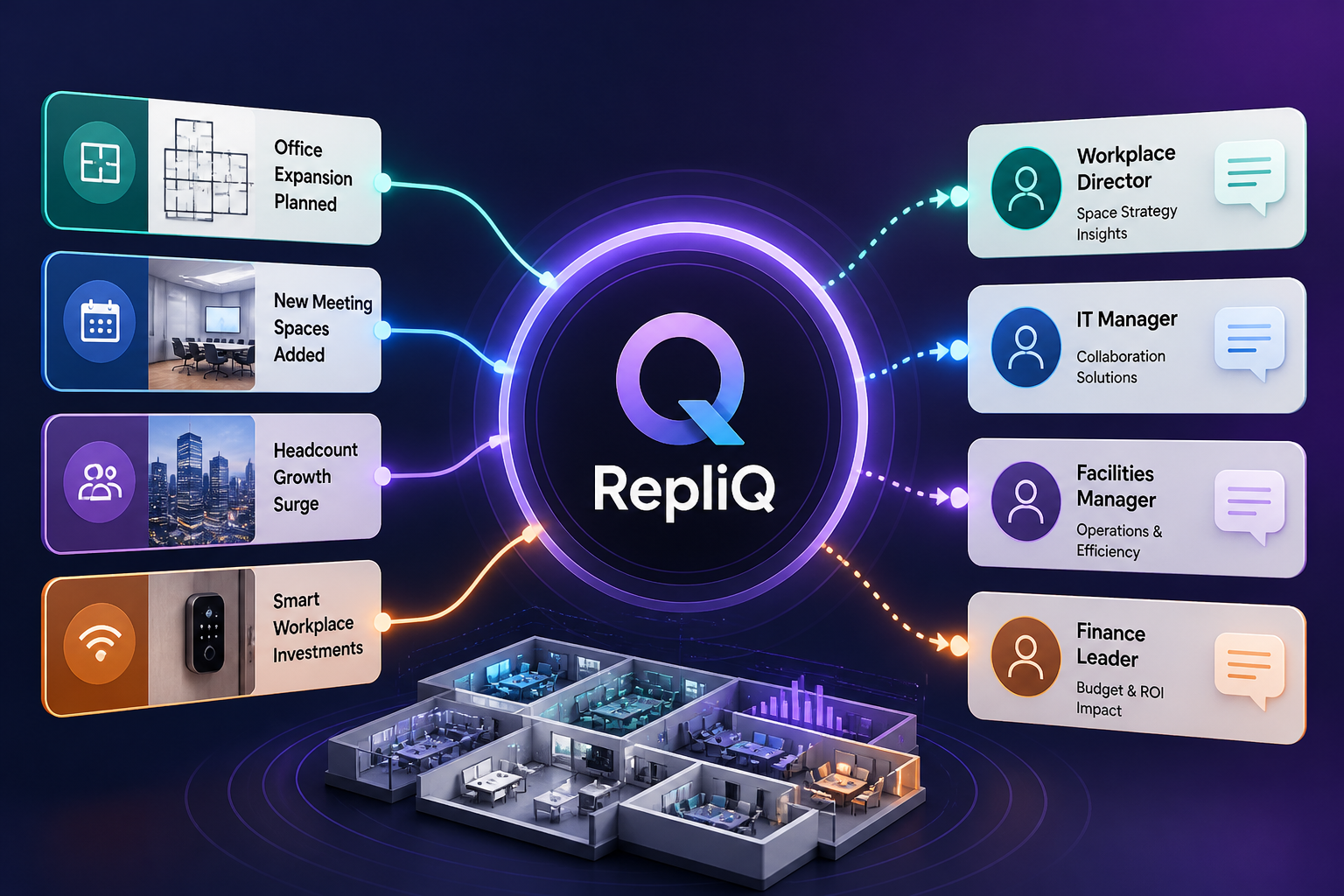
Workplace Technology Leads: A Signal-Based Framework for Personalized Office Technology Outreach
Generating qualified workplace technology leads is increasingly complex. Broad contact lists and generic sequence blasts often fail to reveal the most critical piece of the puzzle: whether an account actually has an active, operational need for workplace technology. When outreach relies solely on firmographics, sales teams waste time pitching to companies that are years away from an office upgrade.
To succeed, B2B sales and marketing teams must identify observable workplace initiatives—such as office expansions, relocations, hybrid-work transitions, and modernization projects—and map these signals to the correct buying committees. This article provides a practical, signal-based framework that prioritizes operational context over generic intent data or sheer outreach volume. By learning how to spot these triggers, create role-specific personalized prospecting campaigns, and measure true pipeline impact, providers can dramatically improve their sales efficiency.
For teams selling office, facilities, collaboration, or smart workplace solutions, RepliQ serves as an operations-focused platform designed to turn these workplace-related account signals into structured, highly relevant prospecting workflows.
Why Signal-Based Prospecting Matters for Workplace Technology Providers
Successful workplace technology lead generation requires far more than general firmographic targeting or high-volume outbound tactics. Poorly timed or generic office technology outreach leads to a cascade of sales problems: low-quality leads, weak message relevance, difficulty identifying the correct decision-maker, and long, fragmented buying cycles.
Workplace technology purchases rarely happen in a vacuum. As highlighted in organizational buying-center research, these are cross-functional purchasing decisions involving facilities, IT, workplace experience, real estate, operations, HR, procurement, finance, and executive sponsors.
This reality underscores the vital difference between list-based and signal-based prospecting. List-based prospecting relies on static assumptions: "This company matches our industry and size criteria, therefore they might buy." Signal-based prospecting relies on operational context: "This company has a verified workplace initiative that may create a relevant operational need."
It is important to note that signals should support a reasonable business hypothesis, not be treated as absolute proof that an account is ready to buy. While broad sales-intelligence databases and sequence tools provide valuable contact data and generic intent metrics, they are merely inputs. Applying workplace-specific signal interpretation is what ultimately creates the context needed for account-based marketing for workplace technology.
The Difference Between a Workplace Signal and Generic Intent
A general content-consumption or industry-interest signal may not reveal an underlying workplace problem. Just because a prospect downloaded a whitepaper on B2B technology outreach does not mean they are actively buying hybrid work technology buyers' solutions.
A concrete initiative creates a much stronger outreach hypothesis. Look for observable facts rather than assumptions, such as:
- An office opening or expansion
- Relocation or lease activity
- A formalized return-to-office or hybrid-work program
- A workplace modernization announcement
- Smart-building or connected-workplace initiatives
- Relevant hiring growth or changes in workplace operations
Focusing on these concrete office expansion signals helps identify genuine office modernization prospects over those merely browsing the web.
Identify High-Intent Workplace Investment Signals
Finding accounts with a plausible and timely workplace technology need requires a practical taxonomy of signals. Rather than merely listing events, organize these signals by what they indicate operationally.
For every signal, record the source, date, account, affected location, likely initiative, and your confidence level. Signal strength depends heavily on timing, specificity, account fit, and the direct connection to your solution. By categorizing these effectively, you can consistently generate high-quality workplace modernization companies and smart office lead generation opportunities.
Office Expansion, New Locations, and Relocation Signals
Key office expansion leads often originate from:
- New office openings and expansions
- Corporate relocations
- Commercial lease announcements
- Construction or renovation activity
- Regional growth initiatives
These events carry massive operational implications. A new location requires collaboration environments, room technology, connectivity, workplace systems, facilities infrastructure, and employee experience planning.
However, avoid assuming that expansion automatically guarantees a purchase. Always validate the timing, location, scale, and business fit. When researching these commercial real estate technology leads, you might consult Census construction spending data as a macro-level research input to understand nonresidential investment trends, though it is not proof of an individual company’s buying intent. Similarly, BLS telework and relocation findings provide excellent context on the relationship between telework, workplace changes, and relocation considerations.
Hybrid-Work, Return-to-Office, and Workplace-Experience Signals
Hybrid-work initiatives create immediate needs related to collaboration environments, meeting-room technology, occupancy and space management, employee and visitor experience, and workplace connectivity.
To find hybrid-work technology buyers, look for public indications of a return-to-office initiative or a shift in workplace strategy. Connect this signal to a specific operational consequence instead of just dropping "hybrid work" into an email as a generic personalization token. Because public workplace policies can shift rapidly, always document the signal date and source to reduce the risk of using outdated information in your workplace experience outreach.
Workplace Modernization, Smart-Building, and Technology Investment Signals
Workplace modernization prospects can be identified through signals associated with:
- Smart-office initiatives and connected-building projects
- Facilities technology upgrades
- Digital workplace programs
- Collaboration or office technology investments
Qualify whether the signal relates directly to your offer using a simple qualification score based on signal strength, recency, account fit, potential operational pain, and stakeholder relevance. This structured approach is the backbone of a successful office technology sales strategy.
When a Signal Is Not Strong Enough
Not all workplace technology sales leads are created equal. Weak or ambiguous signals—such as a three-year-old press release, a broad claim about company growth, or an unrelated hiring trend—are not strong enough to warrant immediate outreach.
When facing weak signals, combine multiple data points before prioritizing the account. Mark uncertain signals for further account research and human validation rather than presenting them as absolute facts in your initial message.
Map the Workplace Technology Buying Committee
Because a single contact rarely represents the entire purchasing process, mapping the workplace buying committee is critical. Providers must identify both economic buyers and operational influencers, tailoring the message to each person’s unique responsibilities.
As supported by organizational buying-center research, cross-functional stakeholder mapping ensures your facilities management outreach resonates across the organization.
| Stakeholder | Likely Priorities | Common Concerns | Relevant Proof Point | Suggested Call to Action |
|---|---|---|---|---|
| Facilities / Workplace Exp. | Usability, occupancy, space experience, reliability | Facility coordination, operational disruption | Operational example, implementation practicality | Discuss space utilization outcomes |
| IT / Collaboration Tech | Security, standardization, integration | Support requirements, technical compatibility | Security compliance, integration case study | Review technical architecture |
| Real Estate | Location strategy, lease timing, space planning | Portfolio changes, wasted real estate spend | Space optimization metrics | Evaluate location strategy impact |
| Operations | Efficiency, consistency, business continuity | Execution bottlenecks, disjointed systems | Business continuity use case | Explore operational efficiencies |
| HR / Finance / Execs | Employee experience, cost, strategic alignment | Adoption rates, ROI, investment justification | Measurable financial outcomes | Discuss strategic business impact |
Facilities and Workplace Experience Leaders
Facilities and workplace experience teams prioritize usability, occupancy, employee and visitor experience, operational reliability, and facility coordination. When conducting facilities technology outreach, frame your message around workplace outcomes and implementation practicality rather than just technical specifications. Use proof points tied to relevant operational examples or comparable initiatives to drive successful office technology outreach.
IT and Collaboration Technology Leaders
IT workplace technology buyers care deeply about integration, security, governance, reliability, support requirements, and standardization across locations. Messaging here should address technical compatibility and implementation risk without overloading the first touch with dense product details. Identify whether IT owns the initiative or is acting as an evaluator. Responsible evaluation and governance are paramount; teams should look to NIST Privacy Framework guidance when considering stakeholder coordination, privacy requirements, and technology governance.
Real Estate, Operations, HR, Finance, and Executive Stakeholders
Messaging must pivot based on the role. Real estate leaders focus on location strategy and lease timing. Operations technology buyers prioritize efficiency and business continuity. HR cares about policy adoption and employee experience. Finance requires investment justification, and executive sponsors look at strategic alignment and risk. Coordinate your account-based marketing for workplace technology so that multiple contacts receive related, yet highly role-specific messages.
Create Trigger-Based Personalized Outreach
Turning one verified workplace signal into a concise, relevant outreach campaign is the essence of personalized prospecting. The core message structure should always include:
- A verified workplace trigger
- A relevant operational implication
- A role-specific value hypothesis
- Credibility or a proof point
- A low-friction call to action
Personalization must demonstrate a deep understanding of an initiative, not simply insert a company name into a template. A generic, product-led office technology pitch will be ignored. A trigger-based message connected to a verified expansion, relocation, or hybrid-work initiative will earn attention.
Build the Account-Specific Value Hypothesis
To generate high-quality workplace technology leads, your account research must answer: What changed at the account? Which workplace problem might follow? Which stakeholder cares most? What evidence supports this? What should they do next?
Use cautious language when the operational problem has not been confirmed. Frame the issue as a possibility ("Often when teams expand to new regions, they face...") rather than an unsupported claim ("I know your new office is struggling with...").
Match the Message to the Stakeholder
An office expansion signal supports vastly different messages depending on the recipient. Facilities leaders need to hear about space coordination; IT leaders need to hear about network standardization; HR needs to hear about employee onboarding experiences. Keep role-specific outreach concise, focusing on one business issue and one next step to maximize your B2B personalization for technology companies.
Include Evidence Without Overloading the First Touch
Support your B2B technology outreach with relevant evidence: a verified initiative, a concise operational observation, or a clear measurement point. Do not imply a relationship, project, or business outcome that has not been strictly verified. Instead of a long product description, utilize a relevant proof asset. You can explore RepliQ use cases to see exactly how workplace signals can be connected to practical, high-converting prospecting outcomes.
Design a Coordinated Multichannel Follow-Up
One account hypothesis should be supported by a multichannel B2B outreach strategy encompassing email, professional-network touchpoints, calls, and internal sales tasks. Rather than repeating the same message, change the angle or add useful context in your follow-ups. A strong personalized outreach sequence framework includes signal confirmation, role relevance, a proof point, a clarifying question, and a final low-pressure close. This context-aware follow-up stands in stark contrast to high-volume sequences that prioritize blind activity over account relevance.
Build a Scalable Research and Follow-Up Workflow
To make this framework a repeatable operating process that reduces manual research while preserving accuracy, teams must build a scalable workflow. ScaliQ is highly relevant for teams looking to implement scalable research, signal handling, and operational workflows.
The sequence should follow these steps:
- Define the ideal customer profile
- Discover workplace signals
- Validate the source and timing
- Score the account
- Map the buying committee
- Create role-specific message hypotheses
- Route tasks and launch outreach
- Review engagement and update the account
Document each step in your CRM. AI-assisted account research and drafting can accelerate preparation, but human review remains mandatory to protect accuracy and relevance.
Use a Workplace Signal Qualification Scorecard
Implement a scorecard to grade office expansion prospects and other leads. Criteria should include signal specificity, signal recency, account fit, estimated workplace impact, stakeholder match, and evidence quality. Use this workplace signal scoring to prioritize accounts—not to create an artificial prediction of purchase probability. Keep a separate “needs verification” status for uncertain accounts.
Add Human Review and Accuracy Controls
Before sending AI-assisted prospecting messages, humans must check source accuracy, signal dates, company/location details, recipient roles, message relevance, and claims made about the prospect. Never present inferred workplace pain as a confirmed fact. Responsible personalization requires strict data ethics; utilize NIST Privacy Framework guidance to ensure the responsible handling of stakeholder information and privacy considerations. Signal-based personalization must rely on publicly accessible, appropriately sourced information and should never encourage misleading or intrusive outreach.
Define Signal Decay and Follow-Up Ownership
Workplace signals age and change. An office expansion signal from two years ago is no longer an active trigger. Record the signal date, last validation date, account owner, next follow-up task, and current account stage. Revise or halt your sales follow-up workflow when the initiative is no longer relevant to ensure highly effective account-based prospecting.
Measure Qualified Pipeline and Outreach ROI
Evaluation must move beyond opens, clicks, and reply volume. Providers must focus on commercial quality and account progression, measuring performance at the account level. As outlined in the GAO IT performance measurement guide, connecting activity to outcomes through results chains and scorecards is essential for true accountability in workplace technology sales metrics.
Metrics for Signal Quality and Engagement
Track early-stage account engagement metrics such as:
- Signal-to-account qualification rate
- Percentage of signals validated
- Account fit rate
- Stakeholder identification rate
- Buying-committee penetration
Relying on response rate alone is dangerous, as it can inadvertently reward irrelevant or overly broad messaging. Focus instead on personalized outreach metrics that indicate true account traction.
Metrics for Pipeline Progression
Commercial measures dictate the success of your workplace technology pipeline. Track the qualified meeting rate, opportunity creation, signal-to-opportunity conversion, sales-cycle progression, pipeline influenced, win rate, and revenue per researched account. Compare signal-led campaigns against broad outbound efforts using consistent definitions and time periods to prove pipeline attribution.
Create a Simple ROI Test Plan
Outline a controlled comparison between broad account targeting and signal-led, role-specific targeting. Keep this prospecting ROI test focused on account quality, qualified pipeline measurement, and closed-won opportunities rather than mere message engagement. Document research effort, campaign costs, conversion rates, and the resulting B2B outreach measurement to validate the strategy.
Practical Workplace Technology Prospecting Checklist
Use this pre-outreach checklist to ensure high-quality personalized prospecting and office technology outreach:
- [ ] Is there a current and specific workplace signal?
- [ ] Has the signal been verified through public, compliant sources?
- [ ] Does the account fit the provider’s target market?
- [ ] Is the likely operational implication clear?
- [ ] Have relevant stakeholders been mapped?
- [ ] Is the message tailored to the recipient’s specific role?
- [ ] Is the evidence accurate and proportionate?
- [ ] Is there a clear, low-friction CTA?
- [ ] Is follow-up ownership clearly defined?
- [ ] Will the outcome be measured at the account and pipeline level?
Do Not Send Yet If: The signal is outdated, the connection to the operational pain is ambiguous, or the initiative is weakly connected to your solution.
Conclusion: Turn Workplace Signals Into More Relevant Pipeline
Generating qualified workplace technology leads requires a shift from volume-based guessing to context-driven engagement. By following this five-part process, teams can consistently drive revenue:
- Identify high-intent workplace investment signals.
- Map the full buying committee.
- Create trigger-based, role-specific outreach.
- Build a scalable research and follow-up workflow.
- Measure qualified pipeline and revenue relevance.
Effective personalization is not a name token or a generic intent score; it is a credible connection between a verified workplace initiative and a recipient’s likely operational priorities. Audit one of your existing campaigns today and rebuild it around a specific office expansion, hybrid-work, relocation, or modernization signal.
For workplace technology providers ready to take the next step, RepliQ can help identify workplace-related account signals and organize more relevant, operations-focused prospecting workflows to scale your workplace technology lead generation.
FAQ
How Do Workplace Technology Providers Generate Qualified Leads?
Providers generate qualified workplace technology leads by combining ideal-customer-profile criteria with observable, compliant signals such as expansion, relocation, hybrid-work, and modernization initiatives. Success relies on signal validation, stakeholder mapping, relevant messaging, and strict qualified-pipeline measurement.
What Signals Indicate That a Company May Be Investing in Workplace Technology?
Key office expansion signals include new locations, relocations, renovations, hybrid-work programs, return-to-office initiatives, smart-building projects, and announcements from workplace modernization companies. A signal indicates a strong research opportunity, not a confirmed purchase intent.
Who Buys Workplace Technology Solutions?
Workplace technology buyers span multiple departments. Depending on the solution, the workplace buying committee typically includes facilities, IT, workplace experience, operations, real estate, HR, procurement, finance, and executive sponsors. This cross-functional dynamic is well-documented in organizational buying-center research.
How Can Outreach Be Personalized Without Manual Research for Every Account?
Teams can achieve personalized prospecting at scale by building a workflow that uses signal discovery, structured account fields, stakeholder mapping, and AI-assisted account research. Automation should accelerate preparation, but human validation must remain to ensure accuracy in all personalized B2B email outreach.
What Should a Personalized Message to a Workplace Technology Buyer Include?
Trigger-based messaging in office technology outreach should include a verified trigger, a relevant operational implication, a role-specific value hypothesis, one credible proof point, and a concise call to action. Avoid unsupported claims, excessive product details, and generic personalized B2B email outreach tokens.
How Should Providers Measure the ROI of Personalized Prospecting?
To measure personalized prospecting ROI, track account engagement, qualified meetings, buying-committee penetration, opportunity creation, pipeline progression, win rate, and revenue per researched account. As supported by the GAO IT performance measurement guide, replies and opens are merely supporting indicators; qualified pipeline metrics are the true measure of success.


