.png)
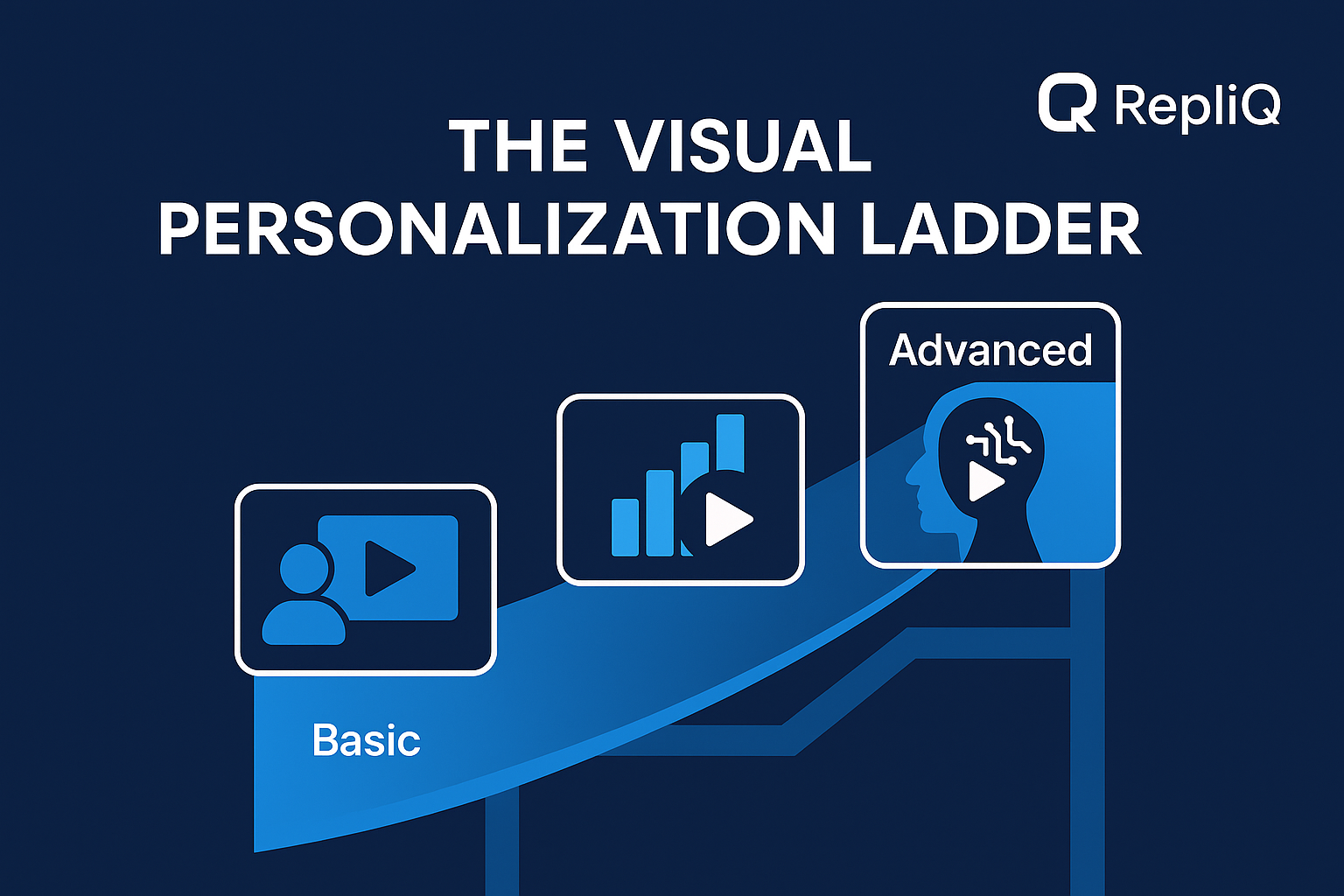
Scaling Personalization: The Visual Personalization Ladder From Basic to Advanced
Table of Contents
- Introduction
- Why Personalization Breaks at Scale
- The Visual Personalization Ladder
- When to Use Text, Images, Video, or Landing Pages
- How to Scale With Templates and AI
- Matching Personalization Depth to Account Value and Funnel Stage
- Conclusion
- FAQ
Introduction
Most revenue teams know the painful truth: generic outreach severely underperforms, but going fully custom for every single prospect quickly becomes unmanageable. There is a constant, underlying tension between the desire for better reply and meeting rates and the reality of needing repeatable systems that do not slow sales reps down. When forced to choose between quality and quantity, many teams compromise, resulting in outreach that is neither highly relevant nor truly scalable.
This article presents a clear solution: the Visual Personalization Ladder. This framework helps teams choose the exact right level of personalization based on production effort, campaign scale, and expected impact. By moving strategically up the ladder—from simple text tweaks to personalized images, targeted video, dynamic landing pages, and AI-assisted asset generation—teams can deploy the perfect amount of effort for every account tier.
Whether you are a startup founder, an SDR team leader, an agency owner, or an ABM practitioner, scaling personalization requires a systematic approach, not just a creative one. As an educator on visual personalization, RepliQ focuses on practical examples tied to repeatable outreach workflows rather than exhausting, one-off tactics. For more insights and outreach personalization education, explore the broader https://repliq.co/blog to see how these strategies operate in the wild.
Why Personalization Breaks at Scale
Personalization becomes exponentially harder as campaign volume grows. When teams lack a clear framework and improvise campaign by campaign, the process inevitably fractures. The main failure modes are highly predictable: generic first-name personalization feels shallow and transparent; deep manual personalization is far too slow to hit quota; and automation often sounds robotic when the underlying relevance is weak.
The real problem is not a simple binary of “personalization vs. no personalization.” The challenge lies in choosing the right depth of personalization for the right prospect at the right stage of their buying journey. Buyers respond to meaningful relevance—insights based on their role, company context, and observable public triggers—much more than they respond to obvious merge tags.
In fact, scaling personalization effectively means understanding that overt or poorly matched customization can actually create skepticism. According to the Stanford Graduate School of Business — "why consumers ignore personalized offers" (https://www.gsb.stanford.edu/insights/itamar-simonson-why-do-consumers-ignore-personalized-offers), overt personalization that lacks genuine utility is often ignored. The Stanford framework for responses to customized offers supports the idea that personalization depth must match the audience's context and perceived value. When sales outreach personalization relies on low-effort tokens instead of higher-signal relevance, inbox overload increases, and authenticity plummets. Scale breaks when teams rely on one-off creative work instead of structured, personalized cold outreach systems.
The 5 Common Reasons Outreach Personalization Fails
To fix outreach, you must first diagnose the root causes that outbound teams experience daily. The most common failures in outbound prospecting personalization include:
- Overusing basic merge fields: Relying solely on
{{First_Name}}and{{Company}}signals to the prospect that the email is part of a mass blast, leading to lower reply rates. - Personalizing the wrong thing: Complimenting a prospect on an irrelevant college sports team instead of addressing a core business challenge wastes attention and damages credibility.
- Spending too much time on low-value accounts: Reps spending 20 minutes researching a prospect whose company is too small to buy your product destroys execution speed and pipeline generation.
- Inconsistent creative production: When customized visuals or copy rely on individual reps feeling "inspired," output fluctuates wildly, making sales personalization at scale impossible.
- No workflow for reuse and QA: Without a system to save, review, and repurpose successful personalized outreach examples, teams constantly reinvent the wheel.
Relevance Beats “Creepiness”
Hyper-personalization works best when it feels genuinely useful, not invasive. Using a prospect's role, their recent company page updates, public funding triggers, or industry pain points often feels much more helpful than referencing hyper-specific, non-business personal details found deep on their social media profiles.
This directly connects to prospect trust: personalized cold outreach should signal professional understanding, not digital surveillance. ABM personalization must rely on transparent, relevant use of public and business-context signals. To maintain this trust, teams should look to established frameworks like the OECD privacy principles (https://www.oecd.org/en/topics/privacy-principles.html), which reinforce responsible data usage, transparency, and purpose specification in scalable personalization systems. Emphasizing safe, professional inputs ensures your outreach is welcomed rather than flagged as spam.
The Visual Personalization Ladder
The Visual Personalization Ladder is a maturity model and a decision-making tool. It shifts the mindset from treating personalization as a single tactic to viewing it as a spectrum. Each level on the ladder maps directly to production effort, scalability, account importance, likely impact, and best-fit outreach channels.
Crucially, teams do not need to use the highest level of this outbound personalization framework every single time. Different formats belong at different stages and Annual Contract Value (ACV) levels. By understanding these personalization levels outreach teams can allocate their resources for maximum return.
Level 1: Basic Text Personalization
This is the entry-level version of personalization. It includes inserting variables like name, company, role, industry, or making simple segmentation-based copy adjustments based on a prospect's vertical.
Basic text personalization works best in larger-volume campaigns, for lower-value accounts, or during early market experiments where you are testing message-market fit. While it is incredibly easy to deploy, its main limitation is that it is often not enough to stand out in a crowded inbox. Useful basic personalization involves weaving the industry context naturally into the sentence structure, whereas lazy token insertion simply slaps a company name into a generic template. When scaling personalization, Level 1 is the baseline, but it requires natural, relevant copy to succeed.
Level 2: Contextual Personalization
Level 2 moves beyond simple tokens and introduces company- and role-aware messaging. Inputs at this level include recent company changes, team structure, hiring signals, market positioning, and specific pain-point relevance.
This level often yields the best effort-to-impact ratio for standard outbound prospecting personalization. Instead of over-investing in rich assets too early, teams use research themes to segment their lists. For example, referencing that a company is actively hiring for three new SDRs indicates a need for onboarding software. This scales exceptionally well when teams use segmented templates, making it the foundational baseline for serious ABM personalization and sales personalization at scale.
Level 3: Visual Personalization
This is the turning point on the ladder where outreach becomes immediately differentiated. Visual personalization includes personalized images, screenshots, branded mockups, custom thumbnails, and annotated visuals tailored to the specific prospect or company.
Visuals create a powerful pattern interruption. They make relevance visible instantly, communicating value faster than text alone. There is a distinct difference between attaching a generic PDF and embedding true personalized visuals that feature the prospect's website or branding. In crowded inboxes, visual cues consistently outperform plain text. For teams wanting higher impact without the heavy lift of full video production, dynamic image personalization is the ultimate sweet spot. To see how scalable this can be, explore how https://repliq.co/ai-images enables AI personalized images without slowing down your workflow.
Level 4: Rich Media Personalization
Level 4 covers effort-intensive assets like personalized video and personalized landing pages. These formats require more time but deliver unparalleled engagement.
Personalized video builds deep human connection and trust, allowing the rep to convey tone and empathy. Personalized landing pages, on the other hand, ensure perfect message match and deeper post-click relevance, creating a tailored destination for the prospect to explore your offer. These rich media tactics are typically reserved for priority accounts, warm follow-ups, or higher-ACV enterprise motions where the potential deal size justifies the production time.
Level 5: AI-Assisted Personalization Systems
The most advanced stage of the ladder involves using AI and reusable systems to achieve high-volume relevance without fully manual production. This includes the AI-assisted generation of images, copy variants, thumbnails, voiceovers, landing-page variants, and enrichment-led creative workflows.
The goal at Level 5 is not to create "fake" personalization, but to achieve repeatable specificity. By leveraging AI personalized outreach, teams can eliminate creative bottlenecks and accelerate production speed. However, human input remains critical for strategic positioning, QA, judgment, and overall account strategy. When deploying hyper-personalization at this scale, transparency is key. Adhering to standards like the FTC guidance on digital advertising disclosures (https://www.ftc.gov/business-guidance/resources/native-advertising-guide-businesses) ensures that AI-assisted outreach remains clear, accurate, and non-deceptive.
When to Use Text, Images, Video, or Landing Pages
Choosing the right personalization format is about matching the medium to the mission, rather than defaulting to whatever tool your team already has installed. No single format wins in every situation. To maximize ROI, teams must tie format choice to account value, urgency, and buying context.
Text Personalization — Best for Speed and Breadth
Text-only personalization is sufficient when you are executing broad outbound campaigns, conducting early testing, or running highly segmented campaigns based on strong data insights. Text works exceptionally well when the underlying insight is highly relevant and the list quality is pristine. Simple does not mean low quality; strong message-market fit and precise sales outreach personalization can easily outperform flashy assets if the text speaks directly to a burning, urgent pain point.
Personalized Images — Best for Fast Visual Relevance
Personalized images are the highest-leverage next step after text. They are ideal for cold email, LinkedIn outreach, and outbound touches that require a quick pattern interruption to capture attention.
What makes an image feel relevant? It is the inclusion of company context, a role-specific message, or a recognizable visual cue—like a mockup of their actual website inside your platform's dashboard. Personalized images for cold email are lighter-weight than video and much easier to templatize. They offer a highly favorable workflow compared to one-off manual design work, allowing teams to achieve visual personalization at scale effortlessly.
Personalized Video — Best for High-Value Human Touch
Video shines in high-value outbound, warm follow-ups, late-stage deal engagement, or executive-to-executive outreach. The core strength of video personalization is its ability to build trust, differentiate the sender, and establish a genuine human connection.
The main limitation is the heavy production requirement and rep time. Because of this operational expense, personalized outreach examples featuring custom video should usually be reserved for top-priority situations, Tier 1 accounts, or scaled through smart workflows that reuse core video assets alongside personalized text introductions.
Personalized Landing Pages — Best for Deeper Account-Based Experiences
When your outreach needs a tailored destination rather than just a tailored message, personalized landing pages are the ideal fit. They are perfect for ABM campaigns, multi-stakeholder enterprise accounts, and highly targeted offers.
Dynamic landing page personalization reinforces the message match after the prospect clicks, maintaining a cohesive outbound personalization framework. These pages are justified when account complexity and deal value are high. When designing these experiences, it is important to consider user friction and usability context, supported by guidelines such as the NIST customer experience considerations (https://pages.nist.gov/800-63-4/sp800-63c/customer/), to ensure the post-click journey is as seamless and relevant as the initial outreach.
How to Scale With Templates and AI
Scalable personalization depends entirely on operational systems. Relying on sheer willpower or individual rep creativity will inevitably bottleneck your pipeline. To scale efficiently, teams need reusable templates, strict input rules, clear account segmentation, organized asset libraries, and structured review workflows. AI works best as a powerful multiplier inside this structured process, not as a replacement for foundational sales strategy.
Build Reusable Personalization Templates
Templating creates consistency without forcing outreach to sound generic. Modular templates allow teams to swap out specific blocks of content based on prospect data.
An effective outbound personalization framework utilizes modular templates for role-specific messaging (e.g., speaking differently to a CFO vs. a CMO), company-context blocks (e.g., recent funding vs. recent acquisition), visual asset layouts, and CTA variations. By building dynamic image personalization templates around recurring use cases rather than rigid, one-off campaign copy, teams ensure their personalization levels outreach remains both agile and scalable.
Use AI to Remove Creative Bottlenecks
AI creates massive leverage in asset production by taking over the repetitive, time-consuming aspects of creative work. AI tools can generate first drafts of copy, create personalized image variants, adapt visuals based on specific audience segments, and produce creative assets exponentially faster than manual design.
The key is targeting the exact points where production slows down. For instance, using AI personalized images removes the need for a designer to manually edit hundreds of screenshots. To see a concrete example of using AI to produce scalable personalized visuals, visit https://repliq.co/ai-images. For readers looking for deeper implementation guidance and broader workflow strategies, https://repliq.co/blog offers extensive resources. Keep in mind that human review remains essential for verifying tone, truthfulness, and strategic fit.
Add QA, Governance, and Trust Checks
Scalable personalization requires strict guardrails. Trust compounds performance over time, while sloppy automation destroys brand reputation instantly.
Quality checks must be built into your workflow to ensure factual accuracy, catch broken personalization fields (the dreaded "Hi {{First_Name}}"), maintain brand consistency, and ensure respectful data usage. As emphasized by the OECD privacy principles for responsible data handling and the FTC guidance on digital advertising disclosures (https://www.ftc.gov/business-guidance/resources/native-advertising-guide-businesses) for transparency, avoiding manipulative or misleading creative is paramount. Implementing a practical checklist mindset guarantees that your AI personalized outreach and hyper-personalization efforts remain professional and compliant.
Matching Personalization Depth to Account Value and Funnel Stage
Applying the ladder strategically means you do not use the same personalization level everywhere. Effort must be allocated based on account tiers (Tier 1, Tier 2, Tier 3), the type of outreach (cold vs. follow-up), and the funnel stage (awareness vs. consideration vs. conversion). The “right” level depends entirely on expected deal value, list size, and timing. Personalization is ultimately an exercise in resource allocation.
Tier 3 Accounts — Keep It Lightweight and Relevant
Tier 3 accounts represent your broadest market segment. The model here is lowest-effort, highest-scale.
For these accounts, text personalization and segmented messaging should be the default. Avoid richer assets because the mathematical ROI does not justify the production time. This tier is about smart efficiency, not lazy outreach. By utilizing strong segmentation and high message relevance, sales personalization at scale ensures you maintain a healthy pipeline without exhausting your SDRs on low-probability targets.
Tier 2 Accounts — Use Visuals to Stand Out
Tier 2 accounts are the middle ground between volume and impact. This is where personalized images and visual cues provide the greatest return on effort.
Because dynamic image personalization is highly repeatable, it allows SDR teams to achieve scalable differentiation without the heavy lift of video. Custom thumbnails, branded screenshots, and AI personalized images make your outreach pop in the inbox, proving to the prospect that you have done your homework while keeping your workflow agile.
Tier 1 Accounts — Reserve Rich Media and Deeper Customization
Tier 1 accounts are your strategic, high-value targets where the largest deal potential lies. This is where the highest-investment personalization is fully justified.
For these accounts, deploy video personalization, personalized landing pages, multi-touch account narratives, and dedicated AI-assisted creative support. Even at this hyper-personalization level, systems matter. Teams should use ABM personalization templates to structure the narrative, ensuring that while the execution is bespoke, the underlying operational workflow remains efficient and organized.
Match the Format to Funnel Stage
Beyond account tier, the funnel stage dictates the format:
- Cold Outreach (Awareness): Text combined with personalized images is often best for capturing immediate attention and pattern interruption.
- Warm Follow-up (Consideration): Image or video personalization deepens engagement, building trust after initial contact.
- Conversion Stage: Personalized landing pages ensure perfect message match and align multiple stakeholders during complex deal evaluations.
By escalating the visual personalization across the sequence rather than front-loading it all at once, you match the buyer's increasing intent with an increasing level of tailored effort.
Conclusion
The best personalization strategy is not maximum customization for everyone; it is deploying the exact right level of effort for the right account at the right moment.
The Visual Personalization Ladder provides a clear path forward: use text for breadth and speed, contextual messaging for stronger relevance, visuals for scalable differentiation, video and landing pages for priority moments, and AI-assisted systems for repeatable scale.
Now is the time to audit your current outreach workflows. Identify where you are over-investing in low-value accounts and where you are under-investing in your top-tier prospects. Look for opportunities to move one level up the ladder without adding unsustainable manual workload.
To start building repeatable, high-converting visual workflows, explore RepliQ’s product-led examples of scalable AI visual personalization at https://repliq.co/ai-images, and read our additional educational guides at https://repliq.co/blog. With the right systems in place, scaling personalization becomes a predictable growth engine rather than an operational bottleneck.
FAQ
What are the different levels of personalization in outreach?
The personalization levels outreach teams use range from Level 1 (basic text and merge tags) to Contextual (segment-based relevance), Visual (custom images and screenshots), Rich Media (video and landing pages), and finally AI-Assisted systems. The best level to deploy depends entirely on the account value, campaign volume, and the specific funnel stage of the prospect. Scaling personalization requires mapping these levels to your strategic priorities.
How do you scale personalization without losing quality?
Scaling personalization without sacrificing quality relies on operational systems rather than manual effort. Teams must utilize modular templates, strict list segmentation, AI assistance for drafting and visual generation, and rigorous QA workflows. By establishing these frameworks, sales personalization at scale becomes a repeatable process that maintains high relevance and authenticity without burning out sales reps.
What is visual personalization in sales outreach?
Visual personalization is the practice of using customized images, annotated screenshots, dynamic thumbnails, or branded assets tailored specifically to the recipient to make relevance immediately visible. It sits perfectly between text-only outreach and full personalized video because it offers a high-impact pattern interrupt with significantly less production effort. Tools that generate AI personalized images make this highly scalable for outbound campaigns.
When should teams move from basic personalization to advanced personalization?
Teams should move up the personalization levels outreach ladder when account value, market competition, or declining response rates justify a higher level of effort. Advancing to hyper-personalization or rich media should follow a clear ROI logic—reserving deeper customization for Tier 1 and Tier 2 accounts—rather than simply chasing new outreach trends without a strategic foundation.
How can AI help personalize outreach at scale?
AI personalized outreach dramatically increases leverage by supporting copy drafting, generating dynamic image variants, and accelerating overall workflow speed. AI tools remove creative bottlenecks, allowing teams to produce personalized assets for hundreds of prospects in minutes. However, when scaling personalization with AI, human review remains absolutely essential to ensure authenticity, strategic alignment, and prospect trust.

.svg)
.png)


.svg)