
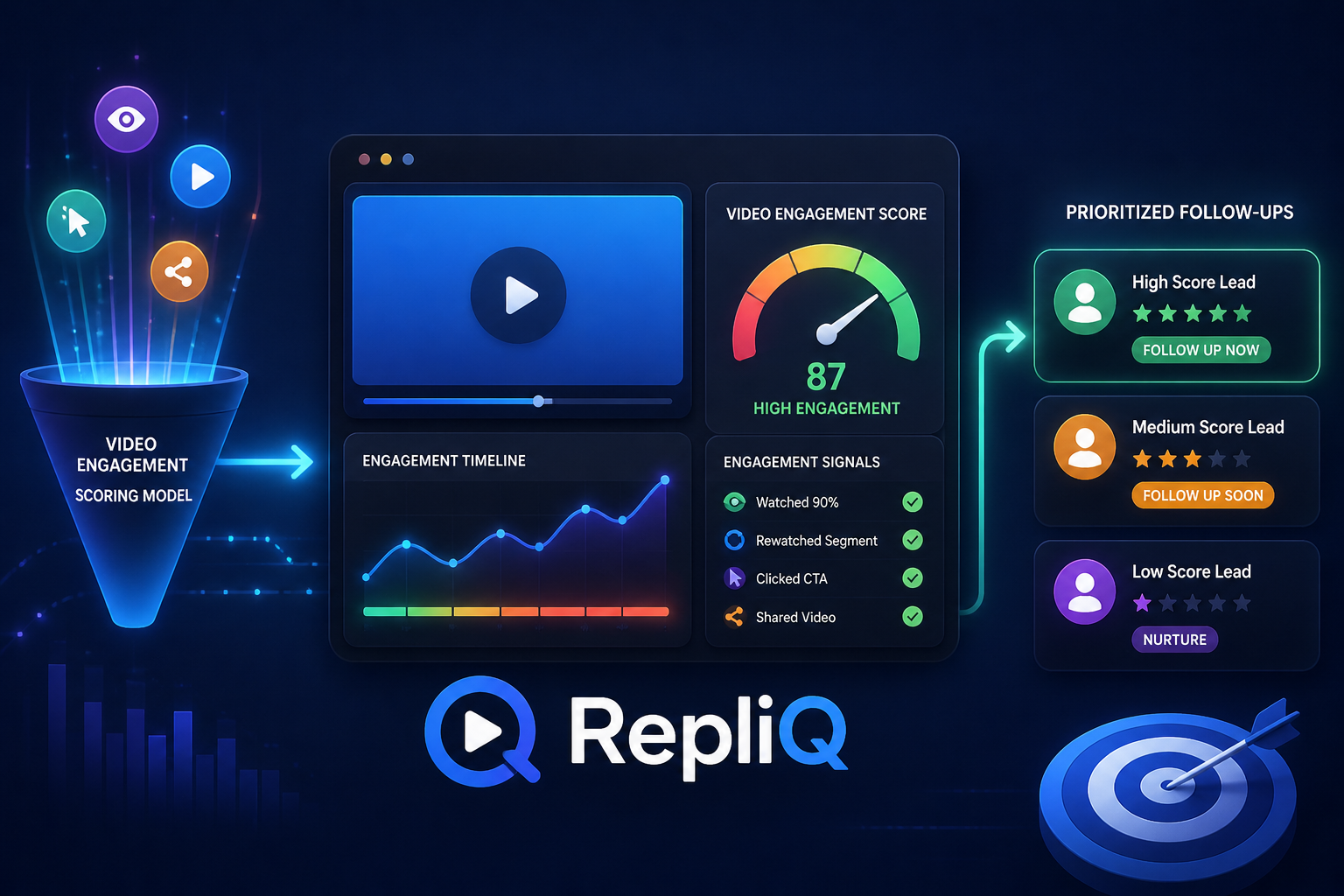
How to Use Video Engagement Signals to Prioritize Sales Follow-Ups
Modern sales teams face a paradox: they have never had more visibility into prospect behavior, yet they still struggle to determine who deserves immediate outreach. When a campaign launches, dashboards quickly fill with video views. However, a raw view count alone does not provide a clear way to determine who is ready for a sales conversation.
A view does not necessarily indicate buying intent. To accurately gauge interest, sales professionals must look beyond the initial click. Metrics such as watch time, completion rate, repeat views, call-to-action (CTA) engagement, recency, and identity confidence provide the necessary context to turn noise into actionable intelligence.
The promise of modern analytics is the ability to transform personalized video analytics into ranked follow-up queues and relevant next actions. By evaluating video engagement signals, advanced sales teams can prioritize outreach effectively. However, it is crucial to clarify that video engagement data should augment—not replace—firmographic fit, CRM activity, buying stage, and explicit conversion actions. As a decision-support tool, views, watch time, and CTA engagement can help decide whom to contact first, but these thresholds require continuous calibration against actual conversion data.
This article provides a practical framework to operationalize this data: identifying signals, assigning weights, applying recency, validating engagement, connecting data to the CRM, and measuring downstream sales outcomes. Platforms like RepliQ are designed to facilitate this process, serving as a platform for connecting personalized video workflows with measurable engagement and sales action.
What Counts as a Meaningful Video Engagement Signal?
A video engagement signal is an observable behavior that may help indicate a prospect’s interest, intent, or readiness for a sales interaction. However, not all behaviors carry the same weight. It is essential to distinguish between mere exposure, meaningful engagement, and explicit conversion behavior.
Because buyer journeys are complex, a single event should rarely determine follow-up priority without additional context. A prospect might click a video accidentally, or a competitor might watch a product demo out of curiosity. To build an accurate prioritization queue, sales teams must map common video viewing behavior to its likely interpretive value:
- Passive or very short views: Generally indicate exposure but lack the depth to confirm interest.
- High completion percentage: Suggests the content resonated and the prospect found the message relevant.
- Absolute watch time: Indicates the total time invested, which is particularly revealing for deep-dive product content.
- Repeat views or rewatches: Often signals a need for clarification, active evaluation, or internal sharing among stakeholders.
- CTA clicks: A strong explicit action demonstrating a desire to learn more or take the next step.
- Engagement from multiple contacts at the same account: Suggests a broader organizational initiative or consensus-building.
- Recent engagement after a sales or marketing touch: Indicates active consideration and high temporal relevance.
Crucially, intent cannot be inferred reliably when identity is unknown, consent is unclear, or the activity may stem from autoplay, internal traffic, or accidental clicks. To make sales engagement signals actionable, the data must be verified and contextualized.
Passive Views vs. Meaningful Engagement
Raw view counts can drastically overstate interest. A three-second view from an auto-playing feed differs fundamentally from a prospect who watches 90% of a detailed product demonstration. Furthermore, a general video view is only actionable when it can be tied to an identifiable, attributable contact or account event.
| Engagement Behavior | What it May Indicate | Confidence Level | Recommended Sales Response |
|---|---|---|---|
| Brief/Passive View (<10%) | Fleeting curiosity, accidental click, or autoplay. | Very Low | Do not trigger urgent outreach. Retain as aggregate context. |
| High Completion Rate (>75%) | Strong interest in the topic or value proposition. | Moderate to High | Contextual follow-up referencing the video's specific subject matter. |
| Repeat Views | Active evaluation, internal sharing, or need for clarification. | High | Direct outreach offering to answer questions or provide related resources. |
| CTA Click | Explicit desire to take the next step in the buyer journey. | Very High | Immediate, prioritized follow-up aligned with the CTA's promise. |
By separating fleeting video views from meaningful video engagement, teams can focus their energy on genuine buyer intent signals rather than chasing digital noise.
The Core Metrics Sales Teams Should Monitor
Every interaction provides a different piece of the puzzle. To interpret intent accurately, sales teams must monitor specific dimensions of engagement:
- Watch time: Measures the depth of exposure and overall time investment.
- Completion rate: Highlights engagement relative to the video length, showing if the narrative held their attention.
- Repeat views: Indicates a possible need for clarification, active evaluation, or internal sharing.
- CTA engagement: Represents a stronger action signal than passive viewing, moving the prospect from observer to participant.
- Recency: Determines how actionable the signal is now.
To make these video engagement metrics for sales useful, CRMs should display the watched video, viewed percentage, last activity time, CTA interaction, and contact/account identity. These metrics should be interpreted together rather than ranked universally. As noted in research on digital sales interactions, video-based buyer–seller communication should be evaluated in the context of communication quality and interaction effectiveness—not just reach. Watch time analytics and video CTA engagement are only valuable when they inform a better, more relevant sales conversation.
How to Build a Video Engagement Scoring Model
To operationalize engagement data, sales organizations need a transparent model that combines engagement intensity, recency, identity confidence, account fit, and existing CRM context. This framework should rank follow-up urgency rather than claim to prove a prospect’s definitive intent.
A highly effective content engagement scoring model separates data into three distinct categories:
- Behavioral score: What the viewer actually did (watch time, CTA clicks, repeat views).
- Fit score: Whether the contact or account matches your ideal customer profile (ICP).
- Context score: The current opportunity stage, prior marketing activity, and known sales history.
By blending these elements, teams can build a reliable sales engagement prioritization framework. A sample formula structure looks like this:
Priority score = engagement weight + recency adjustment + account/contact fit + CRM context – noise or uncertainty adjustment
Because no two sales motions are identical, teams should test these weights against actual commercial outcomes—such as response rates, meetings booked, opportunity creation, pipeline velocity, and false-positive rates—rather than relying on arbitrary industry benchmarks for lead scoring from video.
Assigning Relative Weights to Engagement Behaviors
When building a watch time lead scoring system, relative weights help standardise rep responses. The following is a sample weighted framework to guide implementation:
- Brief or isolated view: Low weight.
- High completion rate: Moderate-to-high weight.
- Significant watch time on a relevant section: Moderate-to-high weight.
- Repeat view: Additional weight, especially when identity and account fit are reliable.
- CTA click: High weight because it represents an explicit, voluntary action.
- Multiple engaged contacts from one account: Account-level multiplier or escalation factor.
Context heavily influences these weights. A single CTA click will generally outweigh a long passive view, as it demonstrates explicit action. Conversely, repeated viewing may become highly valuable when a CTA is absent or ignored. Furthermore, the relevance of the watched content matters immensely: video analytics for lead scoring should treat a deep dive into a pricing or product-demo video with higher urgency than a general brand introduction. Video CTA tracking is critical, but it must be weighed against the content's position in the funnel.
Normalizing Watch Time Across Different Video Lengths
Absolute seconds watched can mislead when comparing a 30-second short personalized introduction with a 10-minute product demonstration. Watching 25 seconds of the former is a high-intent completion; watching 25 seconds of the latter is a bounce.
To solve this, personalized video analytics must utilize both:
- Absolute watch time.
- Completion percentage.
Interpret these watch time analytics in combination:
- High percentage on a short video: Good introductory engagement, warrants a standard follow-up.
- High absolute time but low percentage on a long video: The prospect invested significant time but dropped off. They may need a different format or have found the specific answer they needed early on.
- Low percentage on a long video with a meaningful early-section interaction: The prospect engaged with the index or early chapters, indicating specific feature interest.
Encourage teams to compare viewers against similar videos or funnel stages to establish an accurate baseline for completion rate expectations.
Applying Recency, Identity, and Noise Adjustments
Timing and confidence dictate action. A recent high-intent event should generally receive more urgency than an older equivalent event. Implementing a recency-decay concept ensures that a video watched today scores higher than the same video watched three months ago.
Furthermore, scores must be adjusted downward for noise. Recommend reducing confidence when:
- The viewer is anonymous.
- Identity resolution is uncertain.
- Autoplay or accidental engagement is possible.
- Internal users (employees) are involved.
- Consent or tracking permissions are unclear.
Identity confidence directly affects whether a signal should trigger an immediate rep alert, inform a standard queue, or remain an aggregate account-level insight. Responsible measurement is paramount. As outlined in the FTC report on video data practices, transparency, proper data collection, strict retention policies, and responsible analytics use are vital when tracking CRM video engagement tracking and inferring buyer intent signals from video viewing behavior.
Turning Scores Into Sales Follow-Up Tiers
Raw dashboards full of behavioral data often paralyze sales reps. To be effective, the scoring model must translate into clear action categories so reps do not have to interpret complex metrics manually.
A practical approach divides prospects into three follow-up tiers:
- High priority: Recent, identifiable, deep or repeated engagement, and/or CTA activity combined with relevant account fit.
- Medium priority: Meaningful engagement without a clear conversion action, or strong behavior that is older or less confidently attributed.
- Low priority or nurture: Brief, old, anonymous, or noisy activity with limited supporting context.
Each tier should include an owner, a designated response window, a recommended channel, and a relevant next action. Sales prioritization should be progressive: one minor engagement event can prompt passive context gathering, while multiple aligned events justify direct, personalized outreach. This structured approach to sales follow-up prioritization removes the guesswork from how to prioritize sales leads and optimizes sales follow-up timing based on intent.
High-Priority Follow-Up: CTA Clicks, Demo Engagement, and Repeat Views
High-priority signals justify immediate human review. Conditions that trigger this tier include a recent CTA click, strong completion of a product or demo video, multiple views from an identifiable contact, or several engaged stakeholders from the same account.
When these buyer intent signals occur, sales reps must execute a context-aware response rather than sending a generic “checking in” message. The next action must match the content watched:
- Product demo: Answer likely evaluation questions or offer a deeper, customized conversation.
- Use-case content: Discuss the prospect’s apparent business problem outlined in the video.
- CTA interaction: Follow up immediately on the specific action they initiated.
Before reaching out, sales reps must verify CRM context to ensure no other active deals or support tickets contradict the outreach. Using video engagement signals for sales follow-up prioritization requires tact and situational awareness.
Medium-Priority Follow-Up: High Completion Without an Explicit Action
A prospect who watches most of a relevant video may be worth targeted follow-up even without a CTA click. A high completion rate suggests the message resonated, but the prospect may not be ready to explicitly raise their hand.
In this scenario, use the watched content to personalize the message. Suggest a lower-pressure action, such as sharing a related resource, asking a focused question about their current processes, or offering brief clarification on the video's topic. Teams should monitor these medium-priority contacts to see if this personalized video analytics approach generates additional sales engagement signals before escalating them to a high-priority queue.
Low-Priority or Noisy Engagement
Not all activity deserves immediate attention. Activity that should not enter an urgent queue includes very short views, unverified or anonymous traffic, old engagement with no recent activity, internal viewing, and possible autoplay or accidental clicks.
Retain this video viewing behavior as context in the CRM, but avoid over-personalized outreach based on weak evidence. Mentioning a three-second video view in a cold email can feel intrusive and out of touch. Instead, rely on marketing nurture programs or additional qualification steps to cultivate these contacts until their content engagement scoring and video analytics for lead scoring generate stronger, more reliable signals over time.
Worked Examples: Ranking Three Prospects by Video Engagement
To illustrate how this sales engagement prioritization framework operates in practice, consider the following clearly labeled hypothetical examples.
- Prospect A: Watches 85% of a highly relevant product video once. They match the ideal customer profile and have strong account fit, but they do not click the CTA.
- Prospect B: Watches a short, 45-second personalized introduction video three times and clicks the embedded CTA to view a calendar link, though they have less established CRM context.
- Prospect C: Generates a 4-second brief view from an uncertain or anonymous source with no supporting account activity.
Applying the Model:
- Prospect B (High Priority): Despite lower CRM context, the combination of repeat behavior, explicit CTA action, and high recency on a personalized asset pushes this to the top. Next action: Immediate outreach referencing the calendar link and offering flexibility.
- Prospect A (Medium Priority): The engagement depth (85%) and video relevance are strong, but the lack of a CTA or repeat view implies they are still gathering information. Next action: Send a low-pressure email providing a one-pager related to the product video they watched.
- Prospect C (Low Priority): Low identity confidence, negligible engagement depth, and no account fit. Next action: Do nothing immediately; allow marketing to continue nurturing.
Should repeat views outweigh a single CTA click? The answer depends on identity confidence, content relevance, recency, and downstream evidence. A CTA click is explicit, but repeated deep dives into a technical demo by a known ICP account can be just as valuable. Lead scoring from video relies on synthesizing these video engagement data points holistically.
Interpreting Multiple Stakeholders From One Account
Account-level activity is often more informative than one isolated contact event. When multiple contacts from the same organization engage with related content, it indicates internal sharing and potential consensus-building. This increases the overall account priority, even without assuming that every single contact is individually sales-ready.
When this occurs, route the account to the appropriate owner for coordinated outreach. Avoid sending duplicated or conflicting messages to multiple stakeholders. Instead, leverage these buyer intent signals from video by reaching out to the primary decision-maker, referencing the broader organizational interest. Proper CRM video engagement tracking ensures the entire buying committee is mapped correctly.
Connecting Personalized Video Analytics to the CRM and Sales Workflow
Data is useless if it lives in a silo. To drive revenue, personalized video performance analytics must be deeply integrated into the daily sales workflow.
The workflow from event capture to action should follow these steps:
- Record the video engagement event.
- Resolve the contact or account identity where appropriate.
- Attach the video, topic, and funnel context.
- Apply behavioral, recency, fit, and context rules.
- Assign a priority tier.
- Recommend the next action.
- Record the sales response and downstream outcome.
To support this, critical CRM fields should include: Video title or topic, Contact and account, Viewed percentage, Absolute watch time, Repeat-view count, CTA activity, Last engagement timestamp, Identity confidence, Priority tier, Recommended follow-up, and Sales outcome.
A standalone dashboard is insufficient if sales representatives still need to manually interpret every event. Contrast a passive analytics report with a dynamic workflow that delivers ranked accounts, content context, and next-best-action guidance directly to the rep. By utilizing a platform like RepliQ’s AI video destination, teams can seamlessly connect personalized video creation and engagement data to support a repeatable, automated CRM video engagement tracking workflow that streamlines sales follow-up prioritization.
Note: CRM automation should preserve clarity about how scores are calculated and avoid presenting probabilistic engagement signals as confirmed buyer intent.
Recommended Alerts, Routing, and Suppression Rules
Not every video view requires a Slack notification. Teams must define which events justify an immediate alert versus a task, a queue update, or a passive CRM record.
Routing should be based on account ownership, territory, opportunity stage, or existing relationship. Crucially, strict suppression rules must be implemented to filter out internal traffic, duplicate events, uncertain identity, and contacts already engaged in an active sales conversation. Alerts should be strictly limited to highly actionable events. If reps are bombarded with low-value notifications, they will begin ignoring signal notifications entirely, rendering video analytics for lead scoring and sales follow-up timing based on intent completely ineffective.
Matching the Follow-Up to the Watched Content
Reps need to know what the prospect saw. Store enough content context in the CRM so the sales team can craft relevant messaging.
Message guidance should vary based on behavior:
- Product or demo viewers: Focus on technical evaluation and specific pain points.
- High-completion viewers: Share complementary resources to keep momentum.
- Repeat viewers: Ask if they are sharing the content internally and offer to host a Q&A.
- CTA clickers: Directly address the action they attempted to take.
- Multi-contact account engagement: Address the broader company initiative.
Emphasize relevance and restraint. Do not imply that the prospect’s viewing activity has been observed in a way that feels intrusive or unclear. For examples of how different engagement patterns map to distinct sales scenarios, review RepliQ’s use-case content to see how personalized video analytics, video CTA tracking, and video engagement data inform follow-up actions.
Measurement, Governance, and Optimization
To determine whether video-based prioritization is actually improving sales execution—rather than simply increasing the volume of alerts—teams must measure both operational and commercial outcomes.
Track the following metrics:
- Time from engagement to follow-up.
- Response rate.
- Meeting rate.
- Opportunity creation.
- Pipeline velocity.
- Revenue influenced.
- Conversion by priority tier.
- False-positive rate.
- Rep adoption and task completion.
Review score thresholds regularly and compare the predicted priority with actual outcomes. Encourage controlled testing of weights, follow-up timing, and message variations. Always distinguish correlation from causation: high engagement may accompany intent without independently causing a conversion. Refining this sales engagement prioritization framework ensures that video engagement metrics for sales and content engagement scoring remain accurate over time.
Privacy, Consent, Accessibility, and Data Quality
Ethical data use is non-negotiable. Organizations must enforce transparent data practices, appropriate consent handling, strict access controls, data retention rules, and purpose limitation. Avoid unnecessary collection or retention of viewer data, and ensure compliance with regional privacy regulations. As highlighted in the FTC report on video data practices, responsible data collection and transparency are critical when utilizing personalized video analytics and video analytics for lead scoring.
Additionally, accessibility requirements for sales and marketing videos must be met. This includes providing captions, transcripts, audio descriptions where appropriate, and accessible CTA and media experiences. Following video accessibility guidance not only ensures compliance but improves the reliability and inclusiveness of video engagement data.
When establishing governance, access, and privacy impact considerations, consult broader video privacy and governance principles. While these provide broad governance guidance rather than sales-specific benchmarks, they reinforce the principle that engagement data should never be treated as an absolute, omniscient view of buyer intent.
Common Mistakes When Using Video Engagement Signals
When implementing video prioritization, teams often stumble over the same hurdles. Use this problem-and-solution guide to refine your strategy:
- Mistake: Treating every view as equal.
- Solution: Differentiate between passive video viewing behavior, meaningful engagement, and explicit buyer intent signals.
- Mistake: Using absolute watch time without considering video length.
- Solution: Always pair absolute seconds watched with completion percentage.
- Mistake: Ignoring recency.
- Solution: Implement a time-decay model so older views score lower than recent activity.
- Mistake: Overlooking account fit and CRM context.
- Solution: Blend behavioral scores with firmographic fit and current deal stage.
- Mistake: Triggering outreach from uncertain or noisy identity data.
- Solution: Require high identity confidence before escalating a signal to an active rep alert.
- Mistake: Sending generic messages unrelated to the watched content.
- Solution: Store video topics in the CRM and mandate context-aware outreach.
- Mistake: Creating too many alerts.
- Solution: Reserve instant notifications for high-priority tiers to prevent alert fatigue.
- Mistake: Assuming engagement automatically equals purchase intent.
- Solution: Treat video data as a decision-support signal for sales follow-up prioritization, not a guarantee of pipeline.
Unlike manual video analytics workflows that leave interpretation entirely to the sales representative, a structured behavior-to-action framework removes ambiguity and drives consistent execution.
Practical Implementation Checklist
Use this concise checklist to operationalize your video engagement framework:
- [ ] Define the target sales outcomes (e.g., meeting rates, pipeline velocity).
- [ ] List available video engagement events (views, clicks, repeat watches).
- [ ] Separate passive, meaningful, and explicit actions.
- [ ] Normalize watch time by video length (use percentages + absolute time).
- [ ] Add recency and identity-confidence adjustments to the scoring model.
- [ ] Combine engagement scores with account fit and CRM context.
- [ ] Create clear high-, medium-, and low-priority tiers.
- [ ] Assign recommended follow-up actions and messaging for each tier.
- [ ] Add suppression and governance rules to filter noise and internal traffic.
- [ ] Connect events to specific CRM fields and assign ownership.
- [ ] Measure response rates, meetings, pipeline influence, and false positives.
- [ ] Recalibrate thresholds regularly using actual sales outcomes.
To streamline this process, teams can create a downloadable prioritization worksheet to map their specific criteria. For those ready to move beyond manual spreadsheets, RepliQ offers a platform-based approach to personalized video analytics, seamlessly connecting video engagement signals to repeatable sales follow-up prioritization workflows.
Conclusion — From Video Analytics to Better Sales Decisions
Raw video views are only the starting point. Meaningful prioritization requires a deeper understanding of engagement depth, recency, identity confidence, account fit, and existing CRM context. The central distinction for modern revenue teams lies between merely reporting behavior and successfully turning that behavior into an actionable, high-converting sales queue.
To achieve this, teams must adopt a rigorous operating model: weight engagement signals accurately, normalize watch time across different assets, apply recency adjustments, filter out digital noise, and connect these events directly to CRM records. By mapping each priority tier to a highly relevant next action, reps can execute outreach with precision. Finally, measuring outcomes and revising thresholds ensures the system improves over time.
Sales organizations should start with a small, manageable set of signals and test them against real sales outcomes rather than launching an overly complex scoring system on day one. Remember that video engagement data is a decision-support signal, not definitive proof of intent. Acknowledge limitations regarding privacy, identity resolution, and the need for ongoing model calibration.
Ready to transform how your team handles buyer intent? Explore how RepliQ can support personalized video workflows and measurable sales follow-up prioritization today.
Frequently Asked Questions
How can video engagement signals prioritize sales follow-ups?
Teams can combine completion rate, watch time, repeat views, CTA clicks, recency, identity confidence, and account fit into distinct priority tiers. By filtering this data, the output becomes a recommended sales action for the rep, not merely a numerical score. Using video engagement signals ensures that sales follow-up prioritization focuses on prospects exhibiting the most actionable intent.
Which video engagement metrics indicate buying intent?
Passive views rarely indicate intent on their own. Instead, teams should look for high completion rates, repeat views, CTA engagement, and recent activity. Because no single metric proves buying intent, content relevance and CRM context are essential. Buyer intent signals from video must be evaluated holistically to ensure video engagement metrics for sales translate into meaningful conversations.
Should repeat views outweigh a single CTA click?
The answer depends entirely on the CTA’s relevance, the viewer’s identity confidence, recency, video topic, and account fit. Both are high-value signals that require contextual scoring rather than a universal ranking. High video CTA engagement is explicit, but repeat video views on a technical demo by a known ICP account can be equally urgent when configuring lead scoring from video.
How should sales teams compare watch time across videos of different lengths?
Teams should use completion percentage together with absolute watch time. Comparisons must account for the video type, topic, and funnel stage. A 50% completion on a one-minute intro is vastly different from a 50% completion on a 20-minute product teardown. Proper watch time analytics and completion rate tracking ensure that watch time lead scoring remains accurate across all assets.
How can teams avoid over-prioritizing accidental or low-intent views?
To filter noise, teams must evaluate identity confidence, autoplay triggers, internal traffic, anonymous viewing, recency, and supporting CRM activity. Implementing strict suppression rules and progressive qualification before triggering urgent outreach is vital. This ensures that video viewing behavior and content engagement scoring accurately reflect true buyer intent signals rather than digital accidents.
What should sales representatives see in the CRM?
To act quickly, reps should see the video or topic viewed, completion percentage, absolute watch time, repeat views, CTA activity, last engagement time, account context, priority tier, and the recommended next action. This information must be concise and directly connected to sales execution. Effective CRM video engagement tracking turns personalized video analytics into actionable sales engagement signals.
How can teams measure whether video-based prioritization works?
Success is measured by tracking response rate, meeting rate, opportunity creation, pipeline velocity, revenue influenced, follow-up speed, and the false-positive rate of alerts. Teams must encourage ongoing threshold and workflow adjustments based on observed outcomes. This continuous loop ensures that video analytics for lead scoring and the overall sales engagement prioritization framework optimize sales follow-up timing based on intent.


