
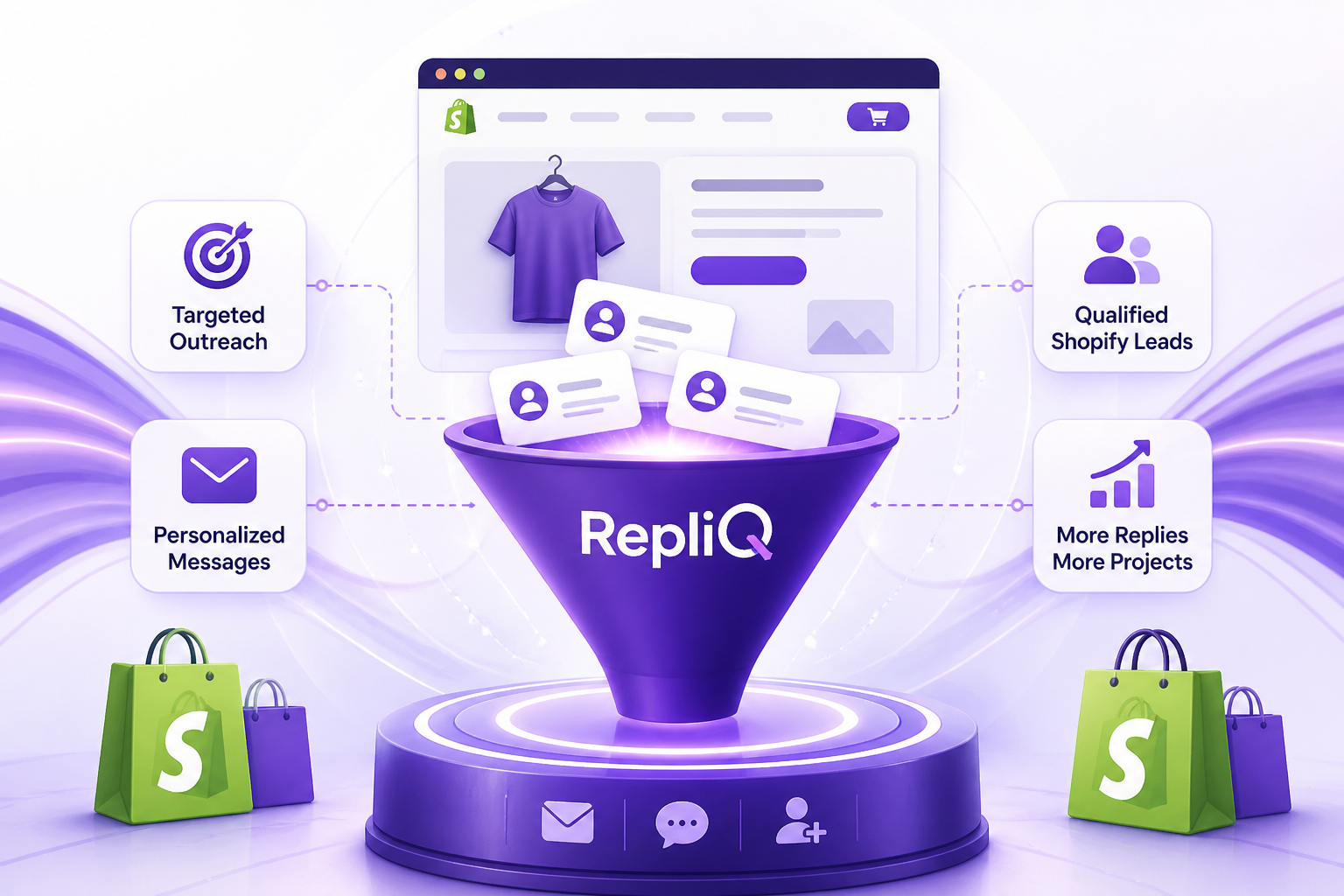
Personalized Ecommerce Agency Outreach: How to Generate Better Shopify Development Leads
Table of Contents
- Introduction
- Why Generic Ecommerce Agency Outreach Gets Ignored
- How to Identify High-Fit Shopify Development Leads
- The Signal-to-Message Framework for Personalized Prospecting
- How to Build a Repeatable Ecommerce Outreach Workflow
- Personalized Outreach Examples for Ecommerce Agencies
- Measuring Outreach Quality and Commercial Results
- Common Mistakes, Compliance Considerations, and Quality Controls
- Conclusion
- FAQ
Introduction
Generic “we build Shopify stores” outreach is remarkably easy to ignore. For ecommerce development agencies, relying on capability-led mass messaging fails to answer the most critical question a prospect has: Why do I need your help right now?
To generate high-quality Shopify development leads, agencies must improve lead quality by connecting observable storefront issues to specific, commercial outcomes. This article provides a comprehensive blueprint for identifying qualified stores, translating storefront observations into useful recommendations, and scaling personalization without sacrificing accuracy.
Instead of relying solely on broad contact databases, successful ecommerce agency outreach combines storefront experience, technology signals, merchandising patterns, and visible conversion opportunities. At RepliQ, our perspective on personalized prospecting is rooted in these observable signals—platform technology, storefront experience, and conversion opportunities—rather than making unsupported claims about a prospect’s revenue, conversion rate, or buying intent.
Designed for intermediate to advanced agency teams, this guide delivers a practical workflow, a robust qualification framework, actionable outreach examples, follow-up guidance, and precise measurement criteria to transform your prospecting pipeline.
Why Generic Ecommerce Agency Outreach Gets Ignored
The primary reason generic B2B ecommerce prospecting fails is a lack of relevance. When an agency sends a message stating, “We are a Shopify development agency,” they place the burden of discovering a need entirely on the prospect. In contrast, an evidence-based message that references a real customer journey, a specific product page layout, or a visible navigation issue immediately demonstrates value.
True personalized cold outreach goes far beyond simply inserting a company name or a first name into an email template. Effective personalization changes the fundamental relevance of the recommendation. It connects technical services to tangible business outcomes, such as reducing purchase friction, clarifying product information, improving mobile browsing, or strengthening the overall path to purchase.
Crucially, agencies should reference only publicly observable information. You must clearly distinguish verified observations from hypotheses. For example, rather than claiming, "Your checkout is losing 30% of your sales," an agency should state, "I noticed the shipping calculator doesn't load until the final checkout step, which might create friction for shoppers trying to estimate total costs." This turns one visible storefront observation into a measured, non-definitive outreach hypothesis.
While tools like BuiltWith and Store Leads are excellent for identifying ecommerce accounts or technology signals, and platforms like Vidyard illustrate the value of humanized video outreach, they do not solve the core challenge. The missing link is the workflow between discovery, diagnosis, messaging, and follow-up. List volume does not automatically create relevance; deep, store-level research does.
How to Identify High-Fit Shopify Development Leads
To generate better Shopify development leads, you must prioritize stores that are highly likely to benefit from ecommerce development support, rather than contacting every Shopify store on the internet.
This requires defining an ideal customer profile (ICP) based on factors your agency can actually observe or validate:
- Platform fit: Confirmation of Shopify or Shopify Plus infrastructure.
- Category relevance: Alignment with a specific product category or ecommerce model (e.g., subscription FMCG, luxury apparel).
- Storefront maturity: The current quality of the customer experience and brand presentation.
- Observable opportunities: Visible development, UX, or conversion gaps.
- Agency alignment: Fit with your agency’s capabilities, services, geography, or preferred account size.
When evaluating a prospect, distinguish between technical fit (they use Shopify), commercial fit (they are in your target industry), observable pain (visible friction on the site), likely urgency (upcoming seasonal peaks), and agency capability (you have a proven solution).
To streamline ecommerce lead generation, use this simple account-prioritization model:
- Technical fit: Is the store on a platform the agency actively supports?
- Customer-experience opportunity: Is there a meaningful issue in navigation, product discovery, mobile browsing, or checkout preparation?
- Commercial relevance: Can the issue reasonably connect to a business outcome?
- Delivery fit: Can the agency credibly solve this specific problem?
- Evidence quality: Can the observation be verified before outreach?
From this evaluation, build a tiered prospect list:
- Tier 1: Strong platform fit combined with a clear, specific storefront opportunity.
- Tier 2: Good platform or category fit, but weaker evidence of an immediate need.
- Tier 3: Broad-fit accounts designated for testing or future nurturing.
Keep in mind that assumptions must be labeled as assumptions. Never state that a store has poor performance, low conversion, or insufficient revenue unless the prospect has publicly confirmed it. To turn these storefront observations into highly relevant prospecting experiences, RepliQ offers a visual ecommerce personalization solution that helps agencies capture and present these insights seamlessly.
Storefront Signals Worth Reviewing
Before initiating outreach, conduct a practical review of the store. Observable signals provide the foundation for your message. Look for:
- Mobile navigation functionality and menu clarity.
- Product detail page (PDP) structure, imagery, descriptions, variant selection, and calls to action.
- Category and collection-page merchandising.
- Search functionality, filtering logic, and product discovery paths.
- Shipping, returns, trust badges, and delivery information clarity.
- Visible friction in the path from product discovery to the cart.
- Theme consistency, accessibility considerations, and technical functionality (evaluated without making performance claims).
Technology signals complement manual storefront reviews but cannot replace them. When conducting a Shopify store audit, document your findings. For example, if you notice a mobile menu issue, take an annotated screenshot highlighting how the sub-categories overlap on a mobile screen. Internally document this as: "Mobile UX friction: Sub-menus on the 'Apparel' dropdown overlap on iOS Safari, making variant selection difficult." This specific website personalization for agencies approach grounds your outreach in reality.
Turning Observations Into Service Opportunities
Once you identify a visible issue, map it to a specific, credible service recommendation using a signal-to-service framework:
- Mobile browsing friction → Mobile UX review or theme improvements.
- Weak product information → Product detail page redesign or merchandising support.
- Difficult discovery → Collection architecture, filtering, or search improvements.
- Unclear trust information → Content hierarchy, UX, or conversion-focused redesign.
- Platform or integration limitations → Technical discovery and implementation assessment.
Your first outreach should recommend one useful next step, not attempt to sell an entire open-ended development project. Use outcome-oriented language. Instead of an unsupported promise like, "We will increase your conversions by 20%," say, "We can help make product sizing information easier to evaluate." Ensure that any recommended service directly matches your agency’s demonstrated expertise to maintain credibility in your ecommerce sales pipeline and website redesign prospecting.
The Signal-to-Message Framework for Personalized Prospecting
Transforming research into concise, useful outreach requires a structured approach. The signal-to-message framework for personalized cold email consists of five steps:
- Observation: Identify one specific, verifiable storefront detail.
- Context: Explain why it matters to the customer journey or merchandising experience.
- Hypothesis: State the possible opportunity without presenting it as proven business data.
- Recommendation: Suggest a practical improvement or audit.
- Call to Action (CTA): Offer a low-friction next step, such as sharing a short visual teardown or discussing the observation.
You can personalize by page, product category, customer journey, platform, or merchandising pattern. Keep the first-touch messaging focused strictly on one primary opportunity to avoid overwhelming the prospect.
Always ask this quality-control question: “Could this same message be sent to 50 unrelated stores?” If the answer is yes, your message lacks relevant evidence and needs deeper personalization. Furthermore, if you use AI-assisted research or message generation, human review is mandatory to verify page references, product details, technical observations, and brand voice.
What to Include in the First Outreach Message
A successful first-touch message for Shopify agency lead generation should be highly structured and respectful of the prospect's time. Include the following components:
- A subject line directly tied to the relevant storefront opportunity.
- A concise, specific observation.
- The likely customer-experience implication.
- A brief introduction of the agency’s relevant capability.
- A useful offer (a short audit, visual recommendation, or walkthrough).
- A clear, low-pressure question.
Avoid long service menus, unsupported claims about revenue or conversion performance, excessive technical jargon, generic praise that fails to connect to the recommendation, and overly aggressive urgency.
Template Structure:
"I noticed [specific storefront observation] on [page or journey]. For shoppers evaluating [product or category], that may make [task] less clear. We help ecommerce teams address [relevant service area]. Would a short visual recommendation be useful?"
Matching the Message to the Decision-Maker
Message framing must adapt based on the recipient's role. Different stakeholders prioritize different outcomes in ecommerce client acquisition:
- Founder or Owner: Prioritizes clarity of opportunity, overall customer experience, and project practicality.
- Ecommerce or Marketing Leader: Focuses on merchandising, campaign landing experiences, and reducing customer journey friction.
- Technical Lead: Cares about platform limitations, integrations, maintainability, and implementation details.
Always verify role relevance before sending. Avoid making assumptions about a contact's ultimate authority or their immediate daily priorities. Tailor the B2B ecommerce prospecting angle to match what they are most likely measured on.
How to Build a Repeatable Ecommerce Outreach Workflow
To scale cold outreach personalization without losing relevance, you must build an agency-friendly process that moves beyond one-off manual research.
Follow this repeatable ecommerce lead generation workflow:
- Define the agency’s ideal client profile.
- Discover potential Shopify stores using technology-based lead generation tools.
- Segment accounts by platform, category, geography, maturity, and service fit.
- Review selected storefront signals manually.
- Record one or two evidence-based observations.
- Map each observation to a relevant agency capability.
- Create a tailored message or visual audit.
- Review for accuracy and tone.
- Send the first touch.
- Follow up with additional value rather than repeating the same pitch.
- Track qualified engagement through meetings and opportunities.
Automation should assist with research organization, account prioritization, and message drafting, but humans must remain responsible for final accuracy and preventing unverified claims. To streamline scalable signal-based research and personalized outreach workflows, agencies can leverage Scaliq.ai.
Maintain a prospecting worksheet with reusable fields to keep data organized:
- Store URL
- Platform or technology signal
- Store category
- Target decision-maker
- Relevant page or customer journey
- Observed opportunity
- Proposed service
- Message status
- Follow-up date
- Outcome
Using Visual Personalization to Demonstrate Relevance
Visual personalization allows an agency to demonstrate expertise long before asking for a discovery call. Visual evidence makes technical recommendations immediately understandable for nontechnical ecommerce stakeholders.
Consider these visual assets for personalized prospecting:
- Annotated storefront screenshots highlighting a specific UX issue.
- Short, page-specific video audits.
- A visual before-and-after concept.
- A brief walkthrough of a specific customer journey.
- A personalized landing experience reflecting the prospect’s context.
Keep the asset tightly focused on one or two observations. Do not deliver a full, unpaid strategy project. Make the CTA clear: invite the prospect to review the recommendation, ask a question, or schedule a short discussion. Explore relevant RepliQ use cases to see how tailored audit experiences and visual ecommerce conversion audits work in practice.
Designing a Useful Follow-Up Sequence
A successful ecommerce outreach sequence adds value at every step without becoming repetitive or intrusive.
Design a short, value-led sequence for personalized cold email for agencies:
- First follow-up: Clarify or expand upon the original observation.
- Second follow-up: Share a related visual or practical recommendation.
- Final follow-up: Close the loop respectfully and leave a relevant resource.
Vary the angle only if the new message adds useful context. Avoid sending "just checking in" emails that offer no new value. Timing should reflect your agency’s audience, the offer, and industry communication norms; there is no universal number of follow-ups that guarantees success in ecommerce agency outreach.
Personalized Outreach Examples for Ecommerce Agencies
The following hypothetical scenarios illustrate how the signal-to-message framework translates into standalone examples, social posts, or sales enablement assets.
Example 1 — Mobile Navigation Friction
- Observable signal: The mobile menu requires three clicks to reach the best-selling product category.
- Customer-experience implication: Shoppers trying to find a specific product category may abandon the site due to navigation fatigue.
- Relevant agency service: Mobile UX review or theme improvements.
- Message angle: Reference the specific navigation step and how it impacts mobile browsers.
- CTA: Offer a quick mobile navigation recommendation.
- Note: Focus on Shopify development leads and mobile ecommerce UX without making unsupported performance claims.
Example 2 — Product Detail Page Opportunity
- Observable signal: Variant selection (e.g., choosing a color) does not update the main product image.
- Customer-experience implication: Shoppers may be unsure if they are adding the correct item to their cart, making evaluation harder.
- Relevant agency service: Product detail page optimization or merchandising support.
- Message angle: Highlight the specific variant issue on a named product page.
- CTA: Offer a concise product-page teardown.
- Note: Frame this Shopify store audit outreach as an opportunity to make evaluation easier, not a declaration that the page is losing sales.
Example 3 — Unclear Shipping, Returns, or Trust Information
- Observable signal: Return policies are hidden deep in the footer and not mentioned near the "Add to Cart" button.
- Customer-experience implication: Missing information creates uncertainty during the purchase consideration phase.
- Relevant agency service: Content hierarchy, UX review, or customer-journey audit.
- Message angle: Explain how answering practical customer questions earlier can reduce friction.
- CTA: Suggest sharing a brief observation on trust signaling.
- Note: Keep the CTA low-pressure for effective website redesign prospecting and personalized prospecting.
Example 4 — Platform or Technology Fit
- Observable signal: The store is running on Shopify Plus, but using an outdated third-party search app that loads slowly.
- Customer-experience implication: Search delays disrupt product discovery for high-intent shoppers.
- Relevant agency service: Technical discovery, integrations, and implementation assessment.
- Message angle: Combine the platform identification with the storefront observation.
- CTA: Offer a quick technical walkthrough of the search delay.
- Note: While technology-based lead generation helps identify Shopify agency lead generation targets, technology data must be validated for freshness and connected to a verified storefront opportunity.
Measuring Outreach Quality and Commercial Results
To ensure your personalized prospecting is producing qualified business opportunities rather than superficial engagement, you must measure the right metrics.
Distinguish between activity metrics and business metrics:
- Activity: Accounts researched, messages sent, and follow-ups completed.
- Engagement: Replies, positive replies, and meaningful conversations.
- Sales Quality: Qualified meetings, opportunity rate, proposal rate, and closed revenue.
For a healthy ecommerce sales pipeline, track the following:
- Positive reply rate.
- Qualified conversation rate.
- Booked meetings.
- Qualified meeting rate.
- Opportunity creation rate.
- Proposal rate.
- Revenue per account or campaign.
- Time spent researching and personalizing each account.
Opens, views, or clicks should never be treated as the sole measure of success in B2B lead generation for web development agencies. Segment your reporting by store platform, store category, signal type, message angle, decision-maker role, and outreach format (email, visual audit, video). When reviewing failed campaigns, analyze message relevance, account fit, evidence quality, offer clarity, and CTA friction. Transparent reporting is vital; avoid claiming that personalization automatically produces a specific response rate or revenue increase.
Common Mistakes, Compliance Considerations, and Quality Controls
Protecting trust and ensuring the reliability of your ecommerce agency outreach requires strict quality controls and adherence to compliance standards.
Avoid these common mistakes:
- Contacting every Shopify store without prioritization.
- Using technology data without manually reviewing the actual storefront.
- Making claims about revenue, traffic, conversion rates, or performance without hard evidence.
- Treating AI-generated research as automatically accurate.
- Overpersonalizing with irrelevant, non-business details.
- Sending a full, unsolicited audit with no clear service fit or next step.
- Measuring campaign volume instead of qualified outcomes.
Privacy-safe prospecting checklist:
- Use only information that is legally and publicly observable or appropriately sourced.
- Verify that page references and technology signals are current.
- Respect applicable outreach, privacy, and communication regulations.
- Keep personalization strictly relevant to the professional purpose of the message.
- Provide a clear, respectful way for prospects to decline further contact where appropriate.
The role of human review:
Human oversight is non-negotiable in AI-assisted personalized cold outreach. A human must confirm the store, page, product, and issue; remove unsupported assumptions; check brand voice and clarity; and ensure the recommendation is genuinely useful.
RepliQ’s storefront and platform experience provides a practical, compliant basis for personalization. However, visible signals are not the same as confirmed business intelligence. A complete, quality-controlled workflow sets you apart from agencies that rely solely on store databases or enrichment platforms. The true differentiator is combining account fit, storefront evidence, visual context, and highly useful recommendations.
Conclusion: Build Outreach Around the Store, Not Just the Service
To generate better Shopify development leads, agencies must build their outreach around the reality of the prospect's store, not just a menu of agency services.
The signal-to-message process is clear: find high-fit stores, review the customer journey, document one credible opportunity, connect it to a relevant agency service, and deliver a concise, visual, and useful message. Measure success by qualified conversations that lead to revenue.
Personalized prospecting is not simply adding a company name to a mass template; it is about using relevant evidence to make your recommendation undeniably useful. Begin with a small, well-defined segment. Test one storefront signal and one outreach angle before scaling.
Ready to transform your agency’s pipeline? Explore RepliQ for visual, ecommerce-focused personalization built on deep storefront experience, platform technology, and conversion-focused insights. For scalable signal-based prospect research and account prioritization, utilize Scaliq.ai to streamline your workflow.
FAQ
How do ecommerce agencies find qualified leads?
Agencies find qualified leads by combining platform fit, store category, storefront maturity, visible customer-experience opportunities, and service capability. Effective ecommerce lead generation emphasizes strict account prioritization over contacting every available account.
How can Shopify development agencies identify stores that may need a redesign?
Agencies should review navigation, mobile browsing, product detail pages, merchandising, trust information, and customer-journey clarity. Visible issues indicate potential website redesign prospecting opportunities, but they are not confirmed proof of redesign intent.
What should an ecommerce agency include in a cold email?
Ecommerce cold email templates should include one specific observation, the possible customer-experience implication, a brief mention of a relevant capability, and a low-friction CTA. Do not list every agency service or make unsupported performance claims.
How can agencies personalize outreach without researching every prospect manually?
Agencies can scale personalized prospecting by using reusable research fields, account segmentation, technology signals, and AI-assisted drafting. However, scaling research must always include human verification to ensure accuracy and relevance.
Should an ecommerce agency offer a free audit?
A short, focused ecommerce conversion audit can effectively demonstrate relevance before a discovery call. Limit the scope to one or two useful observations and connect the Shopify store audit outreach to a clear, actionable next step.
How many follow-ups should an ecommerce agency send?
Instead of a fixed universal number, use a concise, value-led ecommerce outreach sequence. Each personalized cold outreach follow-up should add fresh context, a new recommendation, or a useful asset.
What metrics should ecommerce agencies track?
To measure ecommerce client acquisition success, track positive replies, qualified conversations, booked meetings, opportunity rate, proposal rate, revenue, and research time per account. Opens and views alone do not establish the quality of an ecommerce sales pipeline.


