
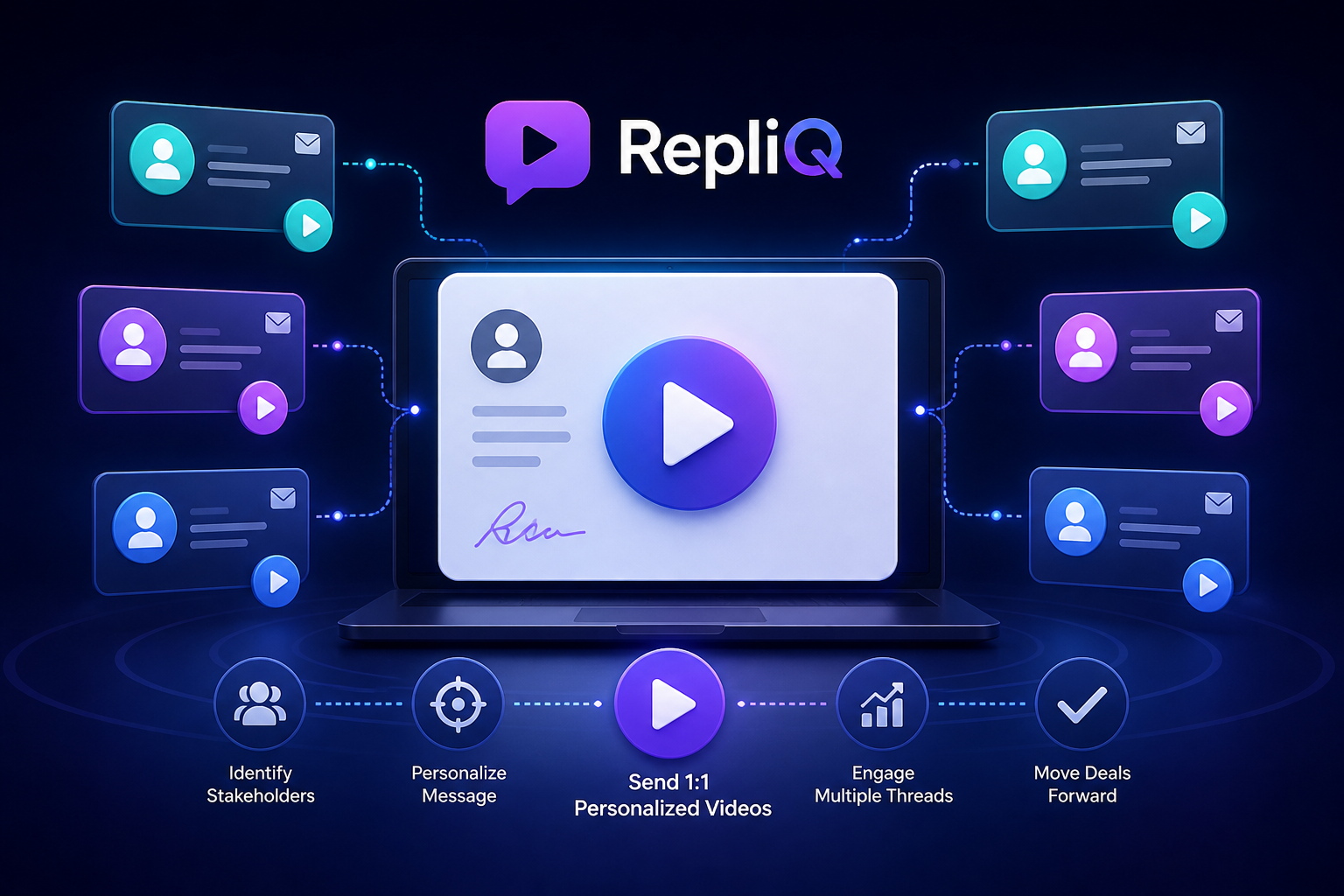
How to Use Personalized Videos in Multi-Threaded Enterprise Sales Deals
Introduction: Why Personalized Videos Matter in Multi-Threaded Sales
Enterprise deals are rarely won on the enthusiasm of a single champion. In today’s complex B2B buying environment, securing a closed-won opportunity requires building consensus across an entire buying committee. Relying on single-threaded sales—where a seller depends entirely on one internal advocate—introduces severe risk. Your champion may be highly motivated, but they often lack the budget authority, cross-departmental influence, or technical expertise to communicate the solution's full value to internal stakeholders.
To mitigate this risk, advanced sales teams must execute a multi-threaded sales strategy, and personalized stakeholder videos have emerged as one of the most effective tools for this enterprise deal outreach. However, this strategy is not about recording one generic product demo and sending it to everyone on the committee. True multi-threading requires adapting the context, business proof, objection handling, and call to action for each specific role.
This guide will show account executives, sales leaders, and revenue teams how to use personalized videos to engage champions, executive decision-makers, technical evaluators, end users, procurement, legal, and finance. By mapping the buying committee, creating role-specific video briefs, coordinating outreach, and measuring account-level progression, sellers can drive true consensus.
As a platform designed to create tailored video experiences for complex enterprise opportunities, RepliQ provides the foundation for adapting video context to champions, decision-makers, users, and financial stakeholders. By implementing the operating model outlined below, you can transform individual interest into organizational alignment.
H2: Understand the Role of Video in Multi-Threaded Enterprise Sales
Multi-threaded sales involves proactively building relevant, value-driven relationships with multiple members of an enterprise buying committee. Unlike a single-threaded deal centered exclusively on one champion, a multi-threaded deal establishes comprehensive coverage across business, technical, operational, financial, and approval stakeholders.
According to Gong’s multi-threading research, relying on a single relationship significantly decreases win rates and increases the likelihood of a stalled deal. Multi-threading sales mitigates this by distributing the relationship capital across the organization. Personalized video plays a crucial role here by reducing information silos. It gives each stakeholder a concise, asynchronous explanation of the solution, directly connected to their unique priorities.
Generic demos are often insufficient for enterprise buyers. An executive needs business context and financial justification; a technical lead requires implementation detail and security information; an end user needs to see workflow adoption evidence. Video bridges these gaps efficiently.
However, video should be viewed as one component of a larger account plan. It works best when integrated with live meetings, executive email outreach, customer reference calls, technical workshops, proof-of-concept sessions, and mutual action plans. Furthermore, sellers must recognize that video views and clicks do not automatically equate to buying intent or consensus. Meaningful account progression is measured by how video engagement translates into subsequent stakeholder actions.
H3: Why Single-Threaded Deals Create Enterprise Risk
A single-threaded deal risk occurs when a seller mistakes one active contact for complete buying-group coverage. A champion may be deeply enthusiastic about your platform, but they are often unable to secure budget independently, influence senior decision-makers, or resolve complex technical and compliance concerns.
When sellers fail to engage the broader committee, they risk late-stage deal collapse. Discovering procurement, legal, security, finance, or implementation objections at the end of the sales cycle often leads to indefinite delays. For advanced enterprise sellers, account executives, and sales leaders, proactive sales champion enablement must be paired with direct enterprise sales outreach to the broader committee to neutralize these risks early.
H3: What Makes a Stakeholder Video Strategically Personalized?
Strategically personalized sales videos change the core message, not merely the recipient’s name, company logo, or opening line. Effective stakeholder engagement requires tailoring the narrative to the individual's specific vantage point.
To achieve this in account-based sales engagement, sellers must use four personalization inputs:
- Stakeholder role and decision authority: Are they an approver, evaluator, or user?
- Business priority or decision criterion: What metric or outcome do they care about most?
- Likely objection or information gap: What will make them say no?
- Specific next action: What is the exact next step required from them?
This distinguishes a role-specific business case from a generic product explanation. Before sending, use a simple checklist: Does this video address this specific person's core priority? Does it preempt their most likely objection? If the answer is no, the video is not genuinely relevant.
H2: Map the Buying Committee Before Creating Any Video
Before recording or generating any personalized videos, sellers must create a comprehensive stakeholder map. This map serves as the blueprint for your enterprise buying committee engagement and should be directly linked to your account plan, CRM, opportunity stage, and mutual action plan.
For each contact identified in the account, document the following:
- Role in the buying process: (e.g., champion, economic buyer, technical lead).
- Influence and decision authority: (e.g., final sign-off, recommender, blocker).
- Desired business outcome: What does success look like for them?
- Likely objections: What concerns will they raise?
- Relationship owner: Who on your team is best positioned to engage them?
- Preferred next step: What action moves the deal forward?
Stakeholder mapping in sales should be dictated by the complexity of the deal and the organization's decision requirements, rather than a fixed number of contacts. Complex deals require a team-selling approach. Recommend involving sales engineers, marketing, solutions consulting, customer success, and executive sponsors when their specific expertise aligns with a stakeholder’s needs.
H3: Identify the Core Enterprise Stakeholder Groups
Enterprise deals typically involve several distinct roles, each requiring different video context:
- Champion: The internal advocate driving the initiative.
- Economic buyer or financial stakeholder: The budget holder focused on ROI.
- Executive decision-maker: The senior leader focused on strategic alignment.
- Technical evaluator: The IT or security lead assessing risk and architecture.
- End user or operational owner: The daily operator focused on usability.
- Procurement and legal: The compliance and contracting authorities.
- Customer success or implementation stakeholder: The team managing deployment.
Be aware that one person may hold multiple roles, or conversely, a massive enterprise may have several people fulfilling one category. Do not assume every deal features the exact same buying committee structure; adapt your economic buyer outreach, decision-maker outreach, and technical evaluator engagement to the reality of the specific account.
H3: Assign a Video Objective to Each Stakeholder
Translating a stakeholder map into an actionable video plan prevents disconnected messaging and inconsistent positioning. Create a planning table to assign a specific objective to each stakeholder-specific video.
Your table should include columns for:
- Stakeholder
- Priority
- Message
- Proof required
- Objection to address
- Call to action
- Owner and send date
This structured enterprise deal outreach ensures that every video aligns with the broader goal of buying-group consensus. Assign one accountable owner—usually the account executive—to oversee the overall account narrative. When using AI-assisted or scalable personalization, human review is critical to verify that stakeholder assumptions, claims, customer examples, and commercial details are perfectly accurate before sending.
H2: Create Role-Specific Personalized Stakeholder Videos
This is the central practical playbook for executing personalized stakeholder videos. The golden rule is that each video must connect the stakeholder’s role to the deal’s next logical decision—it should never repeat the full, generic sales pitch.
To maintain consistency and impact, use the following structure for deal acceleration videos:
- Relevant context: Why are you reaching out to them specifically?
- Stakeholder-specific issue: The business or operational problem they care about.
- Concise explanation: How the solution addresses that specific issue.
- Evidence or validation: Proof, metrics, or a relevant case study.
- Likely objection addressed: Preempting their primary concern.
- Clear next action: A specific, low-friction next step.
Keep each asset focused enough that it can be easily consumed or forwarded internally. While brevity is generally preferred, the length of the personalized video for sales should be determined by the complexity of the topic and the stakeholder's need, rather than a universal time limit. To scale this process efficiently while preserving crucial account context, teams can leverage RepliQ's AI video resource to generate role-specific assets seamlessly.
H3: Champion Video: Help the Internal Advocate Sell the Solution
A sales champion video is not meant to sell to the champion; it is meant to help the champion sell the solution to their peers. Consensus building in B2B sales relies heavily on internal champion enablement.
Include the following in your champion video:
- The agreed-upon business problem.
- Why resolving the issue matters now (compelling event).
- The value case, articulated in language the champion can easily reuse.
- The internal stakeholders who need to be involved next.
- A suggested next step or internal meeting.
Provide a reusable brief within the video: “Here is the business case we aligned on. Here is what your finance or executive stakeholders may want to validate, and here is the material you can forward to them.” This is vastly different from simply asking a champion to forward a generic demo link.
H3: Economic-Buyer and Executive Video: Lead With Outcomes, Risk, and Strategic Fit
When conducting economic buyer outreach or executive stakeholder engagement, focus entirely on business outcomes, investment rationale, organizational impact, and risk reduction. Avoid excessive product detail; executives care about what the product achieves, not how it functions, unless that function supports a strategic enterprise sales outreach decision.
Address these core questions:
- Why should the organization prioritize this initiative right now?
- What overarching business problem does it solve?
- What is the cost of inaction if the organization delays?
- What evidence supports the ROI recommendation?
Conclude with a direct, respectful call to action, such as an executive alignment conversation or a brief review of mutual success criteria.
H3: Technical Evaluator Video: Address Architecture, Security, and Implementation
A technical stakeholder video must provide clarity on feasibility, integration, security, implementation, and operational requirements. Technical evaluators are tasked with protecting the enterprise implementation from risk.
Separate verified product capabilities from roadmap assumptions or future possibilities. Only include links or supporting resources that have been thoroughly reviewed and approved by your own technical team. The ideal call to action for security stakeholder engagement is a technical validation session or architecture review, rather than a generic sales meeting.
Note: Always conduct a compliance and accuracy review before sending any video that discusses security, privacy, architecture, integrations, or implementation commitments.
H3: End-User Video: Show Workflow and Adoption Value
End-user engagement requires demonstrating exactly how the user’s day-to-day workflow will improve. Focus on usability, time savings, user adoption, enablement, and practical outcomes relevant to their specific role.
Use highly tailored examples that help users easily explain the solution to their managers and peers. Rather than asking for a purchasing decision, invite the user to validate your workflow assumptions or participate in a practical, hands-on session. These personalized sales videos build the groundswell of support needed to push a deal upward.
H3: Finance, Procurement, and Legal Video: Reduce Approval Friction
Financial buyer engagement and procurement stakeholder outreach should happen early. Introducing commercial and approval stakeholders only at the very end of the sales cycle guarantees delays.
Address the specific information these groups require to reduce friction:
- Cost structures and purchasing context.
- ROI assumptions and payback logic.
- The contracting process and standard terms.
- Data handling, compliance, and privacy considerations.
- Required approvals and implementation dependencies.
Never make unsupported financial, legal, or compliance claims. Use a clear next action, such as confirming their specific review requirements or scheduling an approval-preparation session. When discussing data handling, transparency is paramount. Ensure your practices align with regulatory expectations, such as those outlined in the FTC report on video-platform data and ad targeting, which emphasizes responsible personalization, privacy, tracking, and transparency. Enterprise sales objection handling is much easier when you are proactive and compliant.
H2: Orchestrate Videos Across the Account, Sales Sequence, and Deal Stage
Isolated video sends create fragmented, inconsistent, and repetitive stakeholder experiences. To succeed, you must build a coordinated sequence that orchestrates video alongside email, LinkedIn outreach, live meetings, executive alignment, workshops, customer proof, and follow-up.
Tie each video to a specific, strategic deal moment in your multi-threaded sales strategy:
- Immediately following a deep discovery call.
- Prior to an executive briefing.
- When introducing a new stakeholder to the buying committee.
- During the technical validation phase.
- Before procurement or legal review begins.
- When a mutual action plan milestone stalls.
Define clear ownership rules across the revenue team. Account executives, sales development representatives, solution consultants, customer success managers, and executive sponsors must know who is sending what, and when. Document every message and CTA in the CRM or sales engagement workflow to maintain visibility. To elevate this account-based sales engagement, teams can use a role-specific AI sales page to provide supporting context, proof, and follow-up material perfectly aligned with each personalized video in the enterprise deal outreach.
H3: Use a Video Sequence to Turn One Champion Into Broader Account Coverage
Transitioning from a single champion to full stakeholder engagement requires a deliberate, step-by-step progression:
- Align with the champion on the exact makeup of the buying committee.
- Create a champion enablement video they can use internally.
- Invite the relevant stakeholders into role-specific conversations via targeted videos.
- Send tailored follow-up to each participant based on their reaction.
- Update the mutual action plan based on the new stakeholder feedback.
When executing how to multi-thread an enterprise deal, it is critical to avoid making the champion feel bypassed or undermined. Give your champion full visibility into the messaging being shared with other stakeholders so they remain the internal orchestrator of the deal.
H3: Combine Video With Internal-Shareable Sales Content
Champions need concise assets they can forward without having to retell the entire complex sales story themselves. Internal champion enablement is most effective when you pair the video with a role-specific summary, relevant proof, next steps, and direct contact information.
Adapt the supporting content to the specific recipient rather than lazily attaching the same generic sales deck to every message. AI sales pages can automate the delivery of this curated content, ensuring that consensus building in B2B sales is supported by the right collateral at the right time.
H2: Measure Whether Stakeholder Videos Are Advancing the Deal
Views, watch time, and clicks are top-of-funnel engagement signals—they are not final proof of sales impact. To truly measure deal acceleration, teams must implement a measurement framework across four distinct levels:
- Coverage: The number and relevance of the specific stakeholders engaged within the account.
- Engagement: Video views, replies, clicks, and follow-up interactions.
- Progression: Meaningful steps taken, such as meetings created, validation events completed, and mutual action plan milestones reached.
- Business impact: Stage progression, stage velocity, opportunity progression, and total influenced pipeline.
Evaluate multi-threaded sales metrics by comparing video engagement against account-level actions, rather than judging each video in a vacuum. In your CRM, systematically record the stakeholder role, asset type, send date, response, next action, and any resulting deal-stage change.
While peer-reviewed research on personalized video ads demonstrates the effectiveness and scalability of personalization in marketing, sellers must remember that evidence from advertising does not automatically guarantee the same outcome in enterprise sales outreach. Use these insights as supporting context for video engagement measurement, but rely on your own pipeline data as the ultimate benchmark.
H3: Distinguish Activity Metrics From Deal-Progress Metrics
To accurately gauge buying-group progression, sales leaders must contrast vanity metrics with true advancement.
- Activity Metrics: Video views, completion rates, replies, and individual curiosity.
- Deal-Progress Metrics: Meeting acceptance, new stakeholder participation, technical or commercial validation sign-offs, mutual action plan progress, and opportunity-stage movement.
Video analytics only matter when they translate into opportunity progression. A video that gets three views but results in a signed technical validation document is infinitely more valuable than a video with fifty views that results in no next steps.
H2: Build Governance, Accessibility, and Trust Into the Workflow
Scaling personalized videos across an enterprise sales organization requires strict approval workflows, brand consistency, privacy reviews, and clear ownership. Without enterprise video governance, reps may inadvertently share inaccurate claims or sensitive data.
Implement a mandatory pre-send quality checklist:
- Is the recipient’s role and persona correct?
- Are all product and ROI claims accurate and approved?
- Does the video avoid making unsupported assumptions about the client's business?
- Is the call to action appropriate for their level of authority?
- Is sensitive or confidential information excluded?
- Is the asset accessible and easy to understand?
Responsible personalization—especially when using AI-assisted tools—requires human review and transparency. Furthermore, accessible sales videos are non-negotiable for modern enterprises. Incorporate captions, transcripts, and accessible supporting content into your production process, following frameworks like the W3C accessible video planning guidance for audio descriptions and media planning. Finally, ensure all data targeting and tracking adhere strictly to privacy regulations, utilizing insights from FTC reports on data practices to guide transparent and compliant engagement.
H2: Personalized Videos Versus Other Multi-Threading Motions
Personalized video is a powerful tool for video prospecting for enterprise sales, but it should complement—not replace—other critical enterprise sales motions.
Video works best when integrated with:
- Executive email: Video adds a human element to formal written outreach.
- Peer references and customer stories: Video can deliver bite-sized customer proof before a live reference call.
- Technical workshops and POCs: Video can summarize findings or prep stakeholders before deep-dive sessions.
- Mutual action plans: Video can recap milestones and clarify next steps.
- Live discovery and validation meetings: Video serves as the asynchronous bridge between live syncs.
It is important to contrast ad hoc recording tools with a coordinated stakeholder workflow. While platforms like Vidyard and Loom support general business video and prospecting, and revenue-intelligence platforms like Gong provide deal insights and multi-threading methodology, the goal is account orchestration. RepliQ differentiates itself by enabling contextual personalization across multiple roles, seamless AI video creation, supporting AI sales-page experiences, and true deal-level coordination. The ultimate test of stakeholder enablement is not which tool records the video, but whether the workflow empowers a team to create relevant, governed, and measurable engagement across the entire buying committee.
H2: Practical Checklist for Launching a Multi-Threaded Video Motion
Use this multi-threaded sales playbook checklist to standardize your enterprise deal outreach and ensure every personalized stakeholder video drives impact:
- Map the buying committee: Identify all active and missing roles in the CRM.
- Identify the key players: Pinpoint the champion, economic buyer, technical evaluator, user, and approval stakeholders.
- Define the strategy: Document each person’s priority, likely objection, required proof, and specific next action.
- Create a role-specific video brief: Outline the context, issue, solution, and CTA before recording.
- Review for compliance: Verify all claims, privacy considerations, accessibility (captions/transcripts), and brand consistency.
- Coordinate the send: Align the video delivery with the broader account plan and mutual action plan milestones.
- Pair with collateral: Package the video with relevant, role-specific supporting content.
- Track the impact: Measure stakeholder coverage and opportunity progression, not just views.
- Follow up: Execute the next step based strictly on the recipient’s role and their specific response.
Conclusion: Use Video to Build Consensus, Not Just Attention
Personalized stakeholder videos unlock their true value when they move beyond merely capturing attention and instead help multiple people understand, validate, approve, and advance the same complex enterprise decision. Multi-threaded sales is about mitigating risk and building a unified business case across the organization.
To achieve enterprise deal acceleration, reinforce this core framework: map the buying committee meticulously, adapt the message to the unique priorities of each stakeholder, enable your champion to sell internally, engage decision-makers and approvers early in the cycle, and coordinate all videos with the broader account plan. Most importantly, measure success by account progression rather than isolated video views.
As you scale this motion, ensure that personalization always preserves strategic context, mandates human review, and prioritizes accuracy, accessibility, and trust. For revenue teams ready to operationalize this strategy, RepliQ provides the platform to adapt video context for champions, decision-makers, users, and financial stakeholders, combining AI videos and AI sales pages to support flawlessly coordinated stakeholder outreach.
FAQ: Personalized Videos in Multi-Threaded Sales
H2: What Is Multi-Threaded Sales Outreach?
Multi-threading sales outreach is the strategic process of engaging multiple relevant stakeholders within an enterprise account, rather than relying on a single point of contact. This approach reduces the risk of depending solely on one champion, improves visibility into the complex buying process, and ensures that business, technical, and financial requirements are addressed comprehensively.
H2: How Can Personalized Videos Engage Multiple Stakeholders in an Enterprise Deal?
A personalized video for sales engages multiple stakeholders by adapting the core message, business proof, technical detail, and call to action to fit each specific person's role. Rather than sending disconnected outreach, these videos should be carefully coordinated through a unified account plan to drive enterprise buying committee engagement and consensus.
H2: What Should a Champion Video Include?
A champion enablement video should cover the agreed-upon business problem, the internal value narrative, relevant proof points, a list of other stakeholders who need to be involved, and a recommended next step. The primary goal of sales champion enablement is to provide a concise, compelling asset that the champion can easily forward to help communicate the solution internally.
H2: How Should Videos Differ for an Economic Buyer, Technical Evaluator, and End User?
Videos must align with distinct priorities:
- Economic buyer outreach: Focuses on business outcomes, total investment, risk reduction, and strategic organizational fit.
- Technical evaluator: Focuses on technical feasibility, security compliance, architecture, and implementation realities.
- End-user engagement: Focuses on daily workflow improvements, usability, user adoption, and practical operational value.
H2: How Many Stakeholders Should Be Included in a Multi-Threaded Deal Plan?
The appropriate number of stakeholders in a stakeholder mapping in sales strategy depends on the size of the target organization, deal complexity, the internal approval process, and specific decision criteria. Buying committee engagement should prioritize reaching the relevant roles required to close the deal, rather than indiscriminately contacting as many people as possible.
H2: How Do You Measure Whether Personalized Video Is Helping a Deal Progress?
To measure video engagement measurement accurately, track stakeholder coverage, reply rates, meetings booked, validation events completed, mutual action plan milestones achieved, stage progression, and influenced pipeline. Deal progression metrics rely on tangible buying-group actions; video views alone are insufficient to prove a deal is moving forward.
H2: How Can Teams Scale Personalized Videos Without Losing Relevance?
Teams can scale production by using repeatable video briefs, pre-approved messaging, stakeholder-specific templates, AI-assisted production, mandatory human review, and strict account-level governance. To maintain relevance at scale, teams can leverage RepliQ's AI video resource for scalable personalized videos, and pair them with RepliQ's AI sales-page resource to deliver role-specific follow-up content automatically.
Author and Brand E-E-A-T Note: RepliQ specializes in creating personalized video experiences that deliver stakeholder-specific sales context for complex B2B deals. The framework detailed in this article treats video as an integrated component of a governed enterprise sales workflow, rather than a standalone engagement tactic. Recommendations are derived from RepliQ’s product context and cited authoritative research, but should always be validated within your company’s unique sales process. All claims regarding privacy, accessibility, and personalization effectiveness align with cited FTC, W3C, and peer-reviewed standards, emphasizing legal, transparent, and compliant data use at all times.


