
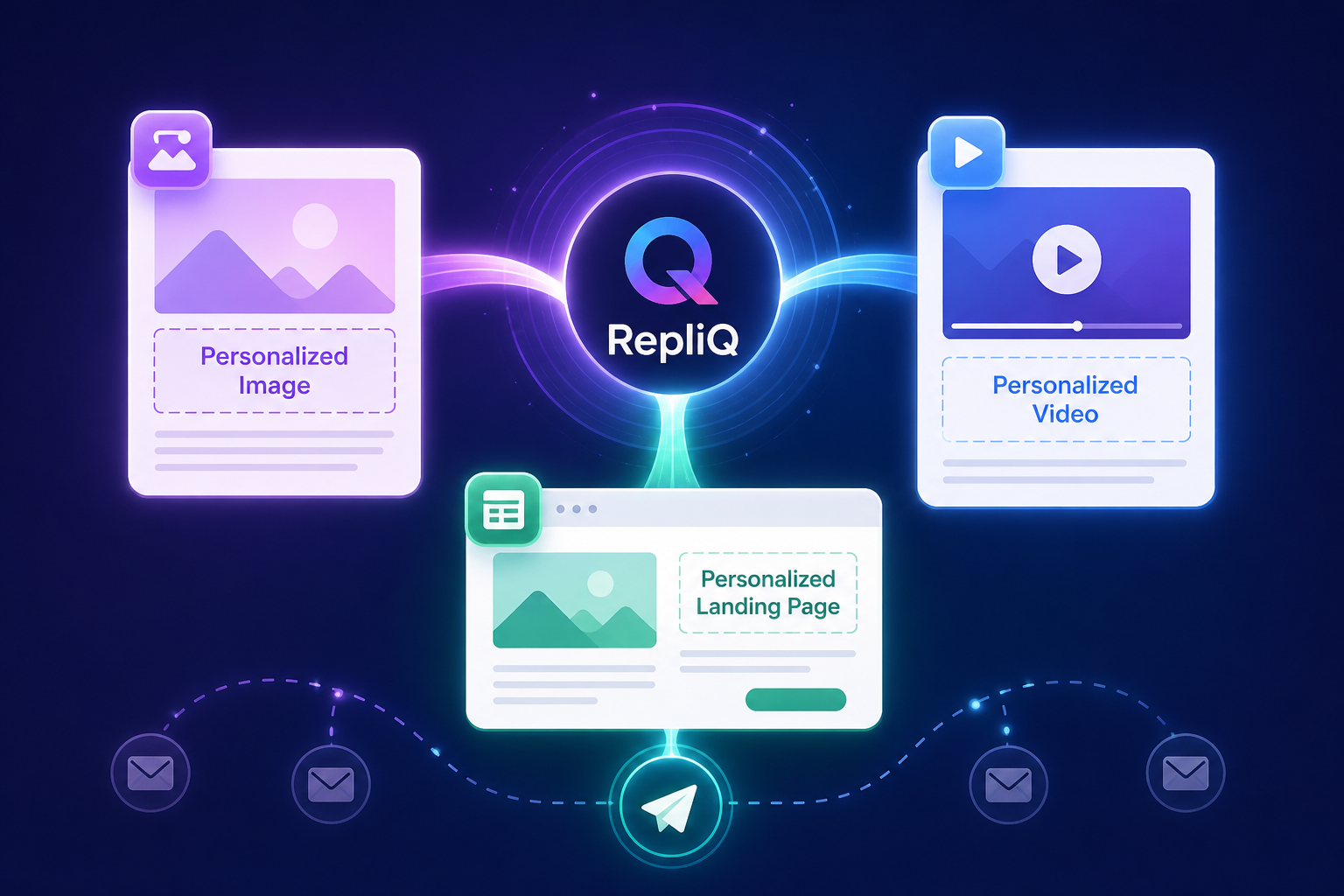
Multimedia Personalized Outreach: The Complete Image, Video, and Landing Page Campaign Blueprint
Table of Contents
- Introduction: Why Multimedia Personalization Needs One Campaign Narrative
- Understanding the Landscape: Why Coordinated Personalization Matters
- Deconstructing the Three-Part Multimedia Personalization Framework
- Design the Campaign Before Creating the Assets
- Build the Outreach Sequence Step by Step
- Personalization Decision Matrix and Worked Campaign Example
- Production and Operations: How to Scale Without Losing Consistency
- Measurement: Evaluate the Campaign as a Connected Funnel
- Risks, Compliance, and Common Failure Modes
- Practical Launch Checklist
- Conclusion: Turn Three Formats into One Conversion Experience
- Frequently Asked Questions
Introduction: Why Multimedia Personalization Needs One Campaign Narrative
Modern sales teams frequently fall into a predictable trap: they personalize the email image, the video, and the destination page completely independently. This siloed approach creates a fragmented, disjointed experience for the buyer rather than one coherent campaign narrative. When multimedia personalized outreach lacks a unified strategy, prospects are forced to piece together disconnected claims, leading to friction and lost conversions.
This blueprint will show advanced outbound teams how to coordinate personalized images, videos, and landing pages around one unified audience context, offer, narrative, and call to action. The strategy is built on a clear distinction of roles for each format:
- Images should create fast visual relevance.
- Videos should explain the prospect’s situation and build trust.
- Landing pages should consolidate proof and make the next action frictionless.
This complete framework covers everything required to launch a high-performing personalized sales campaign, including campaign sequencing, format selection, scalable production systems, quality assurance, measurement, and the responsible use of prospect data. Importantly, this framework is designed for advanced outbound teams and focuses on practical campaign coordination, not unsupported promises about guaranteed conversion increases.
To execute this architecture efficiently, platforms like RepliQ offer a centralized way to coordinate AI-generated images, videos, and sales pages. Instead of treating these formats as isolated features across different tools, RepliQ allows teams to deploy video, image, and landing page personalization as complementary components of a single, high-converting campaign.
Understanding the Landscape: Why Coordinated Personalization Matters
The problem with disconnected personalized assets
When production is siloed across different tools and teams, the personalized outbound funnel breaks down. Marketing might create an image focusing on one pain point, while sales records a video highlighting a completely different offer. This disconnection creates several critical issues:
- Mismatched messaging: Different pain points or offers are presented across assets.
- Redundancy: Information is repeated rather than disclosed progressively.
- Friction: A severe mismatch between the outreach message and the destination page confuses the buyer.
- Operational waste: Duplicated production work and unclear ownership slow down deployment.
- Blind spots: Weak attribution occurs when each asset is tracked separately rather than as a unified journey.
Multichannel personalization should be treated as a connected recipient experience, not a collection of isolated creative tactics. Consider the difference between a generic outbound journey and a coordinated one-to-one sales outreach experience:
- Generic: Generic email → generic attached asset → generic homepage.
- Coordinated: Contextual email → personalized image → tailored video → matching sales page.
Define the campaign’s single narrative
Before creating any assets, cross-channel campaign personalization requires a master campaign brief. This brief serves as the single source of truth, containing:
- Target audience or account segment.
- Prospect or account context.
- Core pain point.
- Campaign offer.
- Proof point or supporting evidence.
- Desired next step.
- Approved personalization fields.
Every asset in your personalized sales campaign can use a different creative treatment, but they must all preserve this same strategic message. Define the "message spine" before generating any content: determine exactly what the prospect should notice (image), what they should understand (video), what they should believe (proof on page), and what they should do next (CTA). This approach separates the best personalized outbound campaign examples from disjointed tactical experiments.
Deconstructing the Three-Part Multimedia Personalization Framework
Personalized Images: Earn Attention and Establish Relevance
At the top of the outreach sequence, personalized marketing images serve one primary function: they communicate relevance within seconds and help a message stand out visually in a crowded inbox.
Appropriate image-level variables include the prospect or company name, relevant account context, their industry or use case, a visual reference to a known challenge, or a campaign-specific headline. However, an image should never attempt to carry the full explanation, proof, and conversion argument. Overloading an image creates visual clutter. Instead, use the image to create a compelling reason for the prospect to continue reading. For teams looking to scale this process efficiently, RepliQ’s AI images provide a scalable way to execute template-based visual personalization without manual design bottlenecks, ensuring your personalized email image and video campaign starts with immediate impact.
Personalized Videos: Explain the Situation and Build Trust
Once the image has earned attention, personalized sales videos should advance the conversation. A video should never simply repeat the headline from the image; it must add depth.
Suitable video roles include explaining an account-specific observation, demonstrating exactly how a solution addresses the prospect’s unique situation, adding a human explanation to the campaign, and introducing the next step before the prospect reaches the sales page.
Always outline the video before production:
- Context: Why the prospect is receiving it.
- Insight: What the sender understands about the account.
- Relevance: Why this issue matters right now.
- Transition: What the viewer should do next.
Keep video claims strictly aligned with the campaign brief and avoid making unsupported assumptions about the prospect's internal operations. For seamless execution, RepliQ’s AI videos allow teams to generate scalable video variations that fit perfectly within a multimedia personalized outreach strategy.
Personalized Landing Pages: Convert Relevance into Action
Personalized landing pages act as the conversion layer of the campaign. This is where relevance is transformed into pipeline.
To maintain continuity, the page elements must reflect the preceding outreach:
- Matching headline and offer.
- Prospect or account context where appropriate.
- Relevant benefits rather than generic feature lists.
- Tailored proof, examples, or use cases.
- Clear call to action.
- Consistent visual treatment and language.
The personalized landing page for sales outreach should reduce the cognitive load on the prospect; they should never have to reconstruct why they are there. You should send a prospect directly to a tailored page when the account has demonstrated intent, the outreach includes a specific offer, sufficient first-party CRM data is available, and the page provides a materially better experience than a generic destination. To build these destinations effortlessly, RepliQ’s AI sales pages empower teams to launch tailored conversion environments that match the outbound message perfectly.
Design the Campaign Before Creating the Assets
Define the audience, trigger, and offer
Campaign inputs determine the appropriate depth of personalization. Not every recipient needs all three formats; an effective multichannel sales personalization strategy uses the minimum effective level of personalization.
| Audience / Segment | Funnel Stage | Available Data | Buyer Intent | Primary Pain Point | Recommended Format | Desired Action |
|---|---|---|---|---|---|---|
| Tier 1 Target Accounts | Cold Prospecting | Rich (CRM + Intent) | Low/Medium | High operational costs | Image + Video | Watch video / Reply |
| Engaged Leads | Warm Follow-up | Verified | Medium/High | Slow time-to-market | Video + Landing Page | Book a consultation |
| High-Intent Accounts | Conversion | Comprehensive | High | Need for ROI proof | Personalized Landing Page | Sign contract / Buy |
Distinguish clearly between cold prospecting (where relevance must be established carefully without being intrusive), warm follow-up (where the team can build on previous engagement), and high-intent conversion (where the personalized outbound funnel must emphasize the page and CTA heavily).
Create a message-continuity system
A cross-channel campaign personalization strategy relies on a strict continuity checklist:
- Same campaign promise.
- Same audience problem.
- Same terminology for the offer.
- Consistent visual identity.
- Progressive information across touchpoints.
- Matching call-to-action language.
Create a variable map before production begins, mapping out fields like {{first_name}}, {{company_name}}, {{industry_or_segment}}, {{pain_point}}, {{offer}}, and {{cta}}. Crucially, distinguish between safe, verified data and assumptions. Unverified data should never appear in personalized content.
Sequential personalization versus simultaneous multi-asset outreach
There are two primary campaign architectures for multimedia personalized outreach:
- Sequential: Image first, video sent after engagement or follow-up, and a landing page introduced when intent is established.
- Simultaneous: Image, video, and landing page presented in one coordinated outbound touchpoint.
Sequential personalization is preferable when data is limited, the audience is cold, the team wants to control production effort, or when each engagement signal should dictate the next logical step. Simultaneous delivery is appropriate when the offer is highly time-sensitive, the audience is highly qualified, the campaign requires a complete account-based experience, or the recipient already possesses the relevant context.
Build the Outreach Sequence Step by Step
Stage 1: Use a personalized image to earn the first interaction
The first touchpoint in one-to-one sales outreach must establish relevance within seconds. The initial message structure should include a specific context or observation, a concise explanation of why it matters, the personalized visual asset, and a low-friction next step.
Avoid excessive personalization that feels intrusive or relies on uncertain data. The image can support subject-line, email-body, or social-message relevance beautifully without needing to carry the entire sales argument.
Stage 2: Use personalized video to deepen understanding
A follow-up video in a personalized video sales funnel must add new information. A highly effective video structure follows five steps:
- Acknowledge the prospect or account context.
- Identify the relevant challenge or opportunity.
- Explain the proposed approach.
- Show the practical benefit.
- Invite the viewer to continue to the tailored page or book a conversation.
Use engagement signals to determine whether the video is sent broadly or reserved for warmer prospects. Ensure the video thumbnail, title, opening frame, and CTA perfectly match the original campaign narrative.
Stage 3: Use a personalized landing page to convert intent
The personalized landing page must answer the questions generated by the earlier touchpoints. The recommended page flow includes a campaign-matched headline, account or segment relevance, problem clarification, solution explanation, supporting proof or use case, objection handling, and a single primary CTA.
Following personalized landing page best practices, this page acts as a vital sales enablement asset for follow-up conversations. Ensure a clear handoff from page engagement to sales follow-up, passing along the relevant account, campaign, and engagement context.
Cold outreach versus warm follow-up
The recommended format mix shifts based on the relationship stage. For cold accounts, use lightweight image personalization and concise context. For engaged accounts, deploy a personalized video that explains the opportunity in depth. For high-intent accounts, deliver a tailored sales page with concrete proof and a direct CTA.
The same account may receive different assets as its context and intent evolve through the multichannel personalization journey. Do not treat every prospect as equally ready for a highly personalized, deep-funnel experience from day one.
Personalization Decision Matrix and Worked Campaign Example
Decision matrix: Which format should the campaign use?
| Buyer Intent | Account Data | Funnel Stage | Offer Complexity | Production Effort | Recommended Format | Do Not Use |
|---|---|---|---|---|---|---|
| Low | Limited | Awareness | Simple | Low | Image | Video / Page |
| Medium | Moderate | Consideration | Moderate | Medium | Video | Page (if data is stale) |
| High | Rich / Verified | Conversion | Complex | High | Landing Page | Image-only |
The strategic logic is simple: use images when attention and immediate relevance are the priority. Use videos when explanation, trust, or account-specific insight is needed. Use landing pages when proof, comparison, and conversion support are required. Use all three in a video image landing page personalization sequence only when each format contributes a distinct, necessary role. If data is incomplete, stale, or unverified, default to the "do not use" column and rely on segment-level messaging instead.
Worked example: One coordinated prospect journey
Note: This framework illustration represents a hypothetical campaign designed to demonstrate structural continuity.
Imagine a personalized sales campaign targeting VP of Operations at mid-sized logistics firms experiencing high fuel variance.
- Initial outreach: Introduces a relevant account insight (recent fleet expansion) through a personalized image showing a chart of their estimated fleet vs. industry averages.
- Follow-up video: Explains how fleet expansion connects to fuel variance tracking challenges.
- Personalized sales page: Presents tailored benefits for logistics firms, a case study of a similar fleet, and a calendar booking CTA.
| Touchpoint | Prospect Objective | Asset Role | Personalization Fields | Message Progression | Success Signal |
|---|---|---|---|---|---|
| Email 1 | Notice relevance | Image | {{company_name}}, {{fleet_size}} | Introduces fleet expansion observation | Image click / Reply |
| Email 2 | Understand problem | Video | {{first_name}}, {{industry}} | Explains fuel variance challenge | Video completion |
| Page | Believe & Act | Landing Page | {{company_name}}, {{use_case}} | Provides proof and books meeting | CTA click / Meeting booked |
Continuity is maintained through a shared campaign promise, shared pain point, shared offer, progressive detail, and a consistent CTA across the personalized email image and video campaign.
Production and Operations: How to Scale Without Losing Consistency
Build reusable templates and structured variables
To scale how to scale one-to-one marketing, teams must build modular templates that reduce one-off production work while preserving campaign quality. Separate your fixed brand and design elements from campaign-level messaging, account-level variables, prospect-level variables, and CTA routing logic.
A single campaign brief should govern the creation of the image, video, and page. While AI personalized sales assets can rapidly support variation, human review remains essential for accuracy, tone, and brand fit. By centralizing this workflow, platforms like RepliQ enable teams to coordinate their production approach seamlessly across all three formats.
Data quality, fallback content, and personalization limits
Personalization is only as good as its data. Missing company details, stale CRM records, incorrect job titles, inconsistent account naming, or personalization that feels overly intrusive will destroy trust instantly.
Implement strict fallback rules for your personalized outbound funnel:
- Use segment-level language when account-level data is incomplete.
- Remove a variable rather than display an empty or incorrect field (e.g., "Hi there," instead of "Hi
{{first_name}},"). - Use a generic but relevant visual treatment when data cannot be verified.
- Route to a standard page when a personalized page would create a poor experience.
Know your personalization limits: if acquiring verified data costs more time than the resulting conversion lift justifies, scale back the personalization depth.
QA and campaign handoffs
A rigorous pre-launch QA process is non-negotiable for cross-channel campaign personalization. Review variable rendering, names, logos, account details, image quality, video playback, mobile layout, links, redirects, CTA consistency, landing-page content, and tracking parameters.
Test the complete recipient journey—not just each asset independently—to ensure progressive disclosure flows logically. Define clear ownership across marketing, sales, creative, and operations to ensure accountability.
Connect production to CRM and outreach workflows
Campaign handoffs to sales require specific CRM data: campaign identifier, audience/account segment, asset version, landing-page URL, engagement events, and sales follow-up status.
Align naming conventions across assets and campaign records. Engagement with an image, video, or page should inform the next follow-up in the sales outreach conversion funnel, but avoid treating one isolated click as definitive, bottom-of-funnel buying intent.
Measurement: Evaluate the Campaign as a Connected Funnel
Asset-level metrics
Diagnose performance at each stage using asset-level metrics:
- Outreach delivery and reply signals.
- Image engagement or click-through behavior.
- Video plays, completion, and CTA interaction.
- Landing-page visits, engagement, and CTA clicks.
These metrics are diagnostic. They tell you if the personalized sales campaign is functioning mechanically, but they are not the final measure of success. Compare personalized assets with a relevant non-personalized or single-format control where practical.
Funnel and pipeline metrics
To evaluate true success, rely on campaign-level measurements:
- Qualified response rate: Qualified responses ÷ delivered outreach.
- Meeting rate: Booked meetings ÷ delivered outreach.
- Landing-page conversion rate: Form fills or bookings ÷ tailored page visitors.
- Assisted conversion rate: Conversions influenced by one or more campaign assets ÷ campaign recipients.
- Campaign ROI: (Attributable pipeline value - campaign cost) ÷ campaign cost.
Define your attribution rules before launch. Never claim that one asset caused a conversion without supporting evidence; a multichannel sales personalization strategy requires multi-touch attribution logic.
Testing the campaign architecture
Test one variable at a time: a personalized image versus a static image, an image-only sequence versus an image-plus-video sequence, a generic destination versus a personalized landing page, or sequential versus simultaneous delivery.
Evaluate both efficiency (production time, cost per personalized campaign) and outcome (engagement quality, qualified meetings, pipeline contribution). Document the audience, sample size, time frame, control group, and success metric for every test to build reliable AI personalized sales assets playbooks.
Risks, Compliance, and Common Failure Modes
Failure mode: Every asset says the same thing
When the image, video, and landing page all repeat the exact same headline and value proposition, it creates unnecessary friction and wastes the value of a multi-format sequence. The correction is progressive disclosure: the image introduces relevance, the video explains the insight, and the page supplies proof and action.
Failure mode: Personalization is based on inaccurate data
Incorrect names, roles, company details, or assumptions immediately undermine trust in an account-based marketing personalization campaign. Prevent this through strict data validation, fallback rules, and human review for high-value campaigns.
Failure mode: The campaign optimizes clicks instead of outcomes
A strong visual interaction with an image may not translate into qualified demand if the underlying offer is weak. Campaign reporting must connect top-of-funnel engagement with meaningful downstream actions in the sales outreach conversion funnel.
Privacy, transparency, and responsible personalization
Campaign teams must meticulously review how prospect data is collected, stored, used, and exposed in personalized content. There is a strict line between leveraging relevant business context and the unnecessary, intrusive use of personal information.
Teams must use only data appropriate for the campaign purpose, review consent requirements for the relevant channel, and provide clear privacy information where tracking technologies are used. Avoid sensitive or unexpected inferences, and always offer a non-personalized fallback experience where appropriate.
For strict compliance in multichannel personalization:
- Review the FTC guidance on online tracking and personalization regarding cookies, pixels, and personalized content.
- Understand the distinction between system-driven personalization and user-controlled customization by reviewing research on personalization, customization, and privacy to respect user agency and perceived control.
- Adhere to local and state regulations, such as the New York guidance on website privacy controls, when deploying tracking technologies, disclosures, and user choice mechanisms on personalized landing pages.
Practical Launch Checklist
Use this pre-launch checklist to ensure your personalized sales campaign executes flawlessly across all touchpoints. Before launch, confirm:
- The campaign has one clearly defined audience and a single, unified offer.
- Each format (image, video, landing page) has a distinct, non-repetitive role.
- The image, video, and landing page use consistent messaging and visual identity.
- All personalization variables are defined, mapped, and validated against CRM data.
- Fallback content exists for every variable in case of missing or stale data.
- The video and landing page advance the story rather than simply repeating the image’s headline.
- All URLs, redirects, and tracking parameters work correctly.
- Asset rendering has been thoroughly reviewed on mobile and desktop devices.
- All claims and proof points have been approved by leadership or legal.
- Privacy, tracking disclosures, and data-use practices have been reviewed for compliance.
- CRM and sales follow-up fields are accurately mapped to capture engagement.
- Success metrics, control groups, and attribution rules are defined prior to deployment.
Conclusion: Turn Three Formats into One Conversion Experience
Transforming cold outreach into high-converting pipeline requires more than just deploying new media formats; it requires strategic coordination. The framework is clear: personalized images earn attention, personalized videos deepen understanding and trust, and personalized landing pages provide the proof needed to convert intent. The true advantage comes from the seamless coordination of these assets, not simply from using more of them.
To succeed, teams must adhere to core operational principles. Start with one unified campaign narrative. Use progressive personalization so each step adds value. Match the chosen format to the funnel stage and buyer intent. Build reusable systems with strict fallback rules to protect brand trust, and measure the connected funnel rather than isolated clicks.
When you contrast this coordinated workflow with generic outbound, single-format personalization, manually assembled campaigns, or disconnected point tools, the efficiency and conversion advantages become undeniable. Instead of wrestling with fragmented software, outbound teams need a centralized engine. RepliQ provides exactly this differentiation: connecting AI-powered images, videos, and sales pages into one consistent, scalable outbound campaign workflow. Stop sending disjointed messages and start building coordinated personalized sales campaigns that guide your buyers smoothly from first glance to final conversion.
Frequently Asked Questions
How do you combine personalized images, videos, and landing pages in one outreach campaign?
You combine them through a coordinated sequence: use the image for immediate visual attention, the video for deep explanation, and the landing page for concrete proof and action. Every asset must share the same campaign narrative while progressively adding new information.
What is the best sequence for personalized images, videos, and landing pages?
The recommended sequential model is: 1) Introduce relevance with a personalized image, 2) Build understanding with a personalized video, and 3) Convert intent with a personalized landing page. However, a simultaneous approach (delivering all three at once) may be appropriate for highly qualified, high-intent audiences.
Should every prospect receive all three personalized formats?
No. Format selection should depend on the funnel stage, buyer intent, available data, offer complexity, and production effort. Use the minimum effective personalization required to advance the deal rather than adding assets simply for the sake of using them.
How do you keep messaging consistent across personalized outreach assets?
Consistency is maintained by using a central campaign brief, a defined message spine, a mapped variable list, a shared offer, a consistent CTA, and a full-journey QA process. Progressive disclosure ensures the message advances without redundant repetition.
How can personalized video and images support landing-page conversions?
Images create the initial relevance needed to earn a click, and videos develop the understanding needed to build trust. By the time the prospect reaches the page, it simply needs to consolidate proof and facilitate action. Campaign-level measurement is required to accurately attribute this conversion impact.
How should teams scale multimedia personalized outreach?
Teams scale by utilizing reusable templates, structured variables, modular creative, fallback content, and automation. Crucially, while AI-assisted production accelerates output, it does not replace the need for rigorous data validation and human message review.
What should happen when prospect data is incomplete?
When data is incomplete, deploy segment-level or generic fallback content rather than displaying inaccurate personalization. If data is entirely unverified, remove the personalization, delay the asset, or route the recipient to a standard, high-quality generic page.
How do you measure the ROI of a multimedia personalized sales campaign?
Measure the entire funnel: delivery, engagement, qualified responses, meetings booked, conversions, and pipeline contribution against total production cost. Define your attribution models and control groups before launch to accurately calculate campaign ROI.
How can teams use personalization responsibly?
Teams must ensure proportionate data use, transparency, privacy review, accurate claims, and appropriate fallback experiences. Always adhere to legal frameworks, such as the FTC guidelines, academic insights on user agency, and state-level privacy controls like New York's guidelines to maintain trust and compliance.


