
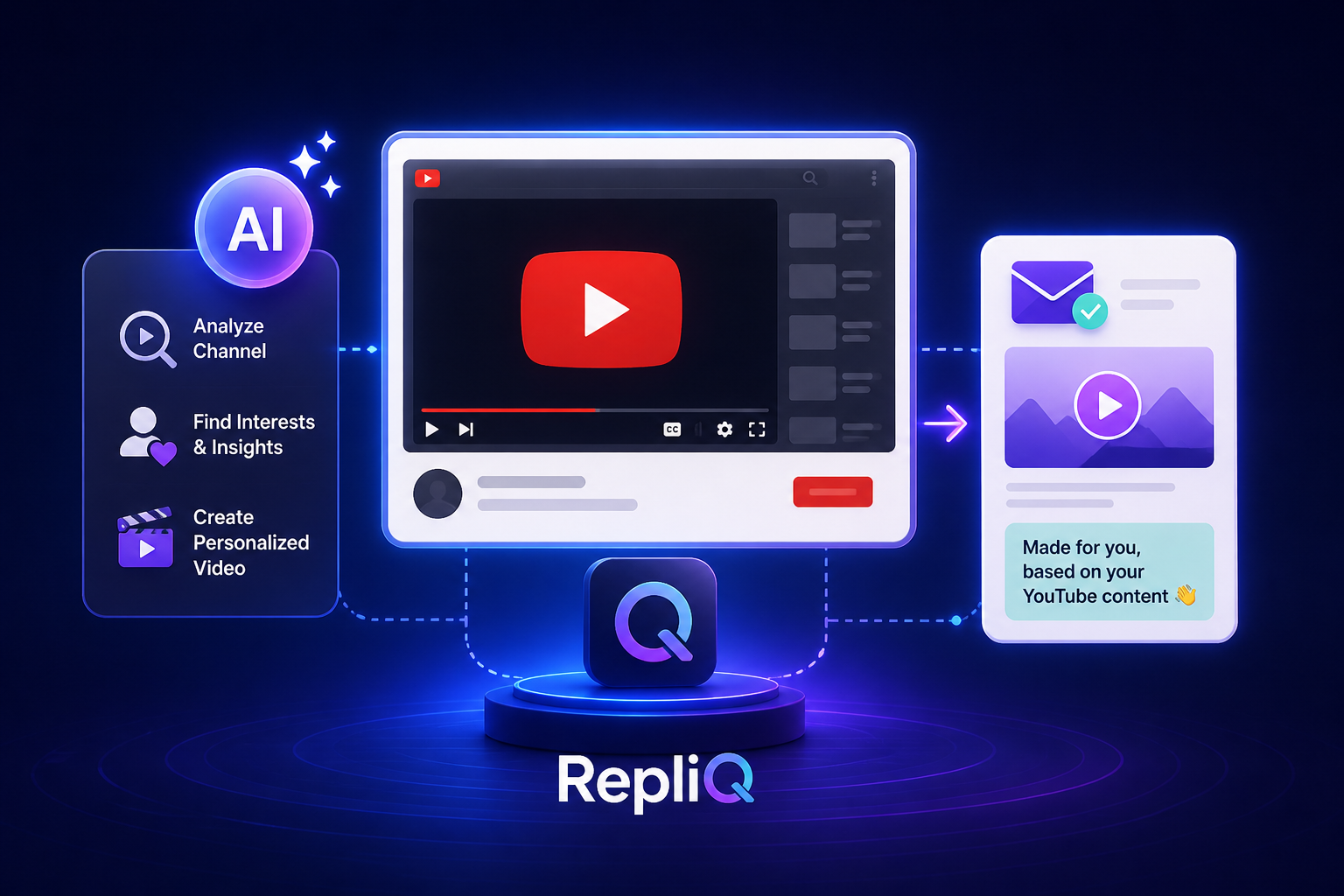
How to Personalize Outreach Using a Prospect’s YouTube Channel
YouTube personalization has emerged as a highly practical form of account research for sales teams, marketers, agencies, and founders running personalized cold outreach. A common problem with outbound messaging is the reliance on generic compliments, job titles, or basic company facts. These surface-level details do not explain why the sender is reaching out now.
However, a prospect’s recent videos, recurring topics, descriptions, playlists, calls to action, and audience language can reveal incredibly useful business context. In this guide, you will learn how to review a prospect’s video channel, identify meaningful signals, convert them into a targeted outreach angle, and decide when to use email, LinkedIn, or personalized video.
The goal is not to summarize everything a prospect has published. The goal is to find one credible observation that supports one relevant business hypothesis. We will walk through a repeatable workflow, scoring rubric, outreach templates, and an AI-assisted process protected by ethical safeguards. From RepliQ’s content-driven perspective, recent videos, recurring themes, and product content provide excellent business context—provided every observation is reviewed for accuracy and relevance before sending.
Why a Prospect’s YouTube Channel Is a Valuable Research Source
YouTube can reveal far more current and nuanced context than standard firmographic research alone. Recent uploads often indicate current priorities, new initiatives, product launches, customer questions, or shifts in market positioning. When you analyze a prospect’s vocabulary, audience focus, calls to action, and content formats, you gain a clearer understanding of what their business is actively trying to achieve.
It is crucial to distinguish content evidence from assumptions. A video can suggest a highly relevant conversation angle, but it does not prove a prospect’s budget, pain point, or buying intent. This nuanced approach contrasts sharply with basic mail-merge personalization based only on names, industries, or company fields. While broad personalization frameworks from tools like Clay and Lavender can improve overall research and copy quality, applying a specific YouTube channel-analysis layer grounds your outreach in the prospect’s immediate, publicly stated priorities.
Channel content serves as a source of evidence for a relevant outreach hypothesis, not as a guaranteed buying signal.
The Difference Between a Content Detail and a Useful Business Signal
There is a vast difference between noticing a video title and understanding what that title reveals about a prospect’s current business context. When conducting YouTube channel analysis, prioritize signals that indicate momentum or strategy, such as:
- Repeated discussions of the same problem or audience need.
- Product, service, launch, or positioning references.
- Calls to action that reveal the exact next step the prospect wants viewers to take.
- Noticeable changes in content themes, formats, presenters, or target audiences.
Treat metrics like view counts, upload frequency, and popularity as background context rather than automatic evidence of commercial intent.
Why Recurring Themes Matter More Than One-Off Videos
Repeated topics indicate a consistent audience concern, a core strategic focus, or a primary area of expertise. When conducting YouTube channel prospecting, compare several recent videos with older or evergreen content to identify whether a theme is a new initiative, a recurring pillar, or an outdated focus.
Identifying recurring language helps you write a message that sounds familiar and native to the prospect’s worldview without excessively copying their exact wording. Remember that a recurring theme still needs to be connected to a plausible business outcome before it becomes a viable angle for your outreach.
The YouTube Channel Review Workflow
To prevent spending excessive time on every prospect, you need a repeatable process for researching a channel. Begin with the prospect’s channel homepage to identify their apparent audience, positioning, presenters, and primary content categories. Review recent uploads first, then compare them with recurring topics in the wider back catalog.
Record your observations in a simple research note containing:
- Evidence: What the prospect published or said.
- Interpretation: What the evidence might indicate about their goals.
- Relevance: Why it could matter to your specific offer.
- Confidence: How strongly the evidence supports your interpretation.
Limit the final message to one or two observations rather than listing every detail you discovered.
Step 1 — Start With Recent Videos
Review the most recent relevant uploads before exploring older content. Look for new topics, product mentions, audience questions, launches, changes in positioning, or recurring pain points. Record the video title, approximate recency, a relevant timestamp or section if available, and the specific observation worth referencing. Avoid treating an old video as evidence of a current priority unless newer content supports the same theme.
Step 2 — Review Titles, Descriptions, Playlists, and Calls to Action
Use titles to identify the subject the prospect chose to foreground. Read descriptions for links, positioning statements, product references, resources, and stated next steps. Reviewing playlists helps you understand how the prospect groups topics for a particular audience or stage of interest. Note calls to action such as subscribing, booking, downloading, joining, or visiting a product page.
These elements can support a personalized message, but they should not be presented as proof of intent unless explicitly stated by the prospect. For a deeper understanding of the public channel and video elements being reviewed, you can consult YouTube Help to ensure you are using platform terminology accurately and interpreting public data responsibly.
Step 3 — Identify Recurring Themes and the Prospect’s Language
Compare multiple videos to find repeated topics, phrases, audience problems, product categories, or business outcomes. Capture the prospect’s terminology so your sales personalization reflects their framing rather than imposing unfamiliar sales language. Separate an evergreen educational theme from a new strategic priority by checking for recency and repetition. Additionally, note whether different presenters or channel sections address different target audiences.
Step 4 — Convert the Observation Into a Business Hypothesis
Transform your account research into a personalized cold outreach angle using a four-part reasoning chain:
- Observation: What did the prospect publish?
- Pattern: Is the topic recent, repeated, or connected to a broader theme?
- Possible implication: What business priority or audience challenge might it relate to?
- Relevant offer: How could you help without overstating what you know?
Make it clear that your hypothesis is just that—a hypothesis. Test it through a respectful question or low-friction CTA. Avoid jumping from "the prospect made a video about a topic" to "the prospect definitely needs our service."
A Signal-to-Message Framework for YouTube Personalization
Transforming channel research into concise, useful outreach requires structure. Otherwise, you risk sending a generic content compliment. Use this message structure: specific observation → relevant implication → useful connection → low-friction next step.
The observation should be publicly verifiable and brief enough to understand without watching the entire video. Connect the observation to a business outcome, workflow, or audience challenge relevant to your offer. Finally, use one clear CTA rather than asking for a meeting before establishing relevance.
The Observation — Reference One Specific Content Signal
Mention one recent or recurring topic rather than summarizing the whole channel. Use a natural reference such as a specific topic, series, audience question, or stated initiative. Avoid commenting on private information, personal characteristics, or details unrelated to the prospect’s professional context. Keep the reference easy for the recipient to verify.
The Implication — Explain Why the Signal Matters
Move beyond "great video" by explaining the business relevance of your observation. Frame implications carefully with language such as "It looks like..." or "That made me wonder whether..." Connect the theme to a plausible challenge, such as producing more relevant content, improving outbound relevance, or communicating a complex offer. Do not imply certainty about their internal priorities, budget, or readiness.
The Connection — Position the Offer Without Forcing It
Explain how your product or service relates to the observed theme. Use the prospect’s content as a reason for the message, not as an excuse to deliver a generic pitch. Keep the value proposition focused on one outcome or use case. If a visual message adds useful context to your pitch, https://repliq.co offers a practical way to connect your research with personalized AI video outreach, turning relevant prospect context into highly engaging outreach assets.
The CTA — Make the Next Step Low Friction
Offer a simple next step, such as asking whether the topic is a current priority, sharing a relevant example, or inviting a short exchange. Match the CTA to the evidence strength: weaker signals call for a broad question, while stronger, highly relevant signals may support offering a specific resource or demonstration. Avoid combining multiple requests, links, and scheduling options in the first message.
Before-and-After Examples of YouTube-Informed Outreach
To demonstrate the difference between superficial personalization and evidence-based messaging, consider these illustrative examples across various prospect types.
Example — A Recent Product or Launch Theme
- Observed Signal: A SaaS founder recently uploaded a walkthrough of a new reporting dashboard feature.
- Weak Opening: "Saw your recent video about the new reporting feature. Great stuff! We help SaaS companies get more leads."
- Stronger Opening: "I noticed your recent walkthrough of the new reporting dashboard—it looks like giving users deeper data visibility is a major focus for this quarter."
- Business Connection: "When launching highly visual features like this, many teams struggle to communicate the UI updates effectively in their outbound campaigns."
- Low-Friction CTA: "Are you currently looking for ways to embed dynamic product walkthroughs into your cold email sequences?"
Example — A Recurring Audience Pain Point
- Observed Signal: A coach consistently publishes videos addressing burnout among middle managers.
- Weak Opening: "Love your YouTube channel and all your videos on burnout. You are such an expert. Do you need help with appointment setting?"
- Stronger Opening: "I saw that your last three videos focused heavily on middle-management burnout."
- Business Connection: "Since you’re consistently addressing this specific audience pain point, I imagine scaling your coaching curriculum to reach more managers is a priority."
- Low-Friction CTA: "Would you be open to seeing a brief example of how similar educators automate their intake workflows?"
Example — A Channel With Multiple Presenters or Audiences
- Observed Signal: A media agency channel features different hosts for SEO and Paid Ads. You want to contact the Paid Ads lead.
- Weak Opening: "Loved the recent agency video on SEO updates. We sell an ad optimization tool." (Addresses the wrong context).
- Stronger Opening: "I caught the paid-social playlist you host on the agency’s channel, specifically your breakdown of Q3 ad costs."
- Business Connection: "Since you're managing those fluctuating CPA trends for clients..."
- Low-Friction CTA: "Is automating budget reallocation across those client accounts on your radar right now?"
Choosing the Right Outreach Format: Email, LinkedIn, or Personalized Video
Deciding when a channel insight should become text-based outreach and when video adds value is critical. Recommend email when the insight can be expressed clearly in a few sentences and the recipient is likely to prefer a concise explanation. Use LinkedIn when the relationship or context makes a shorter conversational touch appropriate.
Use personalized video when showing the idea, product, workflow, or visual proof adds meaningful value. Do not use video merely because the prospect has a YouTube channel. Finding a relevant insight is different from simply sending a video. For teams looking to scale this, https://repliq.co/ai-videos provides an excellent workflow for turning a validated research insight into a personalized video asset, balancing production time with personalization depth and review controls.
When Text Is the Better Option
Choose text when the observation is simple, the value proposition is easy to explain, or the recipient may not want to watch a video. Keep the message concise and avoid adding a video solely to make the outreach appear more personalized. Use the same underlying research insight in the subject line, opening, and CTA without repeating the exact same sentence.
When a Personalized Video Adds Real Value
Use video when you need to demonstrate a workflow, show a visual transformation, or make a complex idea easier to understand. Keep the script focused on one channel observation and one relevant outcome. Make the video short, conversational, and clearly connected to the prospect’s content. Always require human review before sending to check names, references, claims, pronunciation, and tone.
A Simple Video Script Structure
- Opening: Reference one relevant video, recurring theme, or audience problem.
- Context: Explain what the observation made you consider.
- Value: Show how your offer may help with a related outcome.
- CTA: Ask one low-friction question or offer one relevant next step.
- Review note: Remove unnecessary channel details that could make the recipient feel over-researched.
A Lightweight Scoring Rubric for Research Quality
Not every channel observation is strong enough to use in outreach. Score each potential signal from low to high using four dimensions:
- Recency: Is the content current enough to support a timely message?
- Relevance: Does it connect to your offer or the recipient’s likely business context?
- Repetition: Does the theme appear across multiple pieces of content?
- Evidence strength: Is the interpretation clearly supported by public content?
Use the strongest signal rather than combining several weak observations. A low score should lead to broader, less assumptive outreach—or no content reference at all.
High-Signal, Medium-Signal, and Low-Signal Observations
- High signal: A recent and repeated business topic connected directly to the prospect’s audience or offer.
- Medium signal: A relevant topic that appears once but is recent and clearly connected to the business.
- Low signal: A view count, generic category, old upload, or isolated personal detail with no clear connection to the outreach.
This rubric is a quality-control tool, not a prediction of buying intent.
How to Scale YouTube-Based Personalization With AI and Human Review
AI can drastically reduce research and production time without replacing human judgment. You can use AI to summarize public videos, cluster recurring themes, extract repeated language, draft message variations, and prepare personalized video scripts.
However, a complete workflow requires human oversight. RepliQ’s practical position is that AI accelerates synthesis and production, while human review protects accuracy, relevance, and authenticity.
What to Automate
- Channel and video information collection from publicly available content.
- Topic clustering and recurring-theme identification.
- Drafting observation-to-message variations.
- Creating first-pass personalized video scripts.
- Organizing research notes and personalization fields for review.
What Should Remain Human-Reviewed
- Whether the content is recent and relevant.
- Whether a theme represents a genuine business priority or only a one-off topic.
- Whether the message sounds respectful rather than intrusive.
- Whether the offer logically follows from the observation.
- Whether the CTA is appropriate for the recipient and stage of outreach.
Ethical and Compliant Use of YouTube Research in Outreach
Building trust requires using public channel information responsibly. Use professional, publicly available content only and avoid implying access to private data or hidden behavioral information. Reference one relevant observation rather than listing the prospect’s full viewing or publishing history.
Keep the message accurate, identify the sender clearly, and provide an appropriate way to opt out. Always adapt compliance guidance to the recipient’s location, audience, and applicable privacy and electronic-marketing rules. For instance, refer to the FTC CAN-SPAM compliance guide for truthful headers, sender identification, and opt-out mechanisms. Additionally, review the ICO guidance on email personalization and privacy regarding transparency, lawful processing, and responsible use of personal information.
Research on overly personalized email shows that personalization can create negative reactions when its relevance is unclear. For balanced context, consult the study on volunteered data and email response and University of Amsterdam personalization research. Personalization does not automatically improve engagement if it feels invasive.
How to Avoid Sounding Intrusive
Mention only what the prospect would reasonably expect a professional visitor to notice. Avoid phrases that reveal excessive research, such as listing multiple uploads, personal habits, or detailed viewing patterns. Focus strictly on the business-relevant topic and give the recipient an easy way to correct your assumption.
Edge Cases to Handle Before Contacting a Prospect
Prevent inaccurate personalization when a channel does not provide a clear or current signal:
- Inactive channel: Use older content only if it remains clearly relevant, and avoid presenting it as a current priority.
- Large back catalog: Start with recent uploads, then use recurring themes to narrow the research.
- Founder-led channel: Separate founder opinions, company announcements, and personal content before choosing an angle.
- Educational channel: Focus on the audience problem or learning theme rather than assuming a product need.
- Multiple presenters: Confirm that the relevant presenter, business unit, and audience align with the person being contacted.
- No clear business connection: Do not force a YouTube reference; use other account-research sources or omit the personalization.
Outreach Templates for Email, LinkedIn, and Personalized Video
These copy-ready structures preserve evidence-based personalization. Complete them with a verified observation rather than generic praise. Keep each template centered on one signal, one business connection, and one CTA.
Short Email Template
- Subject:
[recent video topic]/[relevant outcome] - Opening: "I noticed your recent video on
[topic]..." - Connection: "It looks like
[relevant implication], which made me wonder how you are handling[related workflow]." - Value: "We’ve been helping teams in your space achieve
[relevant outcome]by[brief solution description]." - CTA: "
[low-friction CTA]?"
LinkedIn Message Template
Keep this shorter than the email and avoid repeating the full pitch. Reference one content theme and ask a context-setting question:
"Hi [Name], caught your recent video on [recurring theme]. Since you're actively addressing that, are you currently looking at ways to [relevant outcome]? Let me know if you'd be open to a quick example."
Personalized Video Script Template
Start with the specific channel observation, explain why it connects to their likely business context, and show one practical idea.
"Hi [Name], I saw your recent video covering [topic]. Since it seems like [business implication] is a priority right now, I wanted to quickly show you how [practical idea/workflow] can help achieve [relevant outcome]. [Low-friction question]?"
(Ready to build this? https://repliq.co/ai-videos can help turn these scripts into personalized AI video outreach at scale.)
Measuring Whether YouTube Personalization Is Working
To evaluate effectiveness beyond opens or superficial engagement, compare YouTube-informed outreach against a relevant control group. Track:
- Positive response rate.
- Qualified response rate.
- Meetings booked.
- Opportunities created.
- Unsubscribe or opt-out rate.
- Message quality feedback from sales reps.
Segment results by outreach format, signal type, recency, persona, and degree of human review. Measurement should evaluate both effectiveness and recipient experience. A higher reply rate alone does not prove relevance if negative replies, unsubscribes, or poor-quality meetings also increase.
Conclusion — Make Every Outreach Reference Earn Its Place
Effective YouTube personalization is not about proving how much research you did; it is about making the outreach more relevant and useful. Start with recent videos, compare recurring themes, capture the prospect’s language, and convert that evidence into a cautious business hypothesis. Choose the right outreach format and ensure every AI-assisted message is human-reviewed before sending.
Begin with a small prospect segment and test one signal-to-message framework before scaling. Public content should be interpreted carefully, AI output must be reviewed, and all outreach must follow applicable privacy requirements. For readers ready to apply this workflow and turn validated prospect context into personalized AI video outreach, https://repliq.co is the practical next step. You can also explore related guidance on prospecting and video-led outreach at https://repliq.co/blog.
FAQ: YouTube Personalization and Video Channel Prospecting
How do you personalize outreach using a prospect’s YouTube channel?
Review recent videos, recurring themes, descriptions, playlists, audience language, and calls to action. Then, convert one verified public observation into a relevant business hypothesis and a concise message.
How many videos should you review before contacting a prospect?
Start with recent uploads and check enough additional content to determine whether a theme is recurring or isolated. Evidence quality is far more important than a fixed number of videos.
How can you reference a prospect’s video without sounding intrusive?
Mention one professional, publicly verifiable observation and explain why it is relevant to the outreach. Avoid listing multiple details or implying access to private information.
Can AI help personalize cold outreach from YouTube content?
Yes, AI can accelerate summarization, theme detection, drafting, and video-script creation. However, human review is strictly required for accuracy, relevance, tone, compliance, and non-intrusive phrasing.
When should you use a personalized video instead of a text-based email?
Use video when a visual explanation, proof, or demonstration adds value. Use text when the insight and offer can be communicated clearly and respectfully in a few short sentences.
What should you do if a prospect’s YouTube channel is inactive?
Treat older content as historical or evergreen context rather than proof of a current priority. Look for recurring themes that remain relevant, or omit the YouTube reference entirely if the evidence is too weak.
How do you measure YouTube-based outreach personalization?
Track positive responses, qualified responses, meetings, opportunities, opt-outs, and qualitative message feedback. Compare formats and signal types rather than relying on a single aggregate metric.


