.png)
How to Personalize Outreach Based on Prospect Industry Signals: A Practical Framework for Niche Targeting
Table of Contents
- Introduction
- What Counts as an Industry Signal
- How to Map Signals to Pain Points and Buyer Roles
- A Prioritization Framework for First-Touch Outreach
- Industry-Specific Examples by Niche
- How to Scale Personalization with Video and AI-Assisted Workflows
- Tools, Resources, and Operational Checklist
- Future Trends in Industry-Specific Outreach
- Conclusion
- FAQ
Introduction
Most outreach fails not because sales teams skip personalization entirely, but because they personalize at the wrong level. Dropping a prospect's name, job title, or company into a template is no longer enough. Today’s buyers expect outreach to reflect their industry reality, business model, market pressures, and timing across email, LinkedIn, and video. If your message ignores the macro environment shaping your prospect's daily decisions, it will be ignored.
Learning how to personalize outreach based on prospect industry signals is the key to breaking through the noise. This guide provides a repeatable system for identifying these signals, mapping them to specific pain points, and translating them into highly relevant messaging.
Unlike generic cold email advice, this framework relies on a three-layer approach: industry, company, and buyer-role signals. By understanding how to prioritize these data points, you can master industry personalization outreach and execute precise niche targeting. At RepliQ, we have built our platform around niche-specific frameworks, empowering teams to leverage these insights into personalized video outreach at scale. By the end of this article, you will have a complete taxonomy of signals, a prioritization matrix, actionable niche examples, and a scalable workflow utilizing AI-assisted research and personalized video.
What Counts as an Industry Signal
To effectively execute industry-specific sales outreach, you must first distinguish between meaningful vertical context and generic company trivia. An industry signal is an observable, public development tied to a specific market, vertical, or niche that suggests a shift in pressure, opportunity, urgency, or compliance.
These signals form the foundation of account-based personalization and sales outreach personalization. They tell you why a prospect might need your solution right now, rather than just what their company does.
Industry vs. Company vs. Role Signals
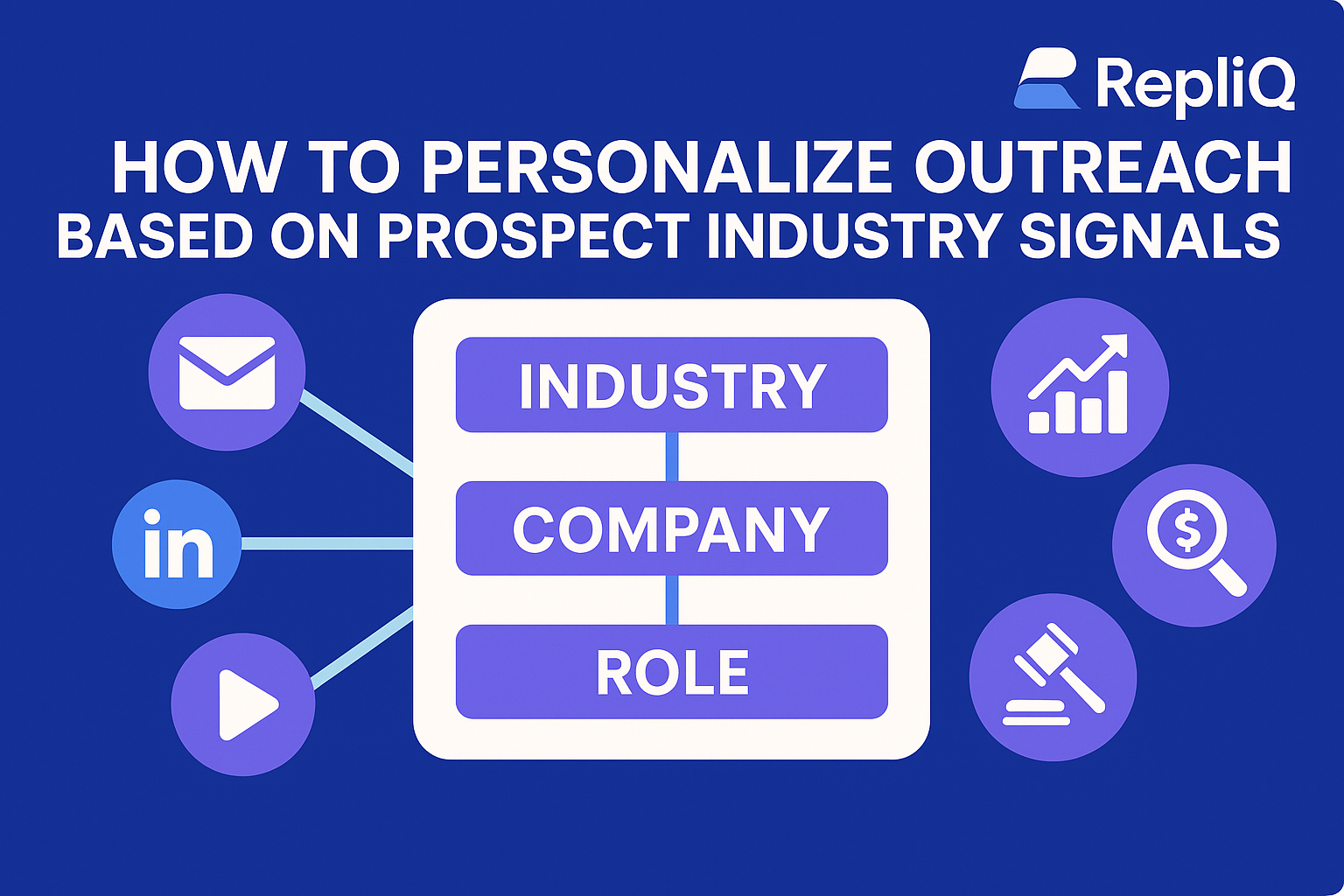
Not all prospect industry signals should be treated equally. To build highly relevant campaigns, you must understand the three-layer framework:
- Industry signals: Macro shifts affecting an entire vertical (e.g., new federal data privacy regulations impacting all fintechs).
- Company signals: Account-level changes (e.g., a specific fintech company securing Series B funding).
- Role signals: Stakeholder-specific priorities (e.g., the VP of Compliance at that fintech needing to overhaul data governance).
The most effective persona-based outreach combines one strong industry signal with one company or role-level insight. This layered approach solves the problem of noisy data and shallow personalization. Furthermore, B2B purchasing is rarely single-threaded; tailoring these layered signals to multiple stakeholders is critical, as supported by research on B2B buying groups.
Common Signal Types Worth Tracking
When executing vertical targeting, the best buyer intent signals are observable and recent. Here are common sales triggers by industry worth tracking:
- Hiring patterns: A surge in engineering hires indicates product expansion; a spike in sales hires signals a push for revenue growth.
- Funding rounds: Fresh capital usually comes with aggressive growth targets and pressure to scale efficiently.
- Product launches: Indicates a need for go-to-market support, demand generation, or customer onboarding infrastructure.
- Partnerships: Reveals strategic shifts, new market access, or integration priorities.
- Compliance or regulatory changes: Creates immediate operational friction, urgency, and risk-mitigation needs.
- Tech stack shifts: Adopting or dropping enterprise software signals changing operational workflows.
- Expansion into new markets: Introduces localization, staffing, and logistical challenges.
- Customer segment changes: Moving from SMB to Enterprise implies a need for more robust, secure, and scalable solutions.
To ground your vertical context in real market movement, look to authoritative baseline data. Resources like the BLS industry statistics overview and U.S. business formation data by industry provide reliable macro trends to inform your industry-level trend spotting.
Persona Personalization vs. Industry Personalization
Understanding persona personalization vs industry personalization is vital for crafting compelling messages.
Persona personalization focuses on the individual: their role, daily tasks, personal KPIs, and common objections. Industry personalization focuses on the environment shaping those goals. For example, a CFO's goal is always to manage cash flow (persona). But a CFO in a logistics company dealing with sudden supply chain tariffs faces entirely different cash flow pressures than a CFO at a SaaS company navigating a software buying slowdown (industry).
Campaigns that stop at job-title-level messaging underperform because they lack environmental context. Combining both creates highly personalized outreach and industry-specific messaging that resonates deeply in cold emails and LinkedIn touches.
How to Map Signals to Pain Points and Buyer Roles
A signal is just a piece of data. It is not useful until you infer its likely impact, urgency, and stakeholder relevance. The goal of account-based personalization is not to list your research findings, but to identify the business implications behind the buyer intent signals. Here is how to map industry events to prospect pain points.
From Signal to Business Impact
To turn prospect research signals into compelling industry-specific messaging, follow this four-step sequence:
- Identify the signal: Notice an observable change.
- Infer the likely business change: Deduce what this means internally.
- Translate into a pain point: Identify the friction this change causes.
- Connect to your solution: Position your offering as the remedy.
Examples of inferences:
- Hiring surge → Scaling pressure → Need for faster onboarding → Your training software.
- Compliance change → Risk and process friction → Need for secure data handling → Your compliance automation tool.
- Funding round → Pressure to grow efficiently → Need for predictable pipeline → Your lead generation service.
Weak Inference: "I saw you just raised $10M, so you probably have budget for our software."
Strong Inference: "I saw you just raised $10M. Usually, that means aggressive targets for the sales team and pressure to decrease ramp time for new reps." This is the core of effective sales outreach personalization.
How Buyer Role Changes the Message
The exact same industry signal must be framed differently depending on who is reading the message. Role-based adaptation dramatically improves first-touch relevance in personalized outreach.
Use this mini-framework when targeting buyer roles:
- What this role cares about: Their primary KPI.
- What risk they are likely managing: Their biggest fear regarding the signal.
- What outcome they want: How they want the situation resolved.
Example (Signal: New Data Privacy Law):
- Sales Leader: Cares about pipeline. Risk: Outreach slows down due to compliance checks. Outcome: A compliant way to keep prospecting at scale.
- Operations Leader: Cares about efficiency. Risk: Manual data auditing drains team hours. Outcome: Automated compliance workflows.
Why Buying Groups Matter in B2B Outreach
In modern B2B environments, industry pain points ripple across departments, affecting multiple stakeholders in unique ways. This shifts vertical sales prospecting strategies from a "one message fits all" approach to a "same signal, different stakeholder angle" methodology.
Account-based personalization requires multithreaded outreach. If you only email the CEO, you miss the operational buyers. Tailoring your outreach to address the distinct concerns of the entire buying committee is essential, as highlighted by research on B2B buying groups.
A Prioritization Framework for First-Touch Outreach
A common pitfall in signal-based selling is over-researching and under-prioritizing. Reps find ten interesting facts and cram them all into one email. To master industry personalization outreach, you must know what industry signals you should use for sales outreach and which to leave out.
The Relevance × Specificity × Recency × Credibility Model
Because signal data is noisy and hard to use in messaging, apply the RSRC scoring model (1–5 scale for each) to filter how to identify meaningful industry-specific triggers:
- Relevance (1-5): Does the signal clearly connect to the prospect’s likely priorities and your solution?
- Specificity (1-5): Is it specific enough to sound thoughtful, or is it a generic observation ("the market is changing")?
- Recency (1-5): Did this happen in the last 30-90 days, making it timely enough to matter now?
- Credibility (1-5): Is it based on an observable, defensible fact rather than a guess?
Strong prospect industry signals for first-touch outreach usually score a 4 or 5 on at least three of these dimensions.
Which Signals Deserve Mention in the First Message
First-touch outreach should feature one primary signal and one inferred implication. It is not a book report.
- When to use an Industry-level signal first: When a macro shift is actively disrupting their specific micro-vertical (e.g., a new FDA regulation in medical device manufacturing).
- When to use a Company-level signal first: When the account has a major, recent trigger event (e.g., they acquired a competitor last week).
- When to use a Role-level signal first: When the individual just changed jobs or posted a specific thought leadership perspective.
Always favor micro-vertical nuance over broad industry labels. "B2B SaaS" is too broad; "Bootstrapped PLG SaaS" is a specific vertical targeting strategy that enables precise industry-specific sales outreach.
Generic vs. Strong Signal-Based Openers
Let's compare openers to see why demonstrating context and implied understanding wins in cold email personalization and sales outreach personalization.
- Generic Opener: "I hope this email finds you well. We help companies in your industry scale their revenue." (Ignored)
- Persona-Only Opener: "As a VP of Sales, I know you are focused on hitting quota this quarter." (Slightly better, but still generic and obvious).
- Industry-Signal-Based Opener: "Noticed your recent expansion into the European market. Usually, when logistics teams spin up EU operations, managing cross-border customs data becomes a massive bottleneck." (Highly relevant, shows industry-specific messaging).
For more deep dives into outreach teardowns and tactical personalization examples, check out our resources here: https://repliq.co/blog.
Industry-Specific Examples by Niche
To make this framework actionable, here is how to apply niche targeting and industry-specific sales outreach across different verticals. This answers the common question: which signals are best for SaaS agencies recruiting and e-commerce companies?
SaaS
SaaS outreach personalization relies heavily on growth and product metrics.
- Common Signals: Series funding, product launches, pricing model shifts, or transitions toward Product-Led Growth (PLG).
- Likely Pain Points: Pipeline quality, user activation, churn rates, and expansion pressure.
- Buyer Roles: VP Sales (cares about pipeline), Head of Growth (cares about activation), Customer Success (cares about churn).
- Example Angle (Email to VP Sales): "Saw the recent Series B announcement and the push toward enterprise features. Typically, moving upmarket means reps struggle to build pipeline because their old SMB messaging falls flat. Is adapting your outbound motion a priority right now?" These prospect industry signals drive account-based personalization.
Staffing and Recruiting
Vertical sales prospecting strategies in recruiting require understanding labor market dynamics.
- Common Signals: Hiring spikes in specific sectors, seasonal demand shifts, new market entry, or recruiter headcount expansion.
- Likely Pain Points: Speed-to-fill, candidate quality, recruiter productivity, and client acquisition.
- Buyer Roles: Agency Founders, Head of Talent Acquisition.
- Example Angle (LinkedIn to Founder): "Noticing a massive spike in demand for travel nurses in the Midwest. With speed-to-fill being critical right now, how is your team automating initial candidate screening to beat competing agencies to the punch?" This industry-specific messaging leverages urgency naturally.
Agencies
Agency outreach personalization requires understanding client churn and operational overhead.
- Common Signals: Client niche pivots, service expansion (e.g., adding TikTok ads), team growth, or rebranding.
- Likely Pain Points: Client retention, market differentiation, reporting burdens, and inconsistent pipeline.
- Buyer Roles: Founders, Client Service Leaders, Growth Leads.
- Example Angle (Personalized Video to Founder): Record a brief personalized video outreach showing their new service page. "Loved the new rollout of your specialized SEO services for DTC brands. Usually, adding a new service line creates a massive reporting bottleneck for account managers. We built a way to automate that..." This execution proves niche targeting visually.
Healthcare
Healthcare outreach requires extreme care. Emphasize compliance, trust, and operational efficiency over hype.
- Common Signals: Compliance shifts, Medicare reimbursement changes, provider network expansion, or staffing shortages.
- Likely Pain Points: Operational burden, compliance risks, patient workflow efficiency.
- Buyer Roles: Operations Directors, Compliance Officers, Practice Managers.
- Example Angle (Email to Ops Director): "With the upcoming changes to telehealth billing codes, practice managers often face a sudden spike in claim denials. We help practices automate code verification prior to submission to protect cash flow." This strictly utilizes observable compliance changes for industry-specific sales outreach.
Fintech
Fintech personalization is highly sensitive to risk and regulation.
- Common Signals: Regulatory updates, banking-as-a-service partnerships, funding, and changing fraud priorities.
- Likely Pain Points: User onboarding friction, compliance audits, fraud mitigation, and customer acquisition costs.
- Buyer Roles: Product Leaders, Compliance Heads, Revenue Leaders.
- Example Angle (Email to Head of Product): "Noticed your recent partnership to offer embedded lending. Balancing a frictionless user onboarding experience with strict KYC compliance is usually the biggest hurdle in rollout. How are you currently verifying identities without dropping conversion rates?" Prospect industry signals and buyer intent signals are perfectly aligned here.
E-commerce
E-commerce outreach thrives on operational and marketing scale.
- Common Signals: Catalog expansion, seasonal campaign launches, new channel launches (e.g., TikTok Shop), or international fulfillment expansion.
- Likely Pain Points: Cart conversion, customer retention, rising acquisition costs, creative fatigue, and fulfillment logistics.
- Buyer Roles: E-commerce Directors, Supply Chain Managers, Head of Performance Marketing.
- Example Angle (Email to Head of Marketing): "Seeing your catalog expand into winter apparel ahead of Q4. Managing creative fatigue across that many new SKUs is usually a massive drain on design resources." To see how niche-specific outreach adapts across verticals, explore our practical applications here: https://repliq.co/use-cases. This level of vertical targeting elevates sales outreach personalization.
How to Scale Personalization with Video and AI-Assisted Workflows
Gathering signals manually is powerful but slow. To scale industry-specific personalization without losing relevance, teams must bridge strategy with execution using AI-assisted prospect research and personalized video outreach.
Manual Research vs. AI-Assisted Research
Doing too much manual research for outbound sales limits your volume. AI should be used to surface, organize, and draft against prospect research signals—but it should never replace human judgment regarding relevance.
A successful workflow involves using AI to scrape legal, publicly accessible data (like press releases or hiring pages) to flag trigger events. Reps then validate these high-value signals before deploying them. When integrating these tools, adherence to ethical automation is critical. Teams should consult guidelines like the NIST AI Risk Management Framework to ensure responsible AI use and governance in personalization workflows. Furthermore, recognizing practical barriers to AI adoption ensures your processes remain realistic and grounded, a concept supported by OECD research on SME AI adoption.
Adapting Industry Signals Across Email, LinkedIn, and Video
The same signal must be expressed differently depending on the channel:
- Email: Focus on concise relevance and curiosity. (Cold email personalization)
- LinkedIn: Focus on context and conversational credibility. (LinkedIn outreach)
- Video: Focus on a fast demonstration of understanding and specificity. (Video outreach personalization)
Personalized video is exceptionally effective for translating niche context into a memorable first impression. A brief video showing you reviewing their recent product launch press release visually proves you have done your homework, cutting through the noise faster than text alone. RepliQ serves as the execution layer for turning these industry signals into highly engaging video flows. Learn more about operationalizing this here: https://repliq.co/use-cases.
Building Reusable Niche Playbooks
To scale, build repeatable playbooks by micro-vertical. Playbooks drastically reduce research time while preserving industry-specific messaging and sales outreach personalization.
A standard niche playbook should include:
- Top signals to watch in that vertical.
- Common pain points tied to those signals.
- Buyer-role messaging angles.
- Channel-specific templates (Email, LinkedIn, Video scripts).
- Approved proof points, case studies, and compliance-checked claims.
By standardizing the framework rather than the message, you achieve true niche targeting at scale. Discover more on building and refining these workflows here: https://repliq.co/blog.
Tools, Resources, and Operational Checklist
To move from theory to execution in industry personalization outreach, you need a minimum viable system. Use this checklist to operationalize your vertical sales prospecting strategies and streamline account research for outbound sales:
- [ ] Pick target verticals: Select 2-3 specific micro-verticals to focus on.
- [ ] Define top signals: Identify 3-4 observable, public triggers for each vertical.
- [ ] Map signals to roles: Document how the CEO, Ops, and Sales leaders view that signal differently.
- [ ] Build first-touch variants: Draft email, LinkedIn, and video templates leaving placeholders for the specific signal.
- [ ] Test by segment: Launch campaigns grouped by industry signal, not just by job title.
- [ ] Review quality: Measure success by reply quality and meeting booked rate, not just open rates and send volume.
Future Trends in Industry-Specific Outreach
The landscape of signal-based outbound is evolving rapidly. Future winners will not just gather more signals; they will interpret the right signals faster and translate them into sharper outreach.
Key trends include:
- AI-assisted message generation: Tools that instantly map a public vertical event to a specific value proposition.
- Micro-vertical messaging: Moving away from "Healthcare" and targeting "Pediatric Telehealth Providers dealing with compliance shift X."
- Cross-channel personalization: Seamlessly weaving the same industry signal through an email, a LinkedIn voice note, and a personalized video outreach.
Generic sequencing and variable-based automation (just swapping {{Company}}) are dead. The future belongs to micro-vertical messaging.
Conclusion
Better outreach comes from understanding not just who the buyer is, but what their industry context is signaling right now. By moving away from generic templates and adopting the three-layer framework—industry signals, company signals, and buyer-role signals—you position yourself as a trusted advisor rather than a spammer.
The process is highly repeatable: identify observable signals, map them to business impact, prioritize what deserves mention using the RSRC model, adapt the message by channel, and scale the execution with playbooks, AI assistance, and personalized video.
Stop relying on shallow personalization. Transition toward niche-specific frameworks that are reusable, compliant, and highly relevant. To see how you can operationalize how to personalize outreach based on prospect industry signals, explore RepliQ’s structured approach to turning industry-specific sales outreach and personalized video outreach into scalable, high-converting workflows.
FAQ
How do you personalize outreach based on a prospect’s industry?
To execute industry personalization outreach, reps should identify a relevant, public industry signal, infer its likely business impact, connect it to the specific buyer’s role, and reflect that insight in a concise first-touch message. This answers exactly how to personalize outreach based on prospect industry signals.
What industry signals should you use for sales outreach?
When deciding what industry signals should you use for sales outreach, look for observable prospect industry signals like hiring trends, funding rounds, compliance changes, partnerships, product launches, and customer segment shifts. Ensure you only use signals that are timely, specific, and relevant to your solution.
How can niche targeting improve cold outreach response rates?
Generic outreach low reply rates occur because messages lack context. Niche targeting improves perceived relevance because the messaging reflects specific vertical pain points, daily workflows, and actual business realities, making the prospect feel understood immediately.
How much personalization is enough for top-of-funnel outreach?
For effective cold email personalization and sales outreach personalization, one strong industry or company signal plus one role-relevant implication is usually enough. Overloading your first-touch outreach with too much research can dilute your core message and reduce clarity.
How can personalized video be adapted by industry segment?
If you are wondering how can personalized video be adapted by industry segment, the key is modularity. The core structure of your video outreach personalization remains the same, but you change the visual background (e.g., their specific press release), the industry context, the signal reference, and the buyer-role framing to fit each niche precisely.

.svg)
.png)


.svg)