
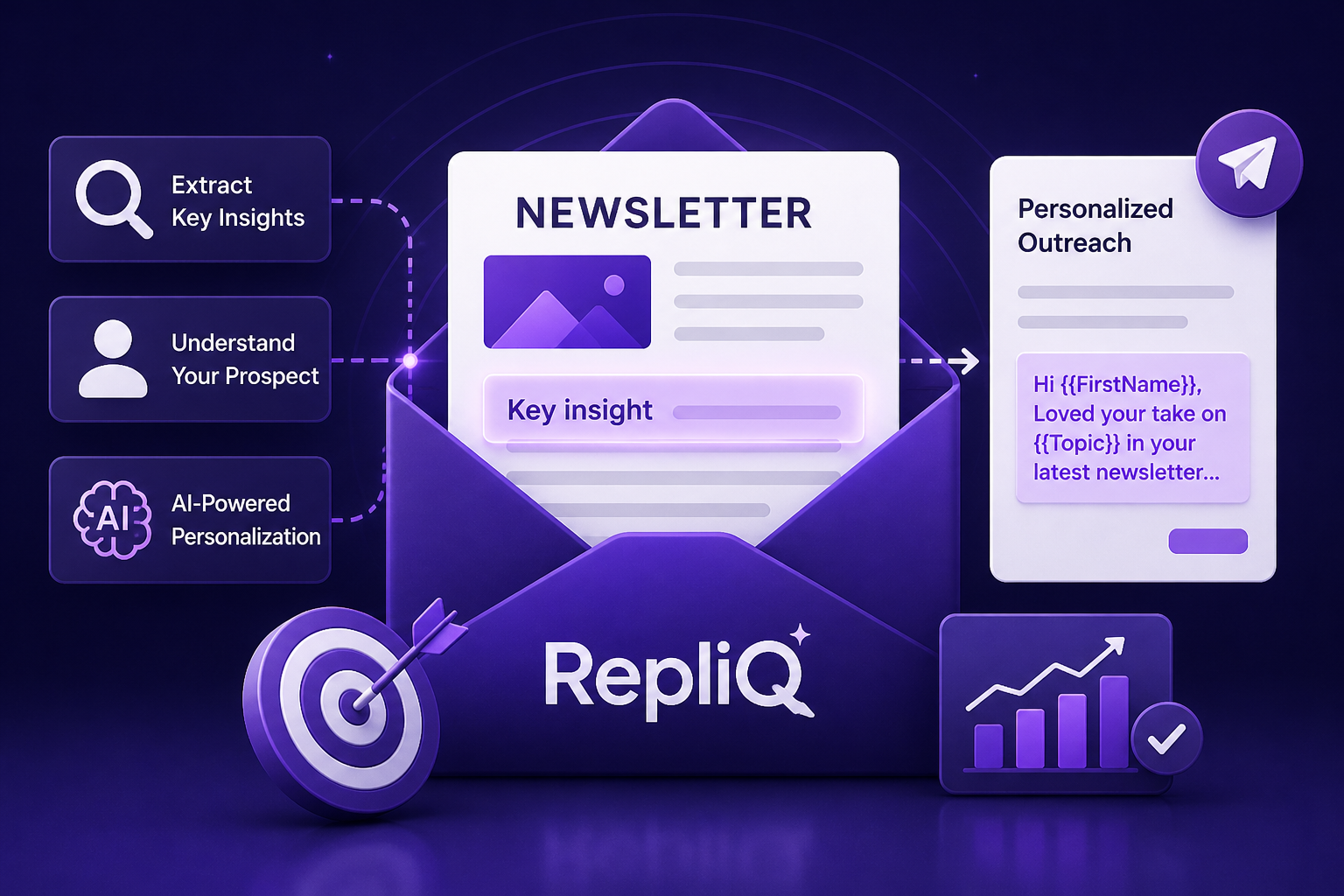
Newsletter Personalization for More Relevant Cold Outreach
Generic cold outreach suffers from a predictable flaw: it relies on surface-level compliments and basic firmographics that could apply to almost any prospect. Opening an email with "I saw your company recently won an award" or "I love what you are doing in the SaaS space" no longer captures attention. Today’s buyers expect relevance, not just observation. This is where a prospect’s newsletter becomes an invaluable asset.
As a public, first-party source of information, a newsletter provides a direct window into a company’s current priorities, campaigns, market positioning, terminology, and calls to action. Unlike static website copy, a newsletter reveals what a prospect cares about right now.
This article will show you how to review newsletter content, identify a relevant business signal, and turn it into a credible cold outreach opening. The goal of newsletter personalization is not to mention every detail you discover or prove you read the entire archive. Instead, it is to find one useful observation that supports a clear, logical reason for contacting the prospect.
By following a structured workflow—research, interpret, verify, write, quality-check, and scale—you can transform public data into meaningful conversations. This methodology relies entirely on publicly available information; a newsletter observation does not prove a prospect’s private internal priorities, but it does provide a highly educated starting point. For teams looking to streamline this process, RepliQ serves as an excellent resource for turning prospect research into relevant outreach language.
Why Newsletters Are Useful for Cold Email Personalization
When executing prospect research for sales outreach, firmographic data (like company size or industry) and role-based assumptions only provide a baseline. Newsletters offer far stronger context because they contain observable, timely signals directly from the prospect or their organization.
By analyzing a prospect’s newsletter, you can uncover observable signals such as:
- Current campaigns, recent announcements, and active initiatives.
- Repeated editorial themes, industry perspectives, or strong opinions.
- Product, service, or feature launches.
- Customer stories, implementation examples, and specific use cases.
- Industry perspectives and exact positioning language.
- Offers, upcoming events, and specific calls to action.
However, there is a critical distinction between a superficial newsletter mention and genuine insight. Simply stating, “I enjoyed your recent newsletter,” is a weak personalization tactic. It proves you know the newsletter exists, but it fails to connect that fact to your reason for reaching out. True cold email personalization requires identifying a specific idea within the newsletter and bridging it to the value you offer.
Newsletter-based prospect research is often more useful than scanning a generic company website or social profile when certain conditions are met: the newsletter is recent, the prospect publishes consistently, the content directly relates to your offer, and the issue contains a clear business context.
Broad personalization advice often starts and ends with a name, job title, or generic company description. In contrast, a focused newsletter workflow uses real-time, public business communication to inform your outreach. It is important to remember that newsletters are just one research source. They are public broadcasts—not definitive proof of a buyer’s private intent or a substitute for core message relevance.
The Difference Between Mentioning a Newsletter and Demonstrating Insight
There is a vast difference between simply acknowledging a newsletter and actually leveraging its content for personalized email opening lines.
A weak approach looks like this: “I saw you publish a newsletter and really loved the latest issue.”
A strong approach demonstrates insight: “Your recent issues repeatedly focus on reducing customer churn through onboarding, which relates to the user-adoption challenges we help SaaS teams solve.”
A useful reference contains three elements: an observable detail, a relevant interpretation of why that detail matters, and a natural transition to your pitch. You must actively avoid exaggerated praise, vague compliments, or bold claims about the prospect’s internal strategy that the newsletter does not explicitly support. Proceed with cautious hypotheses based strictly on newsletter content analysis.
What to Look for When Researching a Prospect’s Newsletter
Conducting prospect newsletter research requires discipline. Without a lightweight extraction checklist, you risk falling down a rabbit hole of irrelevant information. To maximize efficiency, always review the most recent issues first. Then, check whether a specific theme appears repeatedly across multiple editions, as recurring signals are generally more useful and reliable than isolated, one-off details.
When performing newsletter content analysis, organize the signals you find into the following highly actionable categories:
- Current priorities: Look for recurring topics, strategic initiatives, or industry problems the prospect consistently discusses.
- Campaigns and launches: Note any product announcements, upcoming events, special offers, new reports, or partner programs.
- Positioning language: Pay attention to the exact phrases the company uses to describe its market, ideal customers, differentiators, or unique approach.
- Customer evidence: Extract mentions of case studies, testimonials, customer outcomes, and real-world implementation examples.
- Calls to action: Identify what the prospect wants their readers to do next—whether that is booking demos, downloading guides, registering for webinars, or starting product trials.
- Content preferences: Determine if the newsletter leans heavily toward educational, opinion-led, product-led, community-led, or industry-focused themes.
To ensure accuracy when drafting your email, always record the issue date, the exact headline, the relevant passage (verbatim), and the source URL. This ensures your newsletter research for sales is grounded in verifiable facts rather than vague recollections.
A Newsletter Signal Checklist
Use the following practical checklist to evaluate newsletter signals before using them in your outreach personalization tactics. Always preserve the original wording and issue date so references can be accurately checked.
| Signal Type | Evidence from Newsletter | Possible Business Relevance | Confidence Level | Potential Outreach Connection | Do Not Use If... |
|---|---|---|---|---|---|
| Recurring Theme | 3 of the last 4 issues discussed "data privacy." | Compliance is a current marketing focus. | High | Connect to our secure hosting solution. | It is a generic industry observation. |
| Product Launch | Dec 12 issue announced "Feature X." | Expanding into a new user demographic. | High | Highlight our user-adoption tool. | The launch is over a year old. |
| Customer Story | Nov 5 issue highlighted a retail case study. | Pushing deeper into the retail sector. | Medium | Share a relevant retail framework. | The detail cannot be verified. |
| Call to Action | Every issue ends with a webinar signup. | Lead gen relies heavily on live events. | High | Pitch our webinar attendance software. | The link is broken or inactive. |
How Recent Should a Newsletter Reference Be?
When utilizing prospect research for sales outreach, recency is a critical factor—especially for campaign announcements, launches, offers, events, and time-sensitive priorities. Referencing an upcoming webinar makes sense; referencing a webinar from three years ago shows a lack of attention.
However, you must distinguish between recent signals and durable signals. Recent announcements (like a new product feature) support a timely, urgent message. Conversely, repeated positioning themes (like a commitment to sustainability) are durable and may remain useful for much longer. As a rule of thumb for personalized cold outreach, old campaigns and expired offers should be excluded. If a detail’s relevance or current status cannot be confirmed, omit it entirely.
How to Turn a Newsletter Observation Into a Relevant Opening Line
Finding the right data is only half the battle; the other half is writing personalized email opening lines that convert. To do this, rely on a core conversion framework:
Observation → Interpretation → Relevance → Value → Low-friction CTA
Here is how each stage functions within your email:
- Observation: State clearly and neutrally what the prospect actually published in their newsletter.
- Interpretation: Form a cautious, logical hypothesis about why that specific topic might matter to their business right now.
- Relevance: Connect their published topic directly to your specific reason for reaching out.
- Value: Offer a useful idea, framework, resource, or potential outcome rather than immediately forcing a hard product pitch.
- CTA: Ask for a simple, low-friction next step that is appropriate for the context of a cold conversation.
Your opening should move quickly from research to relevance. You want to mirror the prospect’s terminology to show alignment, but avoid copying excessively or sounding artificial. Most importantly, use one strong, clear signal. Combining multiple unrelated references makes the email feel cluttered and desperate. For more examples of this formula in action, explore RepliQ’s personalized lines resource to see how cold email personalization examples are structured for maximum impact.
Weak Versus Strong Newsletter Personalization
Understanding how to personalize cold emails requires looking at before-and-after cold email personalization examples.
Weak: "Hi [Name], I saw you publish a newsletter and I loved your recent issue. It was a great read! Anyway, we sell [Product]..."
Why it fails: It relies on generic praise, offers no specific insight, and provides no logical reason for contacting the prospect.
Stronger: "Hi [Name], I noticed your last three newsletters heavily emphasized moving mid-market clients to annual contracts. Assuming retention is a major priority this quarter, I wanted to share a framework we use to..."
Why it succeeds: This personalized outreach opening line is specific, verifiable, and connected to the sender’s value proposition. It is respectful, forms a cautious business hypothesis, and avoids overly familiar or fake praise.
How Much Newsletter Content Should You Reference?
When executing newsletter personalization, focus on one central observation in your opening. Unless multiple details clearly and undeniably support the exact same point, stick to a single focal point. Summarizing an entire newsletter can make the message feel like it was researched merely for research’s sake, which comes across as performative. Instead, use concise attribution—such as mentioning the specific issue date or the core article topic—to improve your credibility while keeping the email brief and focused on the personalized cold outreach goal.
Newsletter-Informed Cold Outreach Examples
To effectively use newsletter personalization, you must adapt your approach based on the specific type of signal you uncover. Below are illustrative templates for various scenarios. Remember that these are frameworks; a public signal does not confirm an internal business priority, so always frame your outreach as a cautious hypothesis.
Scenario 1: A Recent Article or Point of View
- Newsletter Signal: The prospect wrote an editorial about the challenges of remote team alignment.
- Outreach Hypothesis: They are actively looking for better asynchronous communication methods.
- Personalized Opening Line: "Your recent newsletter piece on the friction of remote team alignment stood out."
- Transition to Value: "Since asynchronous communication seems to be top of mind, I wanted to share how we help distributed teams cut meeting times in half."
- Concise CTA: "Worth a quick look?"
Scenario 2: A Product or Service Announcement
- Newsletter Signal: The company newsletter announced a new integration with a major CRM.
- Outreach Hypothesis: They are trying to move upmarket by appealing to enterprise CRM users.
- Personalized Opening Line: "I saw in your November 12th issue that you just rolled out the new Salesforce integration."
- Transition to Value: "Teams usually launch these integrations to attract upmarket clients, which often requires a shift in sales enablement. We provide enterprise enablement playbooks..."
- Concise CTA: "Open to seeing a quick breakdown of how it works?"
Scenario 3: A Customer Story or Use Case
- Newsletter Signal: The newsletter highlighted a case study of a logistics client saving 20% on shipping.
- Outreach Hypothesis: They are actively targeting the logistics sector.
- Personalized Opening Line: "Noticed your recent newsletter breakdown of how you helped [Client Name] reduce shipping costs by 20%."
- Transition to Value: "If expanding further into the logistics sector is a priority this quarter, our lead routing tool can help you identify high-intent logistics accounts faster."
- Concise CTA: "Would you be opposed to a brief chat next week?"
Complete Cold Email Structure Example:
- Subject line: Thoughts on your logistics case study
- Personalized opening: Hi [Name], I noticed your recent newsletter breakdown of how you helped [Client Name] reduce shipping costs by 20%.
- Relevant transition: If expanding further into the logistics sector is a priority this quarter, you might be looking for ways to capture more of that specific demand.
- Value proposition: We help supply-chain tech companies identify high-intent logistics accounts visiting their site, allowing sales to engage before competitors do.
- Supporting context: We recently helped [Similar Company] increase their logistics pipeline by 15%.
- Low-friction CTA: Open to a quick 5-minute video showing how it works?
- Sign-off: Best, [Your Name] (Include clear opt-out language below signature if required).
Subject Lines Based on Newsletter Research
A personalized subject line should reference a specific newsletter theme without resorting to clickbait. Prioritize clarity over excessive cleverness or false urgency. Effective cold email personalization subject-line patterns include:
- A concise reference to a recent topic: Your newsletter on remote alignment
- A question connected to the observed theme: Question regarding your CRM integration
- A useful follow-up to a newsletter idea: Follow-up: Logistics lead generation
Quality Control: Staying Relevant, Accurate, and Non-Intrusive
Broad, automation-first approaches often underemphasize quality control, leading to awkward or inaccurate emails. Newsletter content analysis requires a strict pre-send scoring rubric to ensure source verification, freshness, attribution, and human judgment are applied to every personalized cold outreach message.
Run your drafts through this checklist:
- Relevance: Does the observation directly support your reason for contacting this prospect?
- Specificity: Is the reference concrete rather than generic praise?
- Freshness: Is the content recent or still clearly relevant?
- Accuracy: Does the draft reflect what the newsletter actually said?
- Attribution: Can the prospect easily recognize the referenced issue or topic?
- Respect: Does the message completely avoid personal or sensitive details?
- Value: Does the email offer a useful, relevant reason to continue the conversation?
You should omit a newsletter observation entirely if it is unrelated to your offer, tied to an expired campaign, requires an unsupported or wild assumption, makes you sound intrusive, or is difficult to verify. Always use transparent wording such as, “Your recent issue discussed…” rather than aggressively asserting, “You are currently prioritizing…” unless the prospect explicitly stated that priority. Furthermore, if you use AI tools to assist with summarization or drafting, human review is absolutely mandatory before hitting send.
Compliance and Responsible Use of Public Newsletter Content
The fact that a newsletter is publicly available does not remove the need for responsible prospect research and compliant outreach practices. Responsible cold email compliance means adhering to legal frameworks governing commercial messaging.
Your outreach must include accurate sender and subject-line information, clear identification of who you are, and a valid, easy-to-use opt-out or unsubscribe process. You must respect unsubscribe requests immediately and handle personal versus corporate email recipients according to applicable laws.
For U.S. commercial email requirements, strictly follow the FTC CAN-SPAM compliance guide. For guidelines concerning consent, corporate versus individual recipients, and electronic marketing requirements in the UK, adhere to the ICO electronic marketing rules.
How to Scale Newsletter Research Without Making Outreach Robotic
Scaling newsletter research for sales requires a repeatable workflow that marketing and sales teams can apply consistently without losing the human touch. This sales prospecting research workflow ensures scalable personalization:
- Locate the prospect’s newsletter archive or public signup/content page.
- Review recent issues and identify recurring themes or major announcements.
- Capture the exact evidence, issue dates, and source URLs.
- Score each signal for relevance, freshness, specificity, and confidence.
- Select the single strongest observation.
- Connect it to a cautious business hypothesis and your outreach offer.
- Draft the email using a consistent, proven structure.
- Complete a human review for tone, accuracy, and compliance before sending.
To keep this organized, maintain a simple research record with fields for: Prospect Name, Company, Newsletter URL, Issue Date, Key Topic, Exact Evidence, Possible Relevance, Draft Opening Line, and Review Status.
While AI can assist with summarization, categorization, and generating a first draft, human judgment is strictly required for determining relevance, ensuring accuracy, checking for sensitivity, and giving final approval. For more guidance on building a repeatable research-to-message workflow, visit RepliQ’s blog.
A Reusable Prompt or Brief for Newsletter Analysis
To leverage AI-assisted prospect research effectively, use a structured prompt framework for your newsletter content analysis. Ask your AI system to:
- Summarize the core themes of the last 3-5 newsletter issues.
- Extract concrete product announcements, events, and calls to action.
- Separate repeated, durable signals from one-off details.
- Quote the exact evidence and include issue dates.
- Suggest 2-3 cautious outreach hypotheses bridging the theme to [Your Value Proposition].
- Flag any claims or assumptions that require human verification.
Crucially, instruct readers and prompt users never to let the AI tool invent newsletter content, internal priorities, or business outcomes. AI-generated summaries must always be checked against the original newsletter source before use in any personalized outreach workflow.
Measuring Whether Newsletter Personalization Improves Outreach Quality
When evaluating newsletter personalization, focus on measurable process and message-quality indicators rather than promising guaranteed revenue results. Track the percentage of drafts that contain a verifiable source, the percentage of references that pass the relevance checklist, and the average review and editing time per prospect.
On the performance side of cold email performance, monitor positive replies or useful conversations (where your team has appropriate tracking), as well as unsubscribe or negative feedback patterns. Compare newsletter-informed personalized outreach tactics against generic or profile-based personalization only when the test is designed fairly, variables are isolated, and the team can interpret the results responsibly.
Email Trust and Authentication Basics
Relevant, highly personalized copy is only one part of trustworthy email outreach; if your message lands in spam, the personalization is wasted. Ensure your sender-domain authentication (SPF, DKIM, DMARC) is properly configured. For comprehensive standards on email authentication and cold email deliverability practices, refer to the NIST trustworthy email guidance.
A Practical Newsletter Personalization Checklist
Before sending any prospect newsletter research-based email, run it through this standalone checklist to ensure your personalized cold outreach hits the mark. You can easily save this and repurpose it into a team SOP:
- [ ] Did I use a public and verifiable newsletter source?
- [ ] Is the issue recent or the theme demonstrably recurring?
- [ ] Did I identify one concrete, specific signal?
- [ ] Is the observation logically connected to my reason for reaching out?
- [ ] Did I avoid claiming knowledge of their private internal priorities?
- [ ] Does the opening sound natural and conversational when read aloud?
- [ ] Did I move quickly from the observation to the value proposition?
- [ ] Is the call to action simple, low-friction, and appropriate?
- [ ] Did I manually verify all facts, dates, and links?
- [ ] Does the message meet all applicable outreach and opt-out compliance requirements?
The Final Decision:
- Send the reference when it is relevant, accurate, current, and useful to the conversation.
- Skip the reference when it is merely interesting but entirely unrelated to your outreach goal.
For teams looking to operationalize this newsletter personalization checklist, RepliQ is a practical option for building a repeatable, high-quality research-to-message workflow.
Conclusion — Use Newsletters to Make Outreach More Contextual, Not More Complicated
Effective newsletter personalization is not about adding more variables to your cold email process or doing research for the sake of looking busy. It is about utilizing one meaningful piece of public context to make your outreach genuinely useful to the recipient.
The process is straightforward: find a recent or recurring newsletter signal, preserve the evidence, and verify the source. Translate that observation into a cautious business hypothesis, and connect it directly to a relevant offer or your reason for contacting the prospect. Keep the reference concise, respectful, and focused. Finally, always review the message for relevance, accuracy, compliance, and tone before sending.
By grounding your personalized cold outreach in actual, real-time newsletter-based prospect research, you elevate your message above the noise of generic firmographic compliments. Apply the checklist provided above to your next prospect, and compare the quality of the resulting message with a generic opening. To take the next step in drafting stronger, more contextual openings, explore the RepliQ personalized lines resource and start building a more repeatable, effective outreach workflow today.
FAQ: Newsletter Personalization for Cold Outreach
How can I use a prospect’s newsletter to personalize cold outreach?
You can use prospect newsletter research by following an observation-to-relevance-to-value process. Identify a specific, verifiable detail in their newsletter, form a cautious hypothesis about why it matters to their business, and connect it to the value you provide. Emphasize using one concrete detail rather than attempting to summarize the entire newsletter, which helps you learn how to personalize cold emails effectively without sounding unnatural.
What should I look for when researching a prospect’s newsletter?
During newsletter content analysis, look for recurring themes, recent product announcements, specific positioning language, customer stories, special offers, and clear calls to action. These elements indicate what the company is prioritizing right now. Always remember to record the issue date and the exact source URL so your newsletter research for sales is verifiable and accurate.
How much newsletter content should I mention in a cold email?
You should focus on exactly one relevant observation. While it might be tempting to show off all your research, referencing multiple unrelated details can make the message feel excessive, cluttered, or performative. Effective cold email personalization relies on concise, personalized email opening lines that transition quickly to the business value.
How do I avoid sounding invasive when referencing a newsletter?
To ensure responsible prospect research, strictly use public business content. Avoid sensitive personal details, and never make unsupported assumptions about a prospect's private internal strategies. Attribute your observation naturally (e.g., "I saw in your recent issue...") and move quickly to a useful reason for contacting them. This keeps your personalized cold outreach respectful and professional.
Can AI help scale newsletter-based prospect research?
Yes, AI can assist with scalable personalization by summarizing recent issues, categorizing themes, and generating first drafts. However, AI-assisted prospect research requires strict human verification. A human must always verify quotes, dates, interpretations, and claims to ensure accuracy and prevent the AI from inventing false newsletter content.
When should I avoid using a newsletter reference?
You should exclude any newsletter observation that is outdated, irrelevant to your offer, unverifiable, overly personal, or completely disconnected from your value proposition. In the realm of outreach personalization tactics, remember that no personalization is always better than irrelevant or forced newsletter personalization.
What compliance issues should I consider when using newsletter research for cold email?
Even when using public data, you must adhere to cold email compliance and electronic marketing rules. Ensure your emails have accurate sender identification, non-deceptive subject lines, and a clear opt-out handling process. Always follow regional requirements, such as the FTC guidelines in the U.S. or the ICO rules in the UK, and carefully handle the distinction between corporate and individual recipients.


