.png)
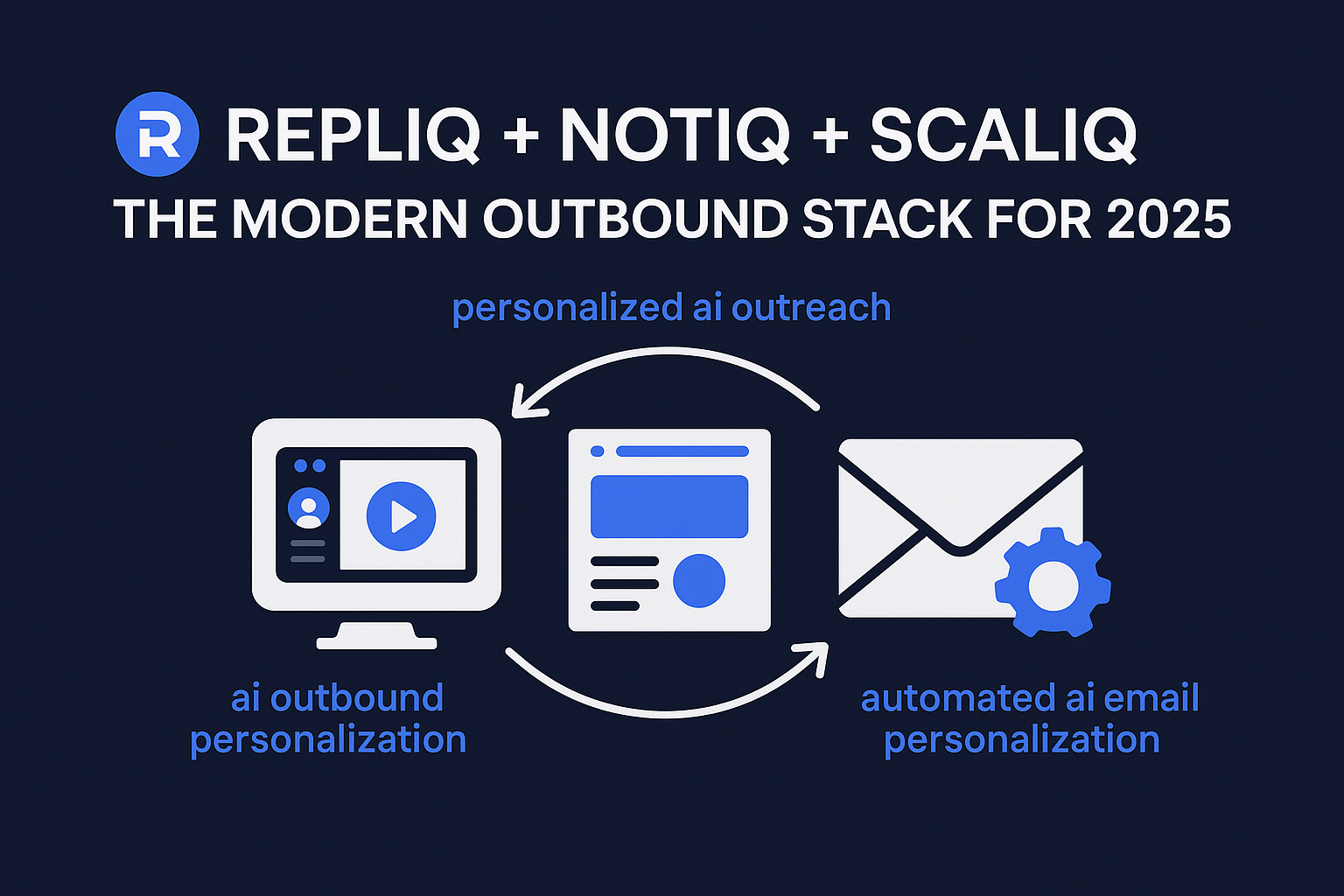
RepliQ + NotiQ + ScaliQ: The Modern Outbound Stack for 2025 — The Most Comprehensive Analysis & Action Plan
Table of Contents
- Introduction
- What Defines a Modern Outbound Stack in 2025
- Why AI‑Driven Personalization Is the New Standard
- How RepliQ, NotiQ, and ScaliQ Work Together as a Unified Ecosystem
- Modern Workflows: Multichannel, Video, and Dynamic Landing Pages
- Metrics, ROI, and When Teams Should Upgrade Their Stack
- Advanced Strategies, Predictions, and 2025 Trends
- Practical Toolkit: Templates, Checklists, and Workflow Blueprints
- Conclusion
- FAQ
Introduction
The era of "spray and pray" is officially over. In 2024, reply rates for generic cold emails plummeted to historic lows, driven by saturated inboxes and increasingly aggressive spam filters. For sales leaders and agencies, the message is clear: the volume-based playbook is dead. The future belongs to those who leverage a modern outbound stack capable of hyper-personalization at scale.
We are witnessing a paradigm shift from linear email sequencing to fully AI-orchestrated personalization. This new standard requires more than just inserting a first name; it demands dynamic video content, personalized landing pages, and intelligent multichannel orchestration.
This analysis explores the unique 3-tool ecosystem—RepliQ + NotiQ + ScaliQ—that is rapidly becoming the backbone of the 2025 outbound strategy. Unlike fragmented legacy tools, this stack unifies creation, orchestration, and execution. According to recent data on AI adoption from Pew Research, businesses utilizing AI for deep customization are seeing significant competitive advantages in communication efficiency.
By integrating RepliQ as the personalization engine early in your workflow, you transform static outreach into dynamic experiences. This guide provides the most comprehensive analysis of how to build, deploy, and scale this modern outreach stack to dominate your market in 2025.
What Defines a Modern Outbound Stack in 2025
A modern outbound stack in 2025 is defined by its ability to move beyond static data and linear sequences. It is a modular ecosystem where distinct AI layers handle specific functions—enrichment, content generation, and delivery—working in unison to simulate human-quality interaction at scale.
For years, the industry relied on "all-in-one" platforms like Apollo or Outreach. While these tools are powerful databases, they often lack the specialized nuance required for deep personalization. As a result, users face fragmented outbound tools, disjointed workflows, and generic messaging that fails to convert.
The shift toward outbound automation 2025 is about modularity. It allows teams to plug in best-in-class engines for specific tasks (like video generation or intent verification) rather than settling for a "jack of all trades" platform that does everything adequately but nothing exceptionally.
As noted in OECD AI policy insights, responsible and precise personalization is critical for maintaining trust in digital ecosystems. A modern stack respects this by prioritizing relevance and data accuracy over sheer volume.
Core Components of a 2025 Outbound Stack
To build a high-performing engine, your stack must include four distinct layers:
- Enrichment Systems: Tools that go beyond email addresses to find intent signals, recent news, and hiring data.
- AI Personalization Layers: Specialized ai outreach tools that generate unique assets (images, videos, text) for every single prospect.
- Orchestration Logic: The "brain" that decides when to send a message and which channel to use based on prospect behavior.
- Multichannel Delivery: The infrastructure for multi-channel outreach ai that ensures high deliverability across Email, LinkedIn, and other platforms.
Why Legacy Approaches Fail in 2025
Legacy approaches rely on volume to compensate for a lack of relevance. The core problem is the "template fatigue" experienced by decision-makers. When a prospect receives 50 emails a week that all follow the same "Quick Question" format, they tune out.
Legacy stacks struggle with low reply rates outbound because they treat every prospect identically. They lack the agility to dynamically swap out a static image for a personalized video or redirect a lead to a custom microsite. In 2025, if your stack cannot adapt the content to the context of the recipient, it is obsolete.
Why AI-Driven Personalization Is the New Standard
Inbox saturation has created a filter mechanism in the human brain: we instantly ignore anything that looks automated. AI outbound personalization is the only reliable way to bypass this filter. It signals to the recipient that you have done your homework, creating a sense of authenticity that static text cannot match.
Scaling this authenticity manually is impossible. This is where scaling personalization outbound via AI becomes essential. By leveraging predictive personalization and intent signals, AI can construct messages that feel hand-written, referencing specific pain points or company news without a human ever typing a keystroke.
Research from Harvard on digital communication highlights that perceived authenticity significantly increases trust and engagement in remote interactions. In an automated world, the technology that feels the most human wins.
The 2025 Personalization Layer: Beyond First‑Name Tokens
The days of {FirstName} being the pinnacle of personalization are gone. The 2025 standard involves:
- Personalized Video Outreach: AI generating unique videos where the speaker addresses the prospect by name and discusses their specific website or LinkedIn profile.
- Dynamic Microsites: Sending a prospect a link to a landing page that is already branded with their company logo, name, and relevant case studies.
- Sentiment-Based Routing: AI analyzing a reply to determine if it’s a hard "no," a "maybe," or a referral, and routing it accordingly.
The ROI of Personalization: 2–5x Engagement Lifts
The investment in outbound engagement ai pays for itself rapidly. Industry benchmarks consistently show that moving from static text to rich media (video + dynamic pages) can lift reply rates by 200% to 500%.
When a prospect sees a video thumbnail with their own website in the background, the click-through rate skyrockets compared to a generic link. This depth of engagement shortens sales cycles and improves the quality of conversations, as prospects enter the call already impressed by the technology and effort demonstrated.
How RepliQ, NotiQ, and ScaliQ Work Together as a Unified Ecosystem
To achieve the level of sophistication described above, you need a stack that integrates creation, coordination, and execution. This is where the RepliQ + NotiQ + ScaliQ ecosystem shines. Together, they answer the question: "how do repliq notiq scaliq work together" to form a seamless modern outreach stack.
This trio adheres to principles found in NIST AI standards regarding modular system architecture, ensuring that data flows safely and efficiently between the generation and execution layers.
RepliQ — AI‑Driven Video and Dynamic Landing Page Personalization
RepliQ is the creative engine. It is responsible for generating the assets that capture attention. Whether it is personalized video outreach or custom images, RepliQ takes prospect data and transforms it into visual content.
For example, RepliQ can automatically generate a video background scrolling through a prospect's LinkedIn profile while an AI avatar delivers a pitch. Crucially, RepliQ allows you to create dynamic landing pages where every element—from the header to the CTA—is customized for the specific visitor. This is essential for high-value targets where generic websites fail to convert.
NotiQ — The AI Workflow Orchestrator
If RepliQ is the creative talent, NotiQ is the manager. It serves as the central hub for ai workflow orchestration. NotiQ connects your data sources, your personalization engine, and your sending tools.
NotiQ handles the logic: "If a prospect has high intent, trigger a RepliQ video. If they click the link but don't reply, notify the sales rep on Slack." By centralizing these triggers, NotiQ ensures that ai outreach tools don't fire randomly but act as part of a coherent strategy. For teams needing to streamline complex operations, NotiQ provides the necessary governance and logic layers.
ScaliQ — Multichannel Automation and Smart Routing
ScaliQ is the delivery mechanism. It is a sophisticated platform for multichannel outreach ai that handles the actual sending of emails and LinkedIn messages.
Unlike basic autoresponders, ScaliQ utilizes smart routing to protect domain reputation and maximize deliverability. It integrates seamlessly with the assets created by RepliQ and the logic defined by NotiQ to execute the campaign. For advanced sequencing and inbox management, ScaliQ ensures your personalized messages actually reach the primary inbox.
The Unified Workflow: From Enrichment to Video to Delivery
Here is how the ecosystem functions as a single unit:
- Input: Prospect data (LinkedIn URL, Website) is fed into the system.
- Creation (RepliQ): The system generates a personalized video and a unique landing page URL for that prospect.
- Orchestration (NotiQ): The data is formatted, and the workflow is triggered based on the prospect's timezone and priority.
- Execution (ScaliQ): The email containing the video thumbnail and custom link is sent.
- Reaction: If the prospect clicks, NotiQ alerts the team; if they reply, ScaliQ stops the sequence.
This outbound automation 2025 workflow eliminates manual handoffs and ensures 100% consistency.
Modern Workflows: Multichannel, Video, and Dynamic Landing Pages
The difference between a legacy sequence and a modern outreach stack journey is fluidity. Modern workflows adapt in real-time.
Video‑First Cold Outreach
Video-first outbound is no longer optional for high-ticket sales. A text email says "I want to sell you something." A video email says "I took the time to understand your business."
- Strategy: Use RepliQ to generate a 30-second teaser video.
- Variable: The background should be the prospect’s website.
- Hook: "I was on your site and noticed [Observation]..."
This approach leverages personalized video outreach to establish immediate credibility.
AI‑Generated Microsites for Each Prospect
Instead of linking to your generic homepage, send prospects to a dynamic landing page.
- Headline: "How [MyCompany] helps [ProspectCompany] Scale."
- Logo: Their logo next to yours.
- Content: Case studies relevant only to their industry.
These ai microsites reduce friction. The prospect doesn't have to hunt for relevance; it is presented to them immediately.
Multichannel Execution With ScaliQ
Multichannel outreach ai means meeting the prospect where they are active.
- Day 1: Email with RepliQ video.
- Day 2: LinkedIn profile view (automated).
- Day 3: LinkedIn connection request (referencing the email).
- Day 5: Email bump with a link to the dynamic microsite.
ScaliQ coordinates this so that if they reply on LinkedIn, the Email sequence stops automatically.
Real-Time Enrichment and Signal-Based Triggers
A modern workflow starts with data enrichment outbound. Instead of cold prospecting, use predictive personalization triggers:
- "Prospect just hired a VP of Sales."
- "Company just raised Series B."
These signals trigger specific NotiQ workflows that deploy highly relevant ScaliQ sequences.
Metrics, ROI, and When Teams Should Upgrade Their Stack
In 2025, vanity metrics like Open Rate are unreliable due to privacy protection updates (like Apple's MPP). You need to track outbound metrics 2025 that reflect actual intent.
The KPIs That Actually Matter in 2025
- Reply Rate: The gold standard.
- Video Watch Rate: What percentage of the video did they watch? (Available via RepliQ analytics).
- Microsite Engagement: Did they scroll? Did they click the calendar embed?
- Sentiment Score: Are the replies positive or negative?
These outbound analytics ai metrics tell you if your messaging is resonating.
ROI Benchmarks: What Teams Should Expect
Teams deploying the RepliQ + NotiQ + ScaliQ stack typically see:
- 3x Increase in Positive Reply Rates.
- 40% Reduction in CAC (Customer Acquisition Cost) due to higher conversion on cold traffic.
- Time Savings: 20+ hours per week per rep saved on manual research and writing.
The ai outbound personalization roi is driven by quality over quantity.
When to Upgrade: Signals Your Stack Is Falling Behind
You need to upgrade if you face these fragmented outbound tools symptoms:
- You are manually copying/pasting data between tools.
- You cannot track if a prospect watched your video.
- Your emails are landing in spam because you lack proper ramp-up protocols.
- Your messaging feels "flat" compared to competitors using video.
Advanced Strategies, Predictions, and 2025 Trends
The future of outbound is autonomous. We are moving toward 2025 outbound trends where agents handle the bulk of the work.
Predictive Personalization and Intent-Driven Messaging
Predictive personalization involves AI analyzing a prospect's digital footprint to predict their personality type (e.g., DISC profiling) and adjusting the tone of the email accordingly. If a prospect is data-driven, the AI emphasizes ROI. If they are expressive, the AI uses storytelling.
AI Outreach Agents Coordinating Multichannel Execution
We are seeing the rise of ai outbound agents—autonomous bots that can negotiate meeting times, answer basic FAQs, and qualify leads before a human steps in. NotiQ’s architecture is built to support these logic flows, acting as the nervous system for agentic workflows.
The Rise of Dynamic, Video-First Pipelines
Text will become the secondary medium. Video-first outbound will be the primary entry point. As deepfake detection improves, the emphasis will be on ethical AI video—tools that scale human effort rather than deceive. Pew Research indicates that as AI tools become ubiquitous, the premium on "verified human connection" (facilitated by video) will increase.
Practical Toolkit: Templates, Checklists, and Workflow Blueprints
To implement this modern outbound stack, use these frameworks.
The 2025 AI-Powered Outbound Checklist
- Enrichment: Is the data clean and verified?
- Segmentation: Are prospects grouped by industry/pain point?
- Asset Generation (RepliQ): Have you created the video/image templates?
- Orchestration (NotiQ): Are the triggers set? (e.g., Stop on Reply).
- Delivery (ScaliQ): Are domains warmed up?
- Analytics: Is the tracking pixel active?
3 Done-For-You Workflow Blueprints
Blueprint A: The "Visual Disruptor" (Video-First)
- Step 1: Email 1 - "Made this video for [Company]" (RepliQ Video).
- Step 2: LinkedIn - "Sent you a video breakdown."
- Step 3: Email 2 - "Here is the summary page" (RepliQ Microsite).
Blueprint B: The "Microsite Authority"
- Step 1: Email 1 - "Built a custom report for [Company]" (Link to Dynamic Page).
- Step 2: Email 2 - Case study relevant to their industry.
- Step 3: Soft breakup.
Blueprint C: The "Signal Hunter"
- Trigger: New Funding Round.
- Step 1: Congratulate on funding + "How we help scale post-Series A."
- Step 2: Video intro from Founder.
Scripts, Prompts, and Personalization Variables
Use these ai personalization prompts when setting up your templates:
- Prompt: "Analyze the prospect's website description and identify one key challenge they likely face in [Industry]. Write a 1-sentence hook."
- Variable:
{unique_value_proposition_sentence} - Variable:
{competitor_name}
Conclusion
The landscape of sales development has changed irreversibly. The winners in 2025 will not be the teams sending the most emails, but the teams sending the most relevant emails.
The modern outbound stack—anchored by the ecosystem of RepliQ + NotiQ + ScaliQ—offers the only scalable path to this level of relevance. By combining the creative power of RepliQ, the logical precision of NotiQ, and the robust delivery of ScaliQ, you can build an engine that feels human, acts fast, and converts consistently.
Don't let your outreach get lost in the noise. Upgrade to a unified ecosystem and turn your outbound strategy into your biggest competitive advantage.
FAQ
What is a modern outbound stack in 2025?
A modern outbound stack is a modular ecosystem of AI tools that integrates data enrichment, dynamic content creation (video/images), and multichannel delivery to achieve hyper-personalization at scale, replacing legacy all-in-one platforms.
How does AI improve personalization and reply rates?
AI outbound personalization analyzes prospect data to create highly relevant messages, videos, and landing pages. This relevance signals authenticity, bypassing mental filters and increasing reply rates by 2–5x compared to generic templates.
How do RepliQ, NotiQ, and ScaliQ integrate?
They function as a unified pipeline: RepliQ creates the personalized assets (videos/microsites), NotiQ orchestrates the workflow logic and data transfer, and ScaliQ executes the multichannel delivery (email/LinkedIn).
Is this better than an all‑in‑one tool like Apollo or Lemlist?
Yes, for advanced teams. While all-in-one tools are good for basics, the RepliQ + NotiQ + ScaliQ ecosystem offers specialized depth—such as dynamic video generation and complex routing logic—that generalist platforms cannot match.
What ROI can teams expect from this ecosystem?
Teams typically see a 3x increase in engagement, significant time savings through automation, and higher conversion rates down-funnel due to the "premium" experience of receiving personalized video and microsites.

.svg)
.png)


.svg)