
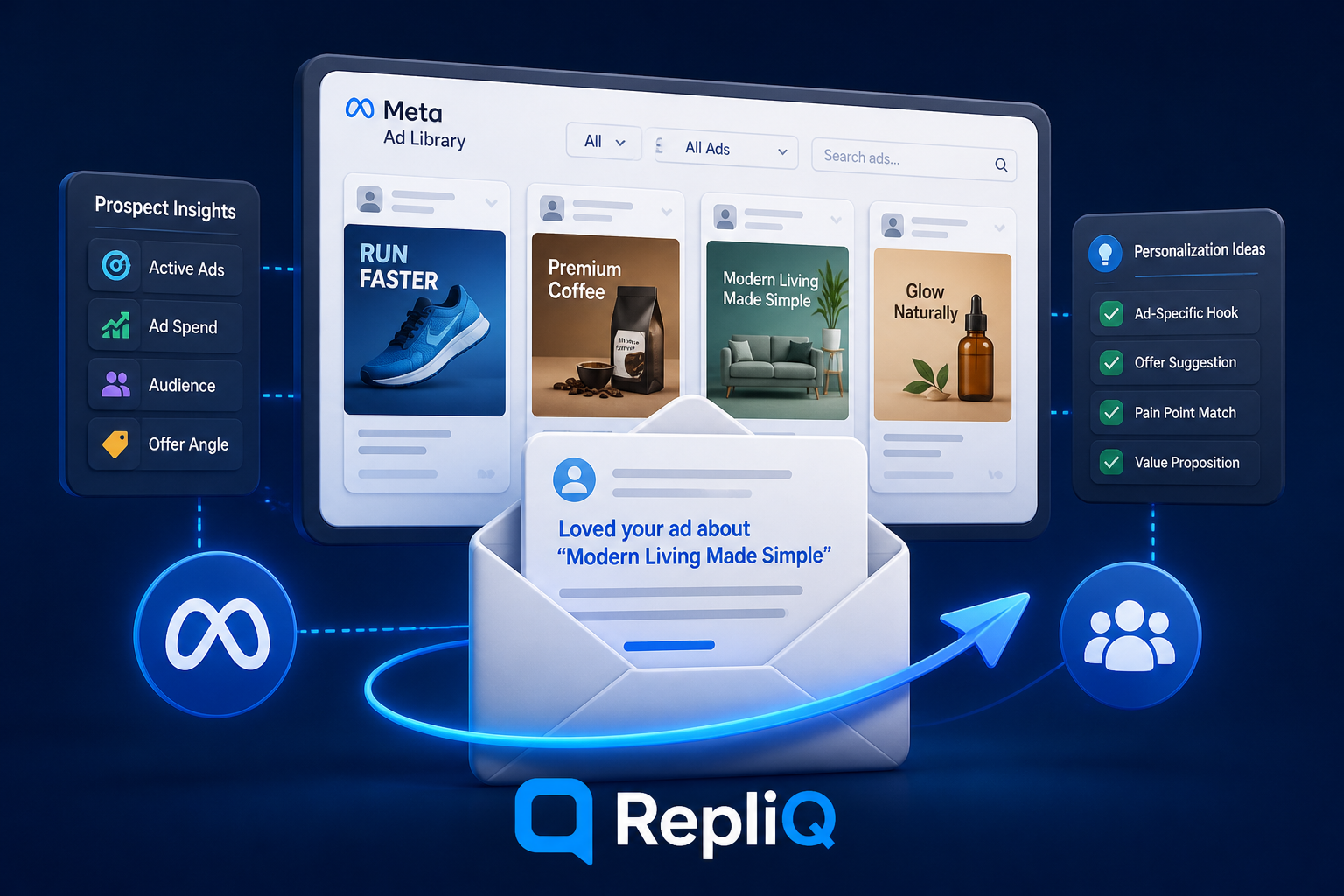
Meta Ads Personalization: How to Turn a Prospect’s Facebook Ads Into Relevant Outreach
Table of Contents
- 1. Introduction: Why Meta Ads Are a Powerful Personalization Signal
- 2. What a Prospect’s Meta Ads Can Tell You
- 3. How to Find and Research a Prospect’s Active Meta Ads
- 4. How to Turn Ad Insights Into Personalized Outreach
- 5. How to Scale Meta Ads-Based Prospecting Without Losing Authenticity
- 6. Measuring the Impact of Ad-Based Outreach
- 7. Common Mistakes and How to Avoid Them
- 8. Conclusion
- 9. FAQ
Introduction: Why Meta Ads Are a Powerful Personalization Signal
Generic agency outreach is a widespread problem. Every day, decision-makers are inundated with templated emails and direct messages offering identical marketing services with no connection to their actual business needs. To cut through the noise, you need a timely, highly visible signal of a prospect’s current business context. Active Meta ads provide exactly that. When a company runs advertisements, they publicly publish useful signals about their current marketing priorities through their Facebook and Instagram creative. These signals include their primary hook, their core offer, the proof they leverage, their chosen creative format, and their call to action.
By leveraging Meta Ads personalization, you can transform these public signals into highly relevant conversations. This guide will teach you how to move seamlessly from Meta Ad Library research to a compelling email, LinkedIn message, or personalized video. It is critical to understand that this process must rely solely on observable, publicly accessible information. Responsible personalized marketing outreach never implies access to private targeting, hidden performance data, or unsupported assumptions about a brand's ROI.
The workflow is straightforward and powerful: you will discover an active ad, analyze its core message, inspect the destination landing page, form one evidence-based hypothesis, and present a useful next step to the prospect. Mastering this Facebook ad prospecting workflow allows you to replace guesswork with context, proving to your prospects that you understand their current marketing landscape before you even ask for a meeting.
What a Prospect’s Meta Ads Can Tell You
Ad creative is an incredibly useful tool for contextual prospecting, provided you maintain clear boundaries around what can reasonably be inferred from public data.
Use the Five-Part Ad Review Framework
To make ad creative personalization systematic, agencies should use a practical five-part ad review framework for every prospect. This ensures your prospect research from ads is thorough and actionable.
- Hook: What attention-grabbing claim, pressing problem, or bold promise appears in the first three seconds of the video or the first line of the copy? The hook reveals what the brand believes is most important to their audience.
- Audience promise: Who does the message appear designed to help? Based on the visible positioning, you can deduce the target persona the creative is speaking to.
- Offer: What specific product, service, discount, lead magnet, or action is being promoted? The offer is the anchor of their current campaign.
- Proof: Does the ad show customer testimonials, product demonstrations, founder-led content, specific outcomes, credentials, or other visible proof? Proof points highlight how the brand builds trust.
- CTA and destination: What action does the ad explicitly ask people to take, and does the landing page continue the exact same message? The continuity between the ad and the destination is often where the best creative-led outreach opportunities lie.
Separate Useful Observations From Unsupported Claims
When engaging in contextual outreach, you must distinguish visible facts from hypotheses about the prospect’s strategy. A common pitfall in personalized sales messaging is claiming that an ad is "performing well" or "failing." You do not have access to their backend metrics. Instead, use careful, observation-based language such as “I noticed,” “Your ad appears to emphasize,” or “One opportunity may be.”
Running an ad may indicate active promotion, creative testing, or financial investment in a campaign, but it absolutely does not prove profitability, high conversion rates, precise targeting, or overall campaign success. Strong claims about performance, audience intent, or campaign objectives should never be presented as facts unless the prospect has publicly stated them elsewhere. For effective Meta Ad Library prospecting, always validate your hypothesis against the ad copy, the creative assets, the landing page, and the brand's publicly visible positioning before mentioning it in your outreach.
How to Find and Research a Prospect’s Active Meta Ads
To make this strategy work, you need a repeatable discovery-to-research workflow using the Meta Ad Library as your primary public source.
Search for the Advertiser in the Meta Ad Library
Begin your prospect research by navigating to the official, first-party source for ad discovery: https://www.facebook.com/ads/library/. Search for the company or brand in the Meta Ad Library and review the available active ads running across relevant Meta platforms.
Use the available filters—such as advertiser name, country, and platform—to narrow your research and find the most relevant creative. Before proceeding, confirm that the advertiser, the brand messaging, and the destination page appear genuinely connected. You want to ensure you are analyzing the correct entity before using the ad as an outreach reference. Once verified, save the specific ad or creative variation that provides the clearest, most compelling personalization angle for your Instagram ad prospecting or Facebook Ad Library research. Remember, this process uses visible ad information for research; do not overstate the platform's capabilities or imply you have access to private account data.
Review the Creative, Copy, and Landing Page
To elevate your personalized cold outreach, you must move beyond simply telling a prospect, "I saw you are running ads." Record the specific ad format, the headline, the primary text, the visual concept, the core offer, the proof points, the CTA, and the visible positioning.
Next, open the destination page and conduct a thorough ad creative analysis. Compare the landing page's headline, offer, lead form, proof points, and CTA with the original ad. Look for one highly useful observation. This could be a remarkably strong promise, a seamlessly repeated message, an interesting creative pattern, or a possible ad-to-page mismatch where the landing-page messaging fails to deliver on the ad's hook. Avoid turning every visible difference into harsh criticism. Instead, frame your potential improvements as collaborative ideas or thoughtful questions.
Capture Findings in an Ad-to-Message Worksheet
To make personalization consistent across an agency team, introduce a concise research template. This ad-to-message worksheet streamlines agency lead generation and ensures high-quality personalized outreach at scale.
Your worksheet should include the following fields: advertiser name, ad URL or reference link, hook, offer, audience promise, proof, format, CTA, landing-page message, observable opportunity, and the proposed outreach angle. Crucially, add a “confidence level” or “evidence” field so writers can clearly identify which observations are verified facts and which are hypotheses.
Limit the final message to one primary observation rather than listing every single detail discovered during your prospect research. For examples of how to apply these workflows in real-world scenarios, explore INTERNAL_LINK: https://repliq.co/use-cases to see how contextual outreach drives results.
How to Turn Ad Insights Into Personalized Outreach
With your research complete, you can now turn these ad insights into a highly relevant reason to contact the prospect.
Use the Observation–Hypothesis–Value Framework
To write personalized marketing outreach that is specific without sounding invasive, rely on the Observation–Hypothesis–Value framework.
- Observation: Mention one visible, factual detail. This could be the ad’s hook, the specific offer, the creative format, or a landing-page message.
- Hypothesis: Suggest a possible opportunity using careful, non-presumptive language. For instance, you might suggest improving message continuity between the ad and the landing page, or testing a clearer proof point.
- Value: Offer a practical, immediate next step. This could be a short audit, a custom creative idea, a landing-page suggestion, or a relevant case study example.
- CTA: Ask for a low-friction response. Instead of immediately requesting a lengthy 45-minute sales call, ask if they are open to seeing a quick idea. This makes your personalized sales messaging and creative-led outreach much more approachable.
Outreach Angles for Different Meta Ad Types
Different ads require different approaches. Here are copy-ready outreach angles for the most useful ad-based personalization scenarios to aid your Facebook ad prospecting:
- Direct-response offer: Reference the specific offer and suggest a way to strengthen the connection between the ad's initial promise and the landing page's next step.
- Testimonial or social-proof ad: Mention the visible proof point and propose a creative idea for extending that exact proof into another creative format or landing-page element.
- Founder-led ad: Acknowledge the personal positioning of the founder and suggest a way to repurpose the founder’s unique point of view across additional outreach or retargeting creative.
- Promotional or seasonal ad: Connect the visible promotion to a timely creative, follow-up, or retargeting idea. Do this without assuming their current campaign performance.
- Lead-generation ad: Reference the lead magnet or offer and suggest a way to make the value proposition or the post-click experience clearer for the user.
These angles ensure your ad creative personalization directly supports your agency lead generation efforts.
Sample Text Outreach Structure
Here is a reusable structure for personalized cold outreach that relies on contextual outreach and personalized marketing outreach principles, without making unsupported claims about results:
- Opening: Identify the specific ad or message observed. (e.g., "I noticed your recent Facebook ad highlighting [Hook/Offer].")
- Insight: Explain one clear creative or positioning observation. (e.g., "The testimonial you used is incredibly strong, but I noticed the landing page it links to doesn't feature that same customer story.")
- Relevance: Connect the observation to your agency’s area of expertise. (e.g., "We help brands improve their ad-to-page continuity to maximize their ad spend.")
- Offer: Provide one useful idea, mini-audit, or creative suggestion. (e.g., "I put together a quick mockup of how you could integrate that proof point above the fold on your landing page.")
- CTA: Ask whether the prospect would like to see the idea or discuss it briefly. (e.g., "Would you be opposed to me sending over a quick screenshot of the idea?")
Keep placeholders for the ad hook, offer, proof point, and proposed improvement so the template remains adaptable for your team.
When a Personalized Video Is the Better Format
Sometimes text isn't enough. Personalized video outreach can make your research highly visible and demonstrate your agency's expertise before a sales conversation ever takes place.
When creating AI videos for agencies, open by visually showing or naming the prospect’s ad on your screen so the reason for the message is immediately clear. Keep the video structure short: share your specific observation, present one improvement idea, briefly state your agency's relevance, and end with a low-friction CTA. Keep the focus entirely on the prospect’s creative rather than presenting a broad, generic agency pitch.
Remember, video should supplement a strong insight—it cannot compensate for weak research or generic messaging. For a streamlined way to turn ad-specific research into contextual video outreach, check out INTERNAL_LINK: https://repliq.co/ai-videos.
Note: Always require human review of every generated video to ensure factual accuracy, appropriate tone, correct brand references, and responsible claims before sending.
How to Scale Meta Ads-Based Prospecting Without Losing Authenticity
Scaling your outreach doesn't mean sacrificing the specificity that makes it credible. Agencies can create a repeatable process while preserving the core insights.
Standardize the Research, Not the Insight
To achieve cold outreach personalization at scale, you must understand which parts of the process can be templated and which must remain prospect-specific. Standardize your research fields, your review checklist, your video structure, your approval process, and your follow-up stages. These are the operational mechanics of agency lead generation.
However, you must keep the actual observation, the hypothesis, the example, and the CTA specific to the prospect’s visible ad. Create message variants for different creative types, but absolutely avoid inserting the same generic compliment (e.g., "Great ad!") into every message. Prioritize prospects where the ad provides a clear, relevant, and timely context for your Meta Ads personalization.
Use AI as a Production Layer, Not a Substitute for Judgment
AI-assisted outreach is a powerful way to reduce production time while preserving human oversight. Use structured inputs from your research—the ad hook, offer, proof, CTA, landing-page message, and approved hypothesis—to guide your content generation.
Always ask a human reviewer to verify that the output reflects the actual ad and does not invent campaign goals or performance results. Remove unnecessary personal details and avoid making the message feel like surveillance. A repeatable workflow helps agencies create more contextual outreach assets without treating every prospect identically.
To see how you can bridge the gap between public ad context and personalized outreach assets, explore INTERNAL_LINK: https://repliq.co as your workflow layer. This contextual workflow stands in stark contrast to generic merge-field personalization or video tools that begin with format rather than a prospect-specific creative insight.
Manual Research Versus a Repeatable Agency Workflow
When evaluating agency prospecting workflows, compare approaches based on workflow needs. Manual research is highly suitable for a small number of high-value prospects that require deep, strategic analysis. However, a repeatable workflow is necessary when agencies need consistent research fields, approvals, message production, and follow-up at volume.
The key differentiator in personalized outreach at scale is not simply automation; it is the ability to connect a visible ad signal to a credible outreach idea. While tools like Clay offer adjacent enrichment and automation, and Vidyard provides personalized-video delivery, the core of this strategy relies on the Meta Ad Library prospecting discovery source paired with a dedicated Meta Ads-to-outreach workflow.
Measuring the Impact of Ad-Based Outreach
To evaluate whether creative-led personalization produces better business outcomes than generic outreach, you must measure the right metrics.
Track the Full Outreach Funnel
Prioritize meaningful business outcomes over surface-level engagement metrics. Track the research time per account and the production time per message or video. Measure delivery rates, replies, positive replies, qualified conversations, booked meetings, opportunities, and ultimate conversions.
Compare performance by personalization angle. Does offer analysis perform better than creative analysis? Do testimonial references outperform landing-page observations? Record whether the prospect's replies reference your specific insight. If they do, it indicates that your personalized outreach measurement is on track and your agency lead generation efforts were noticed and relevant.
Test One Personalization Variable at a Time
Give your agency a practical testing approach that avoids confusing the creative format with message relevance. Compare a generic agency message against an ad-based personalized cold outreach message while keeping the audience and the core offer as consistent as possible.
Test text versus personalized video outreach only after you have proven that the underlying observation and CTA are strong. Evaluate your success based on the positive-response rate and the opportunity rate, rather than relying solely on opens or views, which are often unreliable outreach conversion measurement metrics. Document which observations generate useful conversations and which feel too broad or speculative.
Common Mistakes and How to Avoid Them
Ad-based personalization can feel superficial or intrusive if executed poorly. Avoid these common pitfalls to maintain trust and quality.
Mistake: Complimenting the Ad Without Offering Insight
Saying “I saw your ad and loved it” is not sufficient personalization. It lacks depth and value. Replace generic praise with one concrete observation and a useful improvement idea. Keep your personalized sales messaging focused entirely on the prospect’s business context rather than pivoting immediately to your agency’s capabilities. True creative-led outreach provides immediate value.
Mistake: Treating Ad Activity as Proof of Success
An active ad does not reveal a brand's ad spend, conversion rate, profitability, audience response, or campaign performance. Assuming it does will immediately discredit you. Use careful, hypothesis-based language. Avoid claiming to know the advertiser’s objective. Responsible personalization and effective Meta Ads personalization rely on observable facts, not fabricated metrics.
Mistake: Overloading the Message With Research
Do not overwhelm the prospect. Recommend one primary insight per message and one clear CTA. Avoid listing every ad variation, platform detail, or landing-page observation you found. Overloading the message dilutes the impact of your personalized cold outreach. Keep your contextual outreach focused, and use a follow-up message or a linked resource for additional suggestions.
Mistake: Automating Without Human Review
Never automate without oversight. Require a final human check for brand names, ad details, claims, tone, and relevance. Remove any invented performance statements or assumptions about personal characteristics. Automation should improve consistency and production speed, not eliminate editorial judgment. AI-assisted outreach and personalized marketing outreach must adhere to a clear trust standard: use public business signals, avoid sensitive inferences, and ensure every message accurately reflects what was visibly published. This is the cornerstone of responsible automation.
Conclusion
Turning public creative into a better reason to start a conversation is a game-changer for agencies. The workflow is clear: find the prospect’s active Meta ad, extract the hook, offer, proof, and CTA, inspect the landing page, form one evidence-based hypothesis, and turn it into a concise message or video.
The true value of Meta Ads personalization is not merely mentioning that you saw an ad; it is demonstrating a useful, contextual understanding of the prospect’s current marketing landscape. Start with a small group of prospects and rigorously measure your qualified replies, conversations, meetings, and opportunities to gauge success.
RepliQ offers a practical, highly effective way for agencies to create contextual outreach using publicly available ad creative and positioning. By requiring human review for accuracy, you ensure brand-safe, compliant outreach. Stop sending generic pitches and start leveraging public signals to drive your agency lead generation. Explore RepliQ today to transform your personalized marketing outreach.
FAQ
How can I personalize outreach using a prospect’s Meta ads?
To execute Meta Ads personalization, identify an active ad, record its hook, offer, proof, and CTA, and inspect the landing page. Use one specific observation in the opening of your message. The goal of personalized outreach is to add a relevant idea or hypothesis rather than simply stating that you found their ad online.
How do I find a company’s active Facebook and Instagram ads?
You can find active campaigns using the Meta Ad Library, which is the official public discovery source: https://www.facebook.com/ads/library/. For effective Instagram ad prospecting and Facebook Ad Library research, always verify the advertiser and carefully review the visible creative, copy, and destination landing page.
What should I say when referencing a prospect’s Meta ad?
In your personalized cold outreach, recommend mentioning one specific detail, such as the ad's promise, offer, creative format, or landing-page continuity. Follow this observation with a cautious hypothesis and a useful next step. To maintain credible personalized sales messaging, avoid making claims about performance, targeting, or results that cannot be verified publicly.
How can I avoid sounding creepy when mentioning a prospect’s ads?
Focus strictly on public business content rather than personal or sensitive attributes. Explain clearly why the ad was relevant to your message without implying any private tracking. Keep your tone helpful, concise, and transparent to ensure privacy-conscious personalization and responsible automation in your contextual outreach.
How can agencies scale ad-based personalized video outreach?
To scale personalized video outreach, agencies should standardize their research fields, approval steps, video structures, and follow-up processes. Keep each video anchored to a prospect-specific observation. You can use AI to assist production, but always require human review before distribution. To explore AI videos for agencies and outreach at scale, visit INTERNAL_LINK: https://repliq.co/ai-videos.
What metrics should agencies use to evaluate personalized outreach?
Agencies should track positive replies, qualified conversations, booked meetings, opportunity rates, and research or production time. Opens, views, or clicks alone do not show whether the outreach created meaningful business value. Focus on personalized outreach measurement that highlights qualified conversations and true agency lead generation.


