.png)
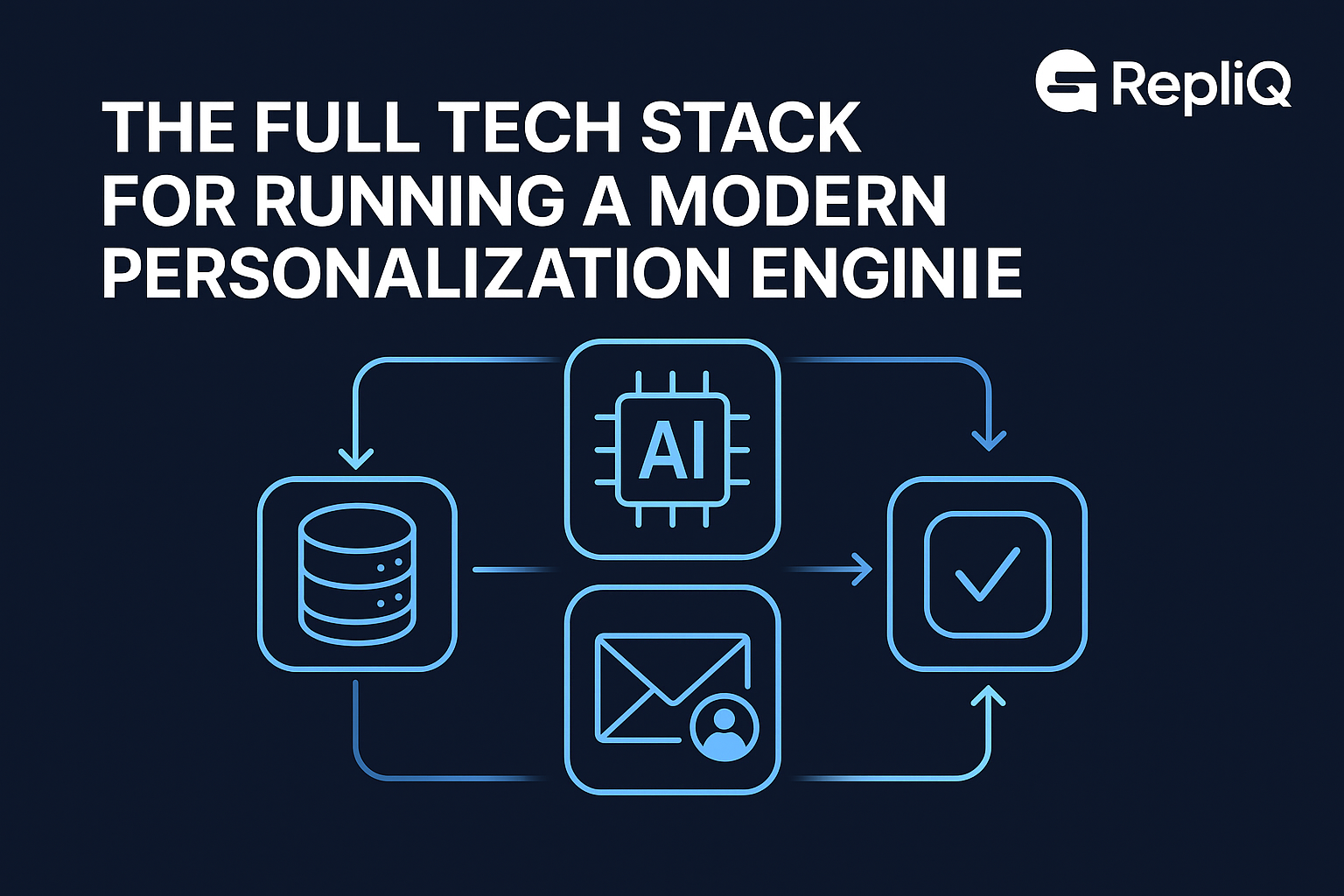
The Full Tech Stack for Running a Modern Personalization Engine: The Most Comprehensive Analysis & Action Plan
Table of Contents
- Introduction
- Understanding the Modern Personalization Landscape
- What a Modern Personalization Tech Stack Looks Like
- Core Architecture: Enrichment, Retrieval, LLM Generation, and Validation
- How to Scale Personalization Without Losing Quality
- Choosing the Right Tools: Gaps, Integrations, and Workflow Orchestration
- Conclusion
- FAQ
Introduction
Most personalization engines fail at scale not because the AI isn't smart enough, but because the infrastructure supporting it is fragmented. When you rely on a patchwork of disconnected tools—one for scraping, another for enrichment, a third for LLM generation, and a fourth for sending—you introduce latency, data inconsistency, and critical points of failure.
For engineering teams and technical marketers, the problem is clear: typical stacks lack a unified validation layer. You might have excellent data enrichment, but if the retrieval layer feeds irrelevant context to the LLM, the output is a hallucination. If the generation layer lacks strict prompt adherence, the tone drifts.
This article provides a deeply technical, end-to-end blueprint for building a true personalization engine. We move beyond basic "mail merge" strategies to explore a unified architecture that orchestrates enrichment, retrieval, LLM generation, scoring, and outbound orchestration into a single, reliable system. Drawing on RepliQ’s experience in building full-stack outbound automation, we will dissect the exact technical requirements for an outreach tech stack that scales without breaking.
Understanding the Modern Personalization Landscape (Why This Matters Now)
The era of rule-based personalization—simple variable replacement like {{FirstName}} or {{CompanyName}}—is effectively over. While these methods are computationally cheap, they yield diminishing returns in a saturated market. The industry has shifted toward AI-driven, multi-step pipelines where the goal is not just to insert a name, but to generate a unique, context-aware message based on real-time data.
However, modern outbound performance relies on a complex equation: Enrichment + Retrieval + LLMs + Validation.
If any variable in this equation is weak, the entire personalization engine fails. Currently, the market is plagued by fragmentation. Teams often use Clay for enrichment, Apollo for contact data, and Smartlead or Instantly for sending. While these tools are powerful individually, passing data between them often requires "glue code" (Zapier, Make) that introduces latency and error handling challenges.
To achieve reliability at scale, you need a unified personalization engine. According to an overview of RAG concepts from authoritative sources in machine learning, the separation of retrieval (finding data) and generation (writing copy) is critical for accuracy. A modern stack must respect this separation, ensuring that the LLM is never asked to "guess" facts but is instead fed strict, validated context.
What a Modern Personalization Tech Stack Looks Like
A robust personalization engine architecture resembles a modern software application more than a marketing campaign. It requires a defined flow of data through modular subsystems, each responsible for a specific transformation of the input.
The Core Visual Flow:
- Input: Raw Lead List (Domain/LinkedIn URL)
- Enrichment Layer: API calls to fetch firmographics, news, and tech stack data.
- Retrieval Layer: Vector search or graph queries to isolate relevant context.
- LLM Generation Layer: Prompt stacking and inference.
- Scoring & Validation: Automated quality checks (hallucination/tone).
- Orchestration: Routing valid messages to the sender and invalid ones to manual review.
- Output: Sent Email/LinkedIn Message.
This modular approach ensures consistency. If the enrichment layer fails to find data, the system halts the specific record rather than sending a generic, low-quality message.
For teams looking to implement this without building the entire infrastructure from scratch, RepliQ operates as an end-to-end outbound personalization system, effectively managing the heavy lifting of these layers to deliver ready-to-send assets.
Data Enrichment Layer
The foundation of any personalization tech stack is the data enrichment layer. In a modern setup, this is not a static database lookup but a dynamic pipeline. It often involves centralized enrichment workflows—similar to Clay—or custom scripts hitting multiple APIs (e.g., Clearbit, People Data Labs, custom scrapers).
Critically, this layer must handle schema management. Data from different providers arrives in different formats. A robust engine normalizes this data into a single schema before passing it downstream. This includes auto-validation: checking if a "recent news" snippet is actually recent or if a "job title" matches the persona target.
Referencing enterprise knowledge retrieval frameworks, best-practice metadata handling suggests that data should be tagged with confidence scores and timestamps immediately upon entry. This prevents "stale context" from contaminating the generation process later.
Retrieval & Context Layer (Vector Search, Graph Context)
Once data is enriched, it must be retrieved intelligently. You cannot feed an entire company's history into an LLM context window without incurring high costs and noise. This is where retrieval pipelines and vector databases (like Pinecone or Weaviate) come into play.
In a RAG architecture (Retrieval-Augmented Generation), the system converts unstructured data (blog posts, case studies) into vector embeddings. When generating a message for a specific prospect, the system queries the vector DB for the most relevant "chunks" of information—perhaps a specific podcast quote or a recent funding announcement.
Peer-reviewed RAG fundamentals highlight that effective retrieval reduces hallucination by grounding the LLM in retrieved evidence. Additionally, graph-based entity resolution helps link disparate data points (e.g., knowing that the CEO of Company A is also a board member of Company B), offering deeper personalization angles.
Core Architecture: Enrichment, Retrieval, LLM Generation, and Validation
Competitors often discuss these tools in isolation, but the secret to a high-performing personalization tech stack lies in the integration of four specific components: Enrichment, Retrieval, Generation, and Validation.
LLM Generation Architecture
The generation layer is where the actual copy is produced. A sophisticated LLM personalization architecture rarely uses a single "zero-shot" prompt. Instead, it utilizes prompt stacking or chain-of-thought reasoning.
- Analyzer Agent: First, an LLM analyzes the retrieved context to determine the best "angle" (e.g., complimenting a recent hire vs. discussing a tech migration).
- Drafter Agent: A second call generates the message using the chosen angle.
- Editor Agent: A third call refines the copy for brevity and tone.
To manage latency, this architecture often employs batching and parallelized inference. Rather than generating one email at a time, the system processes records in chunks. Research on advanced RAG architectures indicates that fine-tuning smaller models (like Llama 3 or Mistral) on high-performing email datasets can often outperform general models (like GPT-4) in specific domains while significantly reducing inference costs and latency.
Validation & Quality‑Scoring Layer
Perhaps the most overlooked layer is validation. In a manual workflow, a human reads every email. In an automated system, you need automated validation.
This layer uses secondary models or rule-based logic to score generated content.
- Compliance Checks: Does the message contain prohibited words?
- Hallucination Detection: Does the message reference data not present in the input context?
- Tone Consistency: Is the sentiment positive and professional?
If a message fails this scoring, it shouldn't be sent. It should be routed to a "human-in-the-loop" queue for manual repair. For teams needing a dedicated solution for this, Scaliq serves as an AI-driven content validation and scoring layer, ensuring that only high-quality, safe content leaves your system.
Orchestration Layer (The Glue)
The orchestration layer binds enrichment, retrieval, and generation together. It is the workflow engine that manages dependencies. It ensures that the LLM generation step doesn't trigger until the enrichment step has successfully returned data.
In a fragmented stack, this "glue" is often brittle (e.g., a Zapier zap that breaks if an API times out). A unified system uses robust orchestration to handle retries, error logging, and state management. This reduces fragmentation and ensures data consistency across the pipeline.
For complex workflows involving multiple agents and triggers, NotiQ acts as an AI workflow orchestrator, streamlining the movement of data between these critical layers.
How to Scale Personalization Without Losing Quality
Scaling personalization is an engineering challenge. As you move from sending 50 emails a day to 5,000, you encounter rate limits, API timeouts, and increased inference costs.
Scaling Enrichment at Volume
To scale enrichment, you must move away from synchronous processing. Instead of waiting for an API to return data before moving to the next record, use asynchronous workers and message queues (like RabbitMQ or AWS SQS).
- Parallelism: Fire enrichment requests for 100 leads simultaneously.
- Redundancy: Implement fallback providers. If Provider A is down or lacks data for a specific domain, the system should automatically query Provider B.
- Error Handling: robust retry logic with exponential backoff ensures that temporary network blips don't cause data loss.
Scaling LLM Generation
Scaling LLM-driven personalization requires managing throughput.
- Multi-Model Orchestration: Route simple tasks to faster, cheaper models (e.g., GPT-3.5-Turbo or Haiku) and complex reasoning tasks to flagship models (GPT-4o or Claude 3.5 Sonnet).
- Distributed Inference: If self-hosting open-source models, load balance requests across multiple GPUs to handle spikes in volume.
- Caching: Cache vector search results and API responses. If you are targeting multiple people at the same company, you shouldn't need to re-enrich the company data for every single person.
Ensuring Quality at Scale
Speed cannot come at the expense of accuracy. To maintain quality at scale, implement sampling validation loops.
- Automated Scoring: Every message gets a machine-generated confidence score.
- Human Sampling: Randomly route 5% of "high confidence" messages to a human reviewer to verify the scoring model's accuracy.
- Feedback Loops: When a message receives a positive reply, feed that data back into the system to fine-tune the prompt or the model, creating a virtuous cycle of improvement.
Choosing the Right Tools: Gaps, Integrations, and Workflow Orchestration
Building this stack requires selecting the right components. While "all-in-one" tools exist, advanced teams often prefer a modular approach to retain control over specific layers.
Enrichment Tools & Data Sources
When selecting data enrichment tools, distinguish between database aggregators (Apollo, ZoomInfo) and workflow enrichers (Clay, custom scripts).
- Aggregators are best for sourcing the initial list.
- Enrichers are best for finding "trigger events" (hiring, funding, news) that drive the personalization.
- Strategy: Use aggregators for the "Who" (contact info) and enrichers for the "Why" (context). Ensure your choice offers strong API documentation and reliable uptime.
LLM Models & Generation Tools
For the generation layer, the choice is usually between hosted APIs (OpenAI, Anthropic) and open-source models (Llama, Mistral).
- Hosted APIs: Easiest to start with. Anthropic’s Claude is often cited for superior creative writing nuances, while OpenAI offers robust function calling for structured data extraction.
- Open Source: Best for high-volume scaling where cost-per-token is a concern. Fine-tuning a 7B parameter model on your best performing emails can yield excellent results at a fraction of the cost.
Orchestration Tools & Native Integrations
Your orchestration layer determines the stability of your outbound automation.
- No-Code: Tools like Make or Zapier are great for prototyping but can become expensive and hard to debug at scale.
- Code-Based: Python scripts running on Airflow or Prefect offer maximum control.
- Specialized Orchestrators: Tools designed specifically for multi-agent systems handle the unique latency and error patterns of AI workflows better than generic automation platforms.
Conclusion
The shift from mail merge to AI-driven personalization is not just a trend; it is a fundamental architectural change in how outbound markets operate. A modern personalization tech stack is a complex ecosystem requiring tight integration between enrichment, retrieval, generation, and validation layers.
Reliance on fragmented tools leads to data silos and broken workflows. By adopting a unified architecture—or leveraging platforms that internalize this complexity—you ensure that every message sent is relevant, accurate, and compliant.
For teams ready to implement this without the engineering overhead, exploring RepliQ’s technical workflows offers a proven path to deployment. We have spent years refining the interaction between data inputs and LLM outputs to build an engine that delivers personalization at scale.
FAQ
Frequently Asked Questions
What is the minimum viable personalization tech stack?
At a minimum, you need a data source (for contact info), an enrichment tool (to find context like recent news), an LLM interface (to generate copy), and a sending platform. However, without an orchestration or validation layer, this "stack" requires significant manual oversight to prevent errors.
How do I prevent hallucinations in LLM personalization?
Hallucinations are prevented by strictly grounding the LLM in retrieved data (RAG architecture). Never ask the AI to "write an email about this company" without providing the specific facts it should mention. Additionally, implementing a validation layer that cross-references the output against the input data is crucial.
What type of data sources are best for hyper-personalized outbound?
The best sources are real-time and public. This includes LinkedIn posts, company blog updates, podcast appearances, and hiring notices. Static database fields (like "Industry" or "Headcount") rarely provide enough context for true hyper-personalization.
How do I choose between hosted vs self-hosted LLMs?
Choose hosted APIs (OpenAI/Anthropic) for ease of use, speed of implementation, and access to state-of-the-art reasoning capabilities. Choose self-hosted open-source models if you have engineering resources and need to process massive volumes of data where cost reduction and data privacy are paramount.
How do I validate AI-generated personalization before sending?
Use a "Validator Agent"—a separate LLM prompt designed solely to grade the output of the "Writer Agent." You can also use regex rules to catch formatting errors and sentiment analysis models to ensure the tone is appropriate. Tools like Scaliq automate this specific part of the workflow.

.svg)
.png)


.svg)