
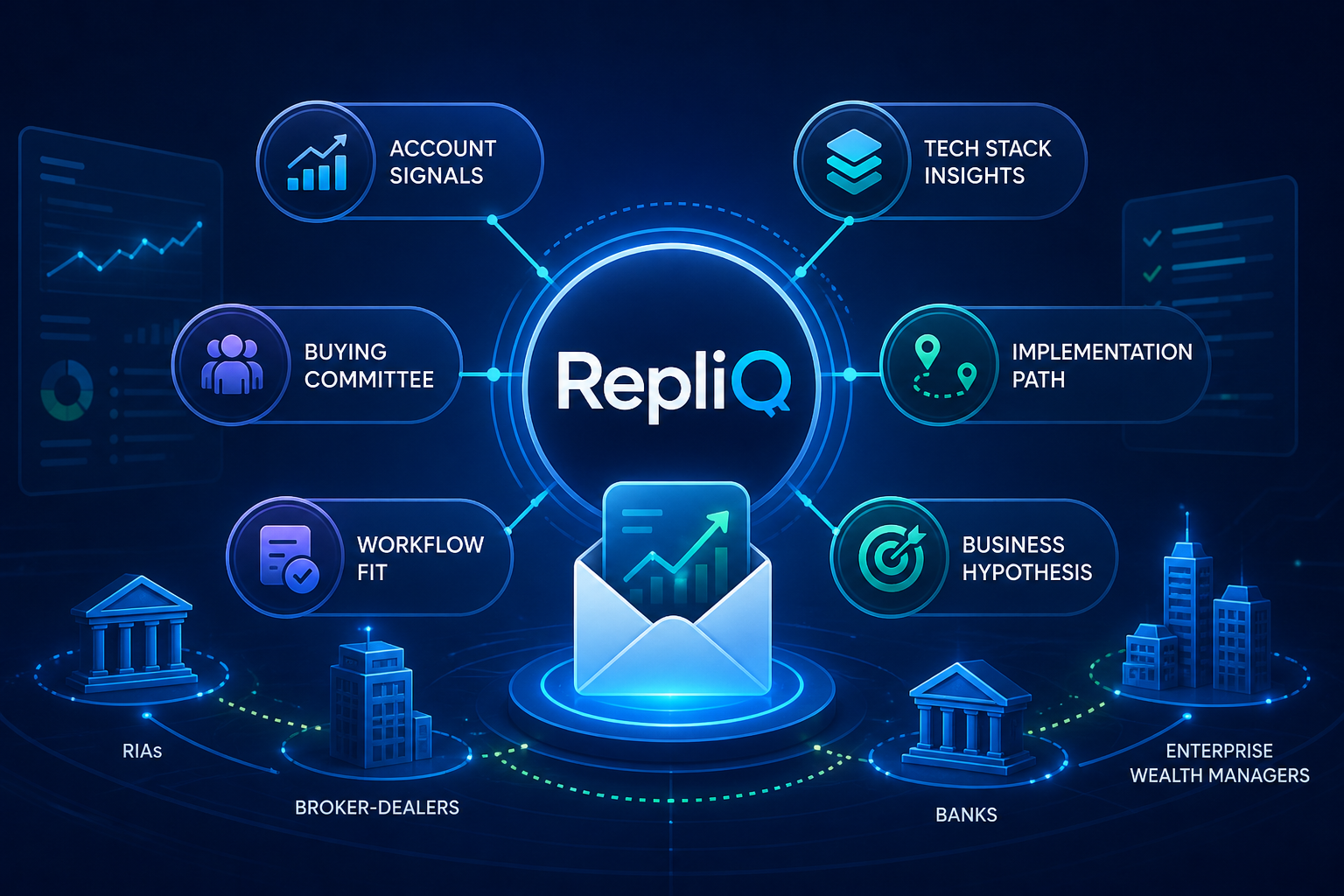
Personalized Financial Planning SaaS Outreach: A Trigger-Based Framework for Qualified Fintech Leads
Table of Contents
- Introduction: Why Generic Fintech Outreach Underperforms
- Segment Financial Planning Prospects by Firm Type and Buying Context
- Identify High-Intent Business and Technology Signals
- Build Workflow- and Role-Specific Outreach Messages
- Address Integrations, Implementation, Security, and Compliance
- Measure Outreach by Pipeline Quality and Revenue Impact
- Practical Framework: A Finance-Specific Signal-to-Message Workflow
- Conclusion: Turn Personalization Into a Repeatable Fintech Pipeline System
- FAQ
Introduction: Why Generic Fintech Outreach Underperforms
Financial planning SaaS companies need more than basic name or industry personalization to generate qualified opportunities. In a crowded marketplace, generic claims about automation, productivity, or AI fail to resonate because they do not address a prospect’s specific planning workflow, existing technology stack, implementation concerns, or complex buying committee.
To break through the noise, revenue teams must adopt a trigger-based framework: connecting observable account signals to a prospect’s firm type, workflow, integrations, role, implementation path, and a measurable business hypothesis. This article is designed for sales, marketing, and revenue operations leaders selling to RIAs, broker-dealers, banks, enterprise wealth managers, and planning networks.
By distinguishing between superficial personalization and true account-based financial technology prospecting, teams can transition from low-converting volume plays to highly relevant outreach. While personalization does not guarantee immediate responses, it is a proven method for improving relevance, lead qualification, and overall sales efficiency. Using platforms like RepliQ serves as a practical example of how to execute scalable account research and market-specific messaging, ensuring your financial planning SaaS outreach remains highly targeted and compliant.
Segment Financial Planning Prospects by Firm Type and Buying Context
Financial planning software vendors must segment accounts by operating model and buying context before drafting a single line of outreach. The same product capability carries vastly different value depending on whether the prospect is an independent RIA, a broker-dealer, a bank, an enterprise wealth manager, or a planning network.
Documenting a firm's structure, planning model, growth stage, advisor capacity, technology environment, and likely buying committee is essential. This allows revenue teams to distinguish between accounts that are replacing legacy planning software, adding a net-new workflow, consolidating redundant tools, or scaling advisor capacity.
RIAs and Independent Planning Firms
For Registered Investment Advisors (RIAs) and independent planning firms, outreach should center on advisor productivity, client capacity, planning consistency, ease of adoption, and seamless integration with the firm’s existing workflow. Messages must be tailored to the operating reality of smaller teams, which often possess limited implementation and sales-operations resources.
It is a mistake to assume that all RIAs share the same planning process, technology stack, or growth priorities. Instead, use observable business signals—such as advisor hiring, office expansion, service-model changes, or the launch of new planning offerings—to form a specific outreach hypothesis. Crucially, always avoid referencing or inferring sensitive client information. Rely strictly on observable, public business data, as practicing data minimization inherently strengthens trust in financial advisor software marketing.
Broker-Dealers, Banks, and Enterprise Wealth Managers
Enterprise prospects evaluate software through a different lens. They prioritize governance, interoperability, stringent security reviews, structured procurement, implementation ownership, and operational resilience. Sending one generalized pitch to an enterprise wealth manager will fail; instead, map distinct messages to business, technology, risk, compliance, and implementation stakeholders.
Outreach must address coexistence with incumbent platforms and the reality of phased rollouts or limited-scope implementations. Enterprise buyers evaluate a vendor as a third-party relationship, not simply as a software purchase. When discussing due diligence, third-party oversight, contracts, operational resilience, and ongoing vendor monitoring, it is vital to align with established standards such as the interagency third-party risk guidance, demonstrating an understanding of enterprise risk frameworks in B2B fintech lead generation.
Planning Networks and High-Growth Firms
Planning networks prioritize standardization across offices, scalable onboarding, reporting consistency, and seamless integration across affiliated firms. Growth-stage prospects within these networks can be segmented by hiring surges, acquisitions, partnerships, product launches, geographic expansion, or specific advisor-capacity objectives.
The business hypothesis driving your outreach must change depending on whether the account is expanding rapidly, consolidating disparate systems post-acquisition, or formalizing a previously manual process. To see how segment-specific account research and outreach workflows can be operationalized for these high-growth entities, explore relevant RepliQ use cases that demonstrate the power of targeted wealth management technology outreach.
Identify High-Intent Business and Technology Signals
Prioritizing accounts requires leveraging observable signals rather than relying on broad industry lists or superficial personalization. A signal is only useful when it supports a documented business hypothesis about why the account may be evaluating, expanding, replacing, or integrating financial planning technology.
Combining firmographic, business, hiring, product, partnership, and technology signals yields a much clearer picture than relying on a single data point. However, intent should only indicate potential commercial relevance—it does not automatically prove buying readiness.
Business and Growth Signals
Valuable business signals include advisor hiring trends, leadership changes, acquisitions, the opening of new offices, expansion into new markets, shifts in service models, or increased planning capacity. Product launches, partnership announcements, and changes to client service models often indicate underlying workflow or infrastructure needs.
Turn each signal into a hypothesis using this format: “Because this account is doing X, it may be evaluating Y, so the outreach should address Z.” Avoid the trap of treating a public announcement as undeniable proof of a specific technology need; rather, use it as a logical entry point for discovery in your financial planning SaaS outreach.
Technology-Stack and Workflow Signals
Existing CRM, planning, portfolio-management, reporting, data, and workflow systems reveal critical integration and interoperability requirements. Research public technology pages, job descriptions, implementation content, partnership information, and technical documentation where available.
Map these technology observations to questions about data migration, workflow duplication, system ownership, reporting capabilities, and user adoption. Always distinguish verified information from inference. Use language such as “may indicate,” “could suggest,” or “worth validating in discovery” rather than claiming a prospect uses a specific platform unless the source is clear and current.
Separating Intent From Commercially Relevant Fit
Research activity or a technology signal must be combined with firm type, use case, implementation capacity, and likely buying authority to determine true fit. Score accounts across four dimensions: business trigger, workflow fit, technical fit, and buying accessibility.
Identify disqualifying or low-priority conditions early. An unclear use case, an absent implementation owner, an incompatible workflow, or an unsupported market requirement should pause outreach. This signal-to-message approach contrasts sharply with horizontal intent-data tools that prioritize raw activity scores over workflow interpretation, implementation fit, and the creation of high-intent fintech accounts.
Build Workflow- and Role-Specific Outreach Messages
Converting account research into credible messaging for complex, multi-stakeholder financial software purchases requires precision. Personalization must reflect the prospect’s planning workflow and business priorities—not simply insert a company name, role, or recent announcement into a template.
Use modular message components: segment, trigger, workflow implication, relevant capability, implementation question, and a low-friction call-to-action (CTA). Ensure the message hypothesis is explicit and testable.
Create an Account Brief Before Writing
Before drafting outreach, create a structured account brief. Minimum fields should include:
- Firm type and operating model
- Observable business trigger
- Current or likely workflow
- Relevant technology and integration context
- Potential business impact
- Likely buying roles
- Evidence gaps and assumptions requiring validation
Connect every personalized statement to a source or clearly label it as a hypothesis. A short, structured brief is far more valuable than extensive research that cannot be translated into actionable outreach. This brief supports email drafting, call preparation, LinkedIn messaging, educational content creation, and discovery. For scalable account research and personalized B2B outreach workflows, platforms like RepliQ provide a pathway to operationalize these briefs efficiently.
Map Messages to Buying Roles
A single account trigger should produce different messages depending on the recipient's role:
- Founders or Executives: Focus on growth, strategic differentiation, and revenue efficiency.
- Heads of Planning: Highlight advisor workflow, planning consistency, and client capacity.
- Operations Leaders: Address process standardization, user adoption, and implementation workload.
- Technology Owners: Discuss integration architecture, data flows, security, and support.
- Compliance or Risk Stakeholders: Emphasize governance, reviewability, data handling, and vendor oversight.
A role-specific message should outline the relevant account observation, the probable operational implication, specific product relevance, supporting evidence, and a discovery question. Never claim that a product improves revenue, productivity, or retention without verifiable evidence.
Use Trigger-Based, Multichannel Sequences
Effective sequences combine educational content, email, sales development follow-up, relevant social touchpoints, and discovery-oriented calls. Sequence timing and content must reflect the buying context rather than following a generic, volume-based cadence.
Use educational assets to proactively address implementation, integration, security, or workflow questions before requesting a product demonstration. Crucially, include a clear stop condition when an account shows no fit, requests no contact, or when available evidence cannot support the outreach hypothesis. This targeted method stands apart from personalization that relies solely on automated email volume.
Address Integrations, Implementation, Security, and Compliance
Technical and regulatory context must be a core part of conversion messaging rather than an objection-handling afterthought. Financial planning software buyers evaluate interoperability, migration effort, security, governance, support, and vendor risk long before discussing feature depth.
Create proof assets such as integration documentation, process diagrams, security information, implementation plans, and clearly sourced claims. Note that compliance requirements vary by jurisdiction, firm type, channel, and communication purpose; outreach should provide operational guidance, not legal advice.
Lead With the Implementation Path
Outreach can significantly reduce perceived switching risk by addressing the implementation path early. Explain what systems may need to connect, which internal teams may own the implementation, whether phased deployment or coexistence is possible, how data migration will be handled, and what the user adoption process entails.
Ask implementation-oriented discovery questions instead of making broad “easy to deploy” claims. Connect implementation details directly to the prospect’s firm type and current workflow. When discussing vendor due diligence, contracts, interoperability, and performance monitoring, align your messaging with the interagency third-party risk guidance to build immediate credibility.
Build Trust Around Security and Data Governance
Discuss security, privacy, access control, data handling, governance, and operational resilience without making unverified certifications or controls claims. Align security messaging with the prospect’s role: technical stakeholders need architecture details, executives need risk visibility, and operations teams need practical governance frameworks.
Data minimization is a central principle. Research public business signals without exposing or inferring sensitive client information. To communicate cybersecurity governance, risk, and third-party oversight effectively, reference recognized structures like the NIST Cybersecurity Framework 2.0. (Note: Referencing NIST provides a framework for discussion, but does not imply or prove a vendor’s compliance). Encourage a documented review process for all AI-generated research and personalized copy.
Apply Compliance-Aware Outreach Controls
Practical controls are essential for compliance-aware sales outreach:
- Use accurate sender and company information.
- Avoid misleading subject lines or unsupported claims.
- Provide required commercial-email disclosures and clear opt-out mechanisms.
- Respect suppression lists and communication preferences.
- Review automated copy before sending.
- Retain appropriate records of communications and approvals.
Outreach must communicate software capabilities and implementation value without drifting into investment advice, performance promises, or individualized recommendations. Route sensitive claims through marketing, legal, compliance, or supervisory review according to internal processes.
Ensure adherence to the FTC CAN-SPAM compliance guide for U.S. commercial-email requirements. When targeting regulated financial firms via digital channels, align with FINRA digital communications guidance. Furthermore, distinguish product education from investment-related calls to action by reviewing SEC guidance on educational communications.
Measure Outreach by Pipeline Quality and Revenue Impact
Shallow engagement metrics must be replaced with a measurement framework that demonstrates whether personalization creates commercially valuable fintech pipeline. Open rates, clicks, replies, or video views alone cannot establish account fit, opportunity quality, or true revenue impact.
Measure performance by segment, trigger, role, message hypothesis, channel, and buying context. Success is defined as a progression from a relevant signal to a qualified conversation, an opportunity, implementation fit, pipeline generation, and closed revenue.
Define Account-Level Metrics
Track metrics that indicate true progression, such as:
- Signal-to-qualified-meeting rate
- Reply quality by segment
- Meeting-to-opportunity rate
- Opportunity-to-technical-validation rate
- Implementation-fit rate
- Sales-cycle velocity
- Pipeline created by segment and trigger
- Closed-won revenue and retention indicators
Separate activity metrics from outcome metrics. Diligently track negative signals, disqualification reasons, unsubscribe rates, and compliance-review issues to continuously refine targeting and improve personalized B2B sales efforts.
Connect Personalization to Revenue Outcomes
Build a logical measurement chain: account signal → message hypothesis → qualified reply → discovery meeting → opportunity → implementation validation → pipeline → revenue.
Compare personalized programs against an appropriate baseline rather than attributing every improvement to personalization. Segment results by RIA, broker-dealer, bank, enterprise wealth manager, and planning network. Always account for sales-cycle length and implementation complexity before judging a campaign's success, and avoid presenting unsupported response-rate or conversion-rate claims.
Test and Improve Outreach Hypotheses
Implement controlled tests to refine your fintech SaaS sales strategy. Test:
- Workflow-led versus feature-led messaging
- Integration-led versus productivity-led positioning
- Executive versus operational CTAs
- Educational content versus direct-demo requests
- Single-trigger versus multi-signal account prioritization
Define clear success criteria before launching each test. Review quantitative data alongside qualitative feedback from sales calls. Feed objections, implementation questions, and disqualification reasons back into your segmentation and message development processes to continually sharpen your trigger-based outreach.
Practical Framework: A Finance-Specific Signal-to-Message Workflow
To operationalize this strategy, revenue teams can use the following seven-stage workflow as a checklist or sales enablement asset:
- Select a defined financial-services segment: (e.g., Independent RIAs scaling through acquisition).
- Identify observable signals: Find business or technology signals (e.g., recent M&A announcement, job postings for specific CRM administrators).
- Document the workflow implication: (e.g., The firm will likely need to consolidate disparate client data into a single planning portal).
- Identify the buying role and implementation stakeholder: (e.g., Head of Operations and Chief Technology Officer).
- Form a measurable business hypothesis: (e.g., Because they are acquiring firms, they may be evaluating data migration tools, so outreach should address seamless CRM-to-planning integrations).
- Draft a role-specific, compliance-reviewed message: Ensure accurate claims, clear opt-outs, and no sensitive data inference.
- Measure pipeline progression and update the hypothesis: Track the signal-to-qualified-meeting rate and adjust based on discovery feedback.
Implement a strict “do not send” checkpoint for any message containing unsupported claims, sensitive data, unclear consent, missing opt-out handling, or unverified integrations. This framework supports email, account briefs, landing pages, sales calls, and internal handoffs. For teams looking to streamline this process, platforms like ScaliQ offer scalable account research, segmentation, message generation, and quality-control workflows. Whenever AI-assisted research is used, human review, data minimization, claim substantiation, and governance remain mandatory.
Conclusion: Turn Personalization Into a Repeatable Fintech Pipeline System
Effective financial planning SaaS outreach is rooted in deep account context, not just contact attributes. Generic pitches fail because they ignore the operational realities, regulatory environments, and implementation hurdles unique to financial services.
By adopting a structured framework, revenue teams can transform outreach into a repeatable pipeline system: segment by firm type and buying context, prioritize observable business and technology signals, map messages to specific workflows and roles, address integration and compliance requirements early, and measure success by qualified pipeline and revenue impact.
Begin with one segment, one trigger category, and one measurable outreach hypothesis rather than attempting full-market personalization immediately. Sales, marketing, and revenue operations leaders are encouraged to evaluate how RepliQ can support scalable, research-backed personalization workflows to drive compliant, high-quality fintech pipeline.
FAQ
How can financial planning SaaS companies personalize B2B outreach?
Basic contact personalization simply inserts a name or company into a template. Research-backed account personalization uses firm type, current workflow, technology environment, business triggers, buying roles, and implementation context to form a highly relevant, hypothesis-driven message that addresses specific operational needs.
What signals indicate that a financial planning firm may be ready for new software?
Observable signals include hiring surges, geographic expansion, acquisitions, new service models, partnerships, product launches, workflow changes, or technology initiatives (like hiring for a specific CRM). These signals create hypotheses that must be carefully validated during the discovery process.
How should outreach differ for RIAs, broker-dealers, banks, and enterprise wealth managers?
The value proposition, buying committee, implementation process, governance needs, and proof requirements differ drastically by firm type. RIAs often prioritize advisor productivity and ease of use, while enterprise wealth managers require rigorous security reviews, interoperability, and third-party risk oversight. Segment-specific account briefs and tailored message paths are essential.
Which data points are useful for personalizing fintech outreach?
Useful data points include firm structure, growth stage, hiring trends, partnerships, public technology stack information, workflow indicators, likely implementation priorities, and specific role responsibilities. Always exclude sensitive client information and unsupported assumptions to maintain trust and compliance.
How can personalized outreach remain compliance-aware?
Compliance-aware outreach relies on accurate sender information, truthful and substantiated claims, clear opt-out controls, and strict data minimization. Establish internal review workflows and adhere to appropriate jurisdictional guidance. (Note: This article is not legal advice; regulated firms must consult internal compliance resources and adhere to FTC, FINRA, and SEC guidelines regarding supervisory and recordkeeping requirements).
How should fintech companies measure the ROI of personalized outreach?
Focus on outcome-driven metrics: qualified replies, meetings booked, opportunities generated, implementation fit, sales-cycle progression, total pipeline created, and closed-won revenue. Open rates, clicks, and views should be treated only as supporting indicators, not primary success measures.
Can AI scale financial planning SaaS personalization without reducing quality?
Yes, AI can support account research, segmentation, message drafting, and workflow orchestration. However, it should never replace factual evidence checks, human review, or compliance controls. Using tools like RepliQ and ScaliQ for verified use cases—such as message generation and quality control—requires reviewing factual accuracy, source quality, sensitive data handling, and role relevance before any message is sent.


