.png)
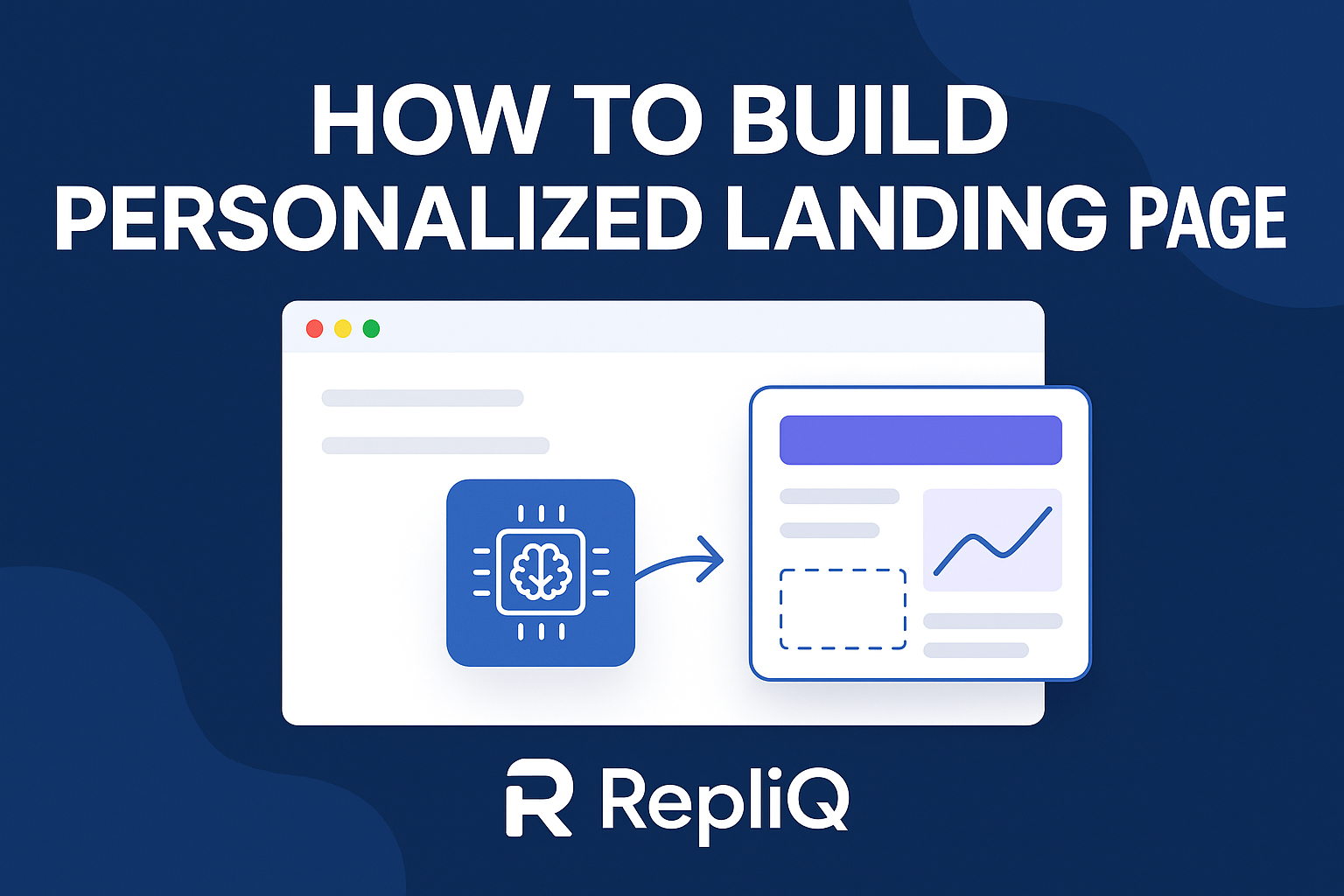
How to Build Personalized Landing Pages Using RepliQ’s Screenshot‑to‑Page Automation
Introduction
In the high-stakes world of digital marketing, relevance is the only metric that truly matters. You spend thousands on hyper-targeted ads, carefully segmenting audiences by intent, industry, and pain point. Yet, when those users click through, they often land on a generic, "one-size-fits-all" page that fails to reflect the promise of the ad. This disconnection is where conversions go to die.
Personalization matters because it proves you understand the visitor immediately. However, current landing page tools make true personalization painfully difficult. Marketers are stuck manually cloning pages, tweaking headlines one by one, or wrestling with complex rule-based software that feels slow and hard to scale.
The problem is clear: manual personalization doesn’t scale, and generic templates don’t convert. The promise of RepliQ is a paradigm shift—screenshot‑to‑page automation. By turning static visual inputs into dynamic, personalized web experiences instantly, you can generate tailored variants for every prospect without the manual grind.
This guide covers RepliQ’s unique screenshot‑driven workflow, how to leverage AI landing page personalization blocks, and how to align pre-sale experiences perfectly. We will explore practical examples and compare this automated approach to traditional tools like Unbounce or Instapage.
As pioneers in screenshot-based pre-sale personalization, RepliQ is redefining how sales and marketing teams build relevance at scale. Learn how RepliQ turns screenshots into dynamic assets to see how static images become conversion engines.
Why Traditional Personalization Fails at Scale
For years, the standard advice for improving conversion rates has been "segment your audience." While the strategy is sound, the execution is often flawed. Traditional personalization fails at scale because it relies heavily on manual intervention or rigid, rule-based logic that cannot keep up with the fluidity of modern traffic.
The Manual Bottleneck
Creating personalized landing pages manually is a slow, repetitive process. To target ten different industries, a marketer using traditional builders must clone a master page ten times, manually edit the copy, swap out images, and manage ten different URLs. This "manual landing page personalization issues" creates a maintenance nightmare. If the core offer changes, you have to update every single variant individually.
The Limitations of Segmentation-Only Tools
Many existing tools rely on basic segmentation rules—showing "Headline A" to "Audience A." While better than nothing, these tools often focus entirely on post-click optimization. They require you to define every rule and outcome beforehand. This lack of agility means that if a user doesn't fit a pre-defined bucket perfectly, they receive a generic experience.
Furthermore, misaligned ad-to-page experiences are the primary driver of bounce rates. If an ad promises a specific solution for "Enterprise Fintech," but the landing page is a generic SaaS homepage, the trust built by the ad evaporates instantly. This friction reduces conversions significantly.
According to a recent real-time personalization study, generic web experiences fail to capture user attention within the critical first few seconds, leading to bounce rates upwards of 70% for non-personalized traffic. Scaling landing page variants requires a system that moves beyond manual rules and into intelligent automation.
How Screenshot-to-Page Automation Works
RepliQ has introduced a revolutionary workflow: screenshot to landing page automation. Instead of dragging and dropping elements onto a blank canvas, you start with a visual reference—a screenshot—and let automation handle the reconstruction and personalization.
The Workflow at a High Level
- Capture & Upload: You upload a screenshot of your desired layout, a prospect's website, or a specific ad creative.
- AI Interpretation: The system analyzes the visual hierarchy, identifying headers, body text, call-to-action buttons, and images.
- Variant Generation: Using personalized pre-sale pages logic, the AI generates hundreds of unique variants, injecting specific prospect data (like their name, company logo, or industry) into the layout.
- Deployment: These pages are deployed instantly as functional, personalized URLs ready for your campaigns.
This approach drastically reduces friction. Imagine taking a screenshot of a prospect's own homepage and instantly generating a landing page that mirrors their branding but pitches your product. The familiarity breeds trust.
Current adaptive UI generation research highlights that systems capable of interpreting visual inputs to construct interfaces reduce development time by over 90% compared to manual coding.
Discover automated pre-sale experiences here to understand how this technology fits into your broader sales funnel.
Turning Screenshots Into Dynamic Components
The core magic lies in how RepliQ treats the input. It doesn't just display a static image; it converts the screenshot into dynamic content blocks.
The AI recognizes the structure of the page. It understands that the text at the top is a headline and the button at the bottom is a CTA. This allows you to overlay personalized text onto what was originally a static image. You can inject a prospect's first name directly into a headline derived from a screenshot, creating a seamless AI landing page personalization experience that looks custom-coded but took seconds to generate.
Deploying Personalized Variants Automatically
Once the template is set, automated landing page generation takes over. You can upload a CSV of 1,000 leads, and the system will produce 1,000 unique links. Each link leads to a page tailored to that specific row of data.
This capability solves the scalability issue. Whether you are targeting 50 niche industries or 5,000 individual prospects, the effort required is exactly the same. AI personalized pages ensure that every visitor feels like the page was built just for them, without you ever touching a code editor.
AI Personalization for Pre‑Sale Experiences
The "pre-sale" phase—the moments immediately before and after a user clicks your link—is often neglected. AI personalized pre-sale pages bridge the gap between initial interest and the final offer. By personalizing this stage, you increase ad relevance and drastically reduce bounce rates.
The Advantage of Early Alignment
Traditional tools often focus on "post-click" personalization, trying to optimize the page after the user has already arrived and potentially decided to leave. RepliQ focuses on pre-sale funnel alignment. By ensuring the landing page visually and contextually matches the specific outreach message or ad creative, you validate the user's click intent immediately.
Leading frameworks, such as the human-centered personalization framework discussed in Springer publications, emphasize that adaptive web experiences must align with user intent before deep engagement occurs to be effective.
Context-Aware AI Personalization Blocks
RepliQ utilizes context-aware blocks that adapt based on the visitor's data.
- Textual Adaptation: A headline changes from "Best CRM for Business" to "Best CRM for [Company Name]."
- Visual Adaptation: The background image shifts to reflect the visitor's city or industry.
- Social Proof: Testimonials swap dynamically to show success stories relevant to the visitor's specific sector.
These dynamic landing pages are not just swapping text; they are reconstructing the narrative to fit the user's context.
Matching Ads to Pages Automatically
Message matching is critical for high quality scores and conversion rates. With personalized landing pages, you can ensure ad-to-page relevance is 1:1.
- Scenario: You run ads for "Dental Marketing Software" and "Real Estate Marketing Software."
- Workflow: Instead of building two separate pages, you build one dynamic page. The automation detects the ad source and adjusts the headline, hero image, and case studies to match "Dental" or "Real Estate" automatically.
Comparison to Existing Personalization Tools
To understand the value of screenshot-to-page automation, it is helpful to compare it with the current landscape of landing page builders. While tools like Unbounce, Instapage, or Mutiny are powerful, they operate on fundamentally different principles.
Manual/Rule-Based Tools vs Automated Screenshot-to-Page Workflows
Most competitors, such as those offering Unbounce Smart Traffic personalization or Instapage post-click personalization, rely on a "builder" model. You start with a template, drag elements, and then apply rules (e.g., "If traffic comes from Facebook, show Section B").
- The Gap: This requires you to build Section B manually. If you have 50 segments, you need 50 rules and potentially 50 variations of content.
- The RepliQ Difference: RepliQ uses automated screenshot-to-page workflows. You don't build sections; you provide data. The AI generates the variations automatically. This is vastly faster for strategies requiring high-volume personalization, such as cold outreach or programmatic SEO.
Unlike Mutiny no-code personalization, which sits on top of an existing website to change elements, RepliQ can generate entirely new standalone assets from screenshots, offering greater flexibility for dedicated campaign pages.
Compliance Note: All dynamic content generation adheres to W3C web standards, ensuring that personalized pages remain accessible and performant across devices.
Why Screenshot Automation Outperforms Templates
Templates are rigid. They force your content into a pre-set box. Screenshot to landing page automation allows you to mimic any successful design instantly.
- Speed: No need to design from scratch.
- Creativity: You are not limited by the template library of your software.
- Relevance: You can mirror the visual language of the prospect's own brand, creating a subliminal connection that generic templates cannot achieve.
Real-World Use Cases for Dynamic Landing Pages
How does this technology translate into daily marketing operations? Here are three scenarios where dynamic landing pages drive measurable impact.
Performance Marketers
For paid media specialists, relevant landing page variants are the key to lowering CPA.
- Use Case: A marketer running Google Ads for a cybersecurity firm targets 100 different keywords (e.g., "ransomware protection," "phishing defense").
- Solution: Using RepliQ, they generate a unique landing page for each keyword group. The headline and hero image match the search term exactly.
- Result: Higher Quality Scores and lower bounce rates due to perfect message matching.
SaaS Marketers
SaaS companies often struggle to personalize demos for different personas.
- Use Case: An outreach team sends emails to CEOs, CTOs, and Marketing Managers.
- Solution: They use AI landing page personalization to send each role a unique link. The CEO sees a page highlighting ROI and speed; the CTO sees API documentation and security specs; the Marketer sees integration capabilities.
- Result: Higher engagement because the value proposition aligns with the specific stakeholder's KPI.
Agencies
Agencies managing dozens of clients need efficiency.
- Use Case: An SEO agency wants to build local landing pages for a franchise with 50 locations.
- Solution: Instead of manually building 50 pages in WordPress, they use a screenshot-based workflow to generate 50 variants, each with local maps, city names, and specific phone numbers.
- Result: Days of work compressed into minutes.
Tools, Resources & Workflow Templates
To get started with automated landing page generation, follow this simple workflow template using RepliQ.
The "Hyper-Personalized Outreach" Workflow:
- Data Collection: Gather your lead list (CSV) including columns for
First Name,Company Name,Industry, andWebsite URL. - Asset Creation:
- Take a screenshot of a high-converting layout or your standard sales deck slide.
- Alternatively, capture a screenshot of the prospect's website to use as a background for a "We analyzed your site" overlay.
- Configuration:
- Upload the screenshot to RepliQ.
- Map the CSV columns to dynamic zones on the image (e.g., replace the generic logo with the
Company Logofrom the lead list).
- Generation: Run the automation to produce unique URLs.
- Distribution: Insert these URLs into your email sequence or ad campaign.
Checklist for Success:
- Ensure your CSV data is clean (no broken URLs or formatting errors).
- Test the dynamic blocks with long and short text to ensure the design doesn't break.
- Verify that your use of data complies with privacy regulations (GDPR/CCPA).
Future Trends & Predictions in AI Landing Page Personalization
The future of web experiences is moving toward AI hyperpersonalization. We are transitioning from "responsive design" (adapting to screen size) to "adaptive intent" (adapting to user psychology).
Emerging trends suggest that automated sales page testing will become autonomous. AI will not just generate pages but will test them in real-time, swapping out screenshot-based components to maximize yield without human input.
Adaptive UI generation research predicts that within five years, static websites will be obsolete for sales. Instead, every visitor will encounter a unique interface generated on the fly. RepliQ’s screenshot-based workflow is the precursor to this future—bridging the gap between static design and generative UI.
Conclusion
The era of the generic landing page is over. In a saturated digital landscape, personalization is the only way to cut through the noise. However, manual methods and rule-based builders simply cannot scale to meet the demands of modern campaigns.
RepliQ’s screenshot to landing page automation offers a powerful alternative. By transforming static visuals into dynamic, editable assets, you can create thousands of highly relevant, personalized landing pages in the time it takes to build one manually. Whether you are aligning pre-sale funnels, improving ad relevance, or scaling outreach, this technology puts you ahead of the curve.
Ready to stop building pages manually? Try RepliQ today and generate your first screenshot-driven personalized landing page to see the power of automation in action.
FAQ
Frequently Asked Questions
Q1: Can screenshots really be turned into fully functional landing pages?
Yes. RepliQ uses advanced AI to interpret the layout of a screenshot. It identifies text, images, and buttons, converting them into a functional, web-accessible format where specific elements can be dynamically edited and personalized.
Q2: How does screenshot-to-landing-page automation improve conversions?
It improves conversions by ensuring perfect relevance. By automating the creation of variants, you can ensure every visitor sees a page that matches their specific search intent, industry, or ad click, significantly reducing bounce rates compared to generic pages.
Q3: Does RepliQ require any coding to generate personalized page variants?
No. RepliQ is a no-code platform. You upload your visual assets and data lists, and the AI landing page personalization engine handles the technical generation of the pages.
Q4: How is this different from rule-based personalization tools?
Rule-based tools like Unbounce or Mutiny require you to manually set up "if/then" logic for every segment (e.g., "If Industry = Tech, show X"). RepliQ automates the creation of infinite variants based on data inputs, eliminating the need to manually build rules for every single audience segment.

.svg)
.png)


.svg)