
How to Personalize Outreach for Companies Entering a New Industry
Table of Contents
- Introduction: Why Industry Expansion Creates a Powerful Outreach Trigger
- Identify and Validate Company Expansion Signals
- Score Signals by Confidence, Freshness, and Commercial Relevance
- Translate Expansion Evidence into Stakeholder-Specific Messaging
- Build Trigger-Based Outreach Sequences and Follow-Up
- Measure Signal Quality, Response, and Pipeline Impact
- Practical Signal-to-Message Framework
- FAQ
- Conclusion: Turn Expansion Evidence into Defensible Outreach
Introduction: Why Industry Expansion Creates a Powerful Outreach Trigger
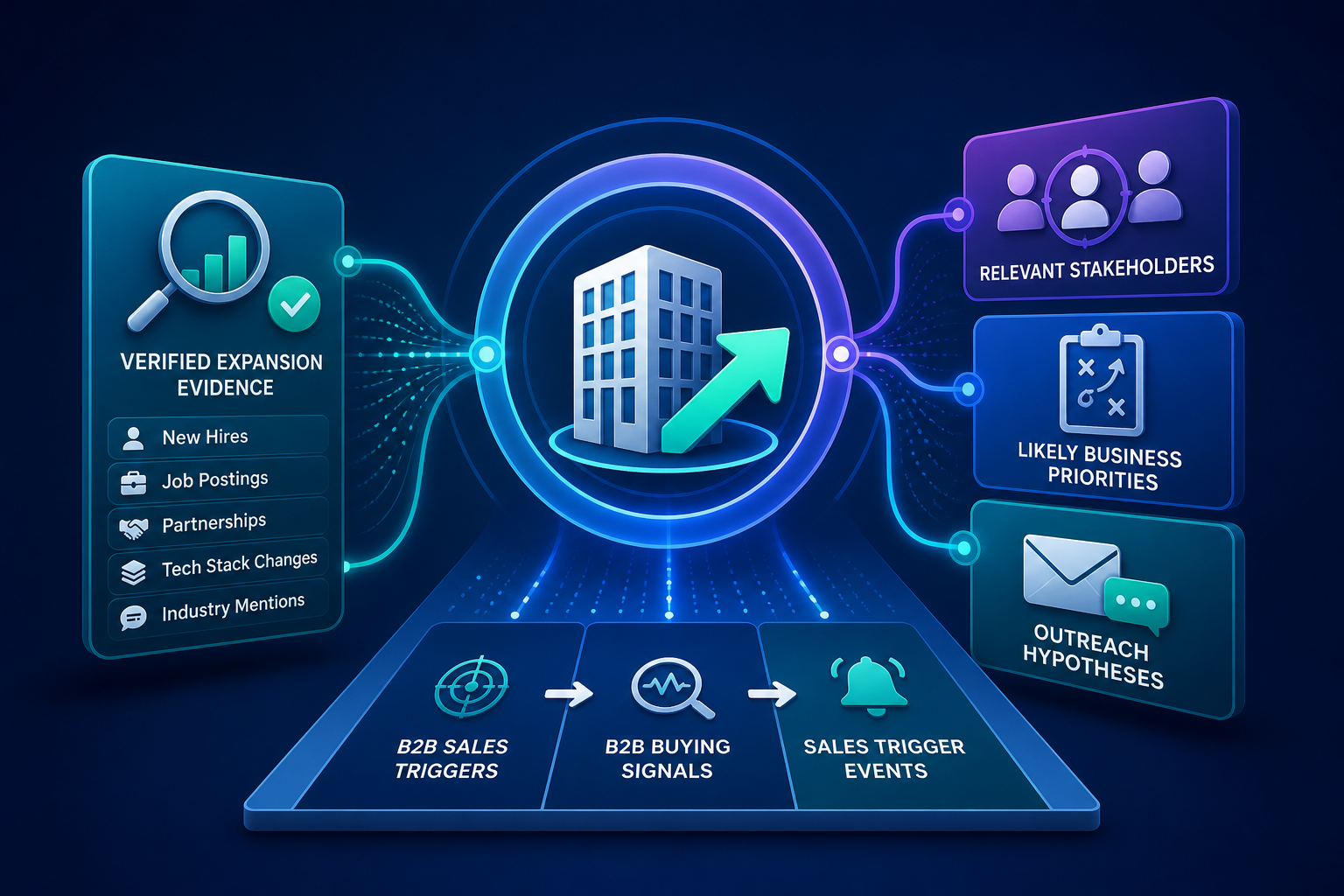
When a company enters a new industry, it triggers a cascade of operational, structural, and strategic needs. For B2B sales teams, this creates a highly timely reason for relevant outreach. However, this relies entirely on the sales team's ability to validate the evidence of expansion and connect it to a credible business priority. The core problem is that expansion evidence rarely arrives neatly packaged. Instead, it is distributed across product pages, press announcements, customer wins, hiring activity, partnerships, and subtle positioning changes.
Generic industry outreach is vastly insufficient for advanced B2B buyers who are entering unfamiliar markets. These buyers are suddenly dealing with new stakeholders, different buying processes, specialized terminology, and strict compliance requirements. Simply mentioning that a company appears to be growing is not enough to capture their attention.
This article serves as a practical signal-to-message playbook. It will guide you through identifying expansion, scoring its reliability, creating stakeholder-specific outreach, and measuring commercial impact. The goal is to distinguish true evidence-led personalization from the superficial tactic of simply mentioning a prospect’s recent news.
As a resource for turning product-page changes, announcements, and customer wins into defensible outreach hypotheses, RepliQ emphasizes the importance of corroboration, human review, and the responsible use of publicly available information. By mastering personalized outreach for companies entering a new industry, revenue teams can leverage these B2B sales triggers to drive meaningful conversations.
Identify and Validate Company Expansion Signals
Finding reliable evidence that a company may be moving into a new industry requires careful observation before writing an expansion-based message. No single event acts as absolute proof of market entry. Instead, multiple signals should be evaluated together and linked to a specific new vertical or customer segment.
To build a reliable foundation for your new industry expansion outreach, always record the source, date, exact wording, target industry, and the business implication suggested by each signal. This evidence-led research stands in stark contrast to superficial personalization, which often just repeats a headline without adding any strategic insight.
Product-Page and Positioning Changes
New industry pages, dedicated solution pages, specialized use cases, updated terminology, distinct customer categories, or modified service descriptions can all serve as strong indicators of a change in positioning. When monitoring for company product page change detection, compare current language with previous iterations (using public web archives if necessary) to identify whether the change introduces a genuinely new market or simply reorganizes existing messaging.
Always capture the exact language used by the company. This allows your outreach to reflect their specific terminology without making overarching assumptions about their internal strategy. Because product updates can sometimes be isolated tests, check whether these changes are supported by other evidence, such as a relevant customer announcement, partnership, or hiring pattern.
When referencing these updates, always cite the prospect’s primary product or solution page and clearly label your observations as evidence rather than confirmed strategic intent. For teams looking to scale this process, https://repliq.co is a powerful resource for turning company-change signals into account-specific outreach research, streamlining market expansion personalization.
Announcements, Customer Wins, Partnerships, and Hiring
Press releases and announcements that mention new industries, vertical-specific customers, market launches, partnerships, acquisitions, or expanded capabilities are prime B2B sales triggers. Customer wins are particularly revealing; when a new customer's type, use case, or buying environment differs drastically from the company’s established market, it often signals a deliberate vertical expansion.
Industry-specific hiring, the development of partner ecosystems, and newly posted role requirements should be treated as supporting signals rather than automatic proof of expansion. A single hire could be an isolated replacement, but multiple hires targeting the same vertical indicate a strategic shift. Always note whether multiple signals appeared within a relevant time period and whether they all point toward the same industry.
For deeper validation when the target is a public company, refer to the SEC guidance on reading 10-K filings to responsibly use public filings to validate business descriptions, products, markets, subsidiaries, or risks. Additionally, consulting the USPTO trademark search guidance can serve as a corroborating source for new goods or services categories, though a trademark filing alone should never be presented as definitive proof of commercial expansion.
Distinguishing Genuine Expansion from Routine Activity
Not every update is a strategic pivot. To distinguish genuine expansion from routine activity, use this qualification checklist to decide whether an observed change is commercially meaningful:
- Does it identify a new industry, buyer group, or use case?
- Is the signal recent and specific?
- Is there a second source that supports the same interpretation?
- Does the change suggest a business priority that your outreach can address?
Routine campaign activity, broad thought leadership content, or isolated hiring often create false positives. When utilizing trigger-based sales prospecting, rely on cautious language. Phrasing such as “I noticed” or “It appears” allows you to present a hypothesis supported by evidence without making a confirmed, potentially inaccurate conclusion.
Score Signals by Confidence, Freshness, and Commercial Relevance
To prevent treating every expansion-related event as equally valuable, revenue teams need a repeatable method for prioritizing accounts. Scoring signals reduces low-quality alerts and highlights which accounts require manual research. Evaluate your B2B expansion intent data across three dimensions:
- Confidence: How directly does the evidence support an expansion hypothesis?
- Freshness: How recently did the signal appear or change?
- Commercial relevance: Does the signal imply a problem, investment, or stakeholder need that your team can address?
Build a Tiered Signal-Confidence Model
Systematic prioritization is highly preferable to relying on intuition alone, a principle supported by peer-reviewed research on B2B lead scoring. A practical three-level model helps categorize these B2B sales triggers:
- Confirmed expansion: Multiple aligned signals, such as an explicit announcement supported by a product-page change or relevant customer evidence.
- Probable expansion: Strong but incomplete evidence, such as industry-specific hiring combined with a new use case or partnership.
- Early-stage or ambiguous expansion: A weak or isolated signal that should support light-touch research rather than a strong claim.
Your outreach must adapt to the tier:
- Confirmed: Use a direct, evidence-led message.
- Probable: Use a hypothesis-based message paired with a clarifying question.
- Ambiguous: Use an educational or observation-led message with minimal assumptions.
Combine Signals into an Account Expansion Score
To operationalize this, create a simple worksheet or table in your CRM with the following columns:
- Signal type
- Source URL
- Date observed
- Industry relevance
- Confidence level
- Likely business implication
- Stakeholder affected
- Recommended outreach action
Corroboration, specificity, and recency should increase an account's priority score, while generic or stale evidence should reduce it. Always document the reasoning behind each score so another seller or manager can review or challenge the hypothesis. This evidence-led scoring workflow provides vastly superior account intelligence for new market entry compared to broad intent-data approaches, which may identify account activity without proving actual new-industry expansion.
Decide When Human Review Is Required
While AI-assisted sales research can efficiently summarize evidence and draft hypotheses, certain situations strictly require human review before outreach is sent:
- The evidence concerns a regulated or sensitive industry.
- The signal is inferred from ambiguous language.
- The message would make a strong claim about strategic intent.
- The account has conflicting or outdated information.
A human must verify source accuracy, context, and tone. Implement a short pre-send checklist: ensure the source is verified, the date is checked, the claim is softened where necessary, and the business implication is directly relevant to the recipient. Responsible messaging, privacy awareness, source verification, and human review are essential trust-building practices.
Translate Expansion Evidence into Stakeholder-Specific Messaging
The goal of market expansion personalization is to convert an expansion signal into a highly useful message, rather than merely repeating the prospect’s own press release back to them. Advanced buyers respond to outreach that demonstrates an understanding of the new industry’s stakeholders, buying process, terminology, proof requirements, and operational risks.
Rely on a core message chain: observable evidence → plausible business consequence → relevant value hypothesis → low-friction next step.
Move from Observable Evidence to a Business Hypothesis
When drafting evidence-based personalized outreach, separate what is definitively known from what is inferred:
- Known: The company published a new industry solution page or announced a relevant customer.
- Inferred: The company may need new demand-generation, qualification, partner, or proof-point processes to support this vertical.
- To validate: Whether that specific priority is active for the recipient’s team.
Connect the signal to one operational or commercial consequence instead of listing every possible challenge they might face. Conclude with a low-friction question that invites correction, such as asking whether the company is prioritizing a specific workflow in the new vertical. Never claim that the prospect “is definitely entering” a market unless the primary source explicitly confirms it.
Map the New Industry to Stakeholders and Priorities
An industry expansion inevitably changes the relevant buying committee. You must map your outreach to new priorities specific to each role:
- Executives: Focus on market-entry risk, overall growth, and strategic validation.
- Marketing leaders: Focus on category language, demand generation, and vertical proof.
- Sales leaders: Focus on qualification, account prioritization, and navigating unfamiliar buying processes.
- Product or operations leaders: Focus on readiness, integrations, compliance context, and delivery requirements.
Create a stakeholder-specific hypothesis before writing the message. Ensure your terminology and proof points change depending on the recipient’s role and the maturity of the expansion. To normalize current and prospective industry categories during your research phase, utilize official NAICS industry classifications. While classification supports research, remember that it does not independently prove strategic intent.
Use Proof Points Without Overstating Relevance
When leveraging industry-specific proof, you can use existing customer evidence even if it is adjacent—but not identical—to the prospect’s new industry. However, you must state the degree of similarity honestly. Avoid implying that a previous result in one vertical will automatically transfer to their new, untested vertical.
Select proof points that demonstrate a relevant capability, workflow, or outcome rather than listing generic company credentials. Before asking for a meeting, offer a useful asset, observation, diagnostic, or framework. Cite context from your own product, announcements, or customer wins only where it directly supports the message angle, avoiding any unsupported performance claims.
For more insights on practical research and customer-evidence workflows, explore this https://repliq.co/blog. Additionally, for intelligence, qualification, and scalable signal-driven workflows, consider utilizing https://scaliq.ai as an adjacent resource.
Build Trigger-Based Outreach Sequences and Follow-Up
A single email is insufficient when an expansion signal could be confirmed, probable, or ambiguous. You must turn one expansion insight into a measured, trigger-based prospecting sequence that adapts to confidence, freshness, and the prospect's response. Assign each account a specific signal tier, message angle, stakeholder, evidence source, and follow-up condition. Every follow-up must add context or value rather than simply repeating the initial claim.
Messaging for Confirmed, Probable, and Early-Stage Expansion
Tailor your approach based on the signal tier:
- Confirmed: Reference the explicit announcement and connect it directly to one likely execution priority.
- Probable: Reference two aligned observations and frame the business implication as a thoughtful hypothesis.
- Early-stage: Mention a relevant change lightly and ask whether the new vertical is an active priority.
Use this recommended message structure for sales messaging for new verticals:
- Specific observation (include dated source references or links to primary evidence in your research record).
- Why it may matter to their specific role.
- Relevant capability or perspective you bring to the table.
- Simple question or low-friction next step.
This structured approach contrasts sharply with generic outreach that merely inserts the industry name without demonstrating any real account understanding.
Sequence Follow-Up by Signal Strength and Recency
High-confidence, recent signals justify a more direct and persistent sequence. Weak or stale signals call for lighter-touch education and nurturing. Base your follow-up angles on providing new value:
- Introduce a different stakeholder-specific implication.
- Share a highly relevant proof point.
- Ask a nuanced question about their expansion readiness.
- Offer to share a diagnostic or framework tailored to the new market.
Include a specific sequence branch for non-responses after an announcement. If they do not reply, reduce your assumptions, offer a universally useful observation, and leave a clear, polite path for them to correct your hypothesis.
Respond to Ambiguous or Incorrect Assumptions
When executing responsible personalization, you will inevitably encounter prospects who state their company is not entering the industry you hypothesized. When this happens:
- Acknowledge the correction immediately and professionally.
- Clarify the public source of your interpretation without being defensive.
- Ask whether an adjacent priority is currently more relevant.
- Update your CRM and remove the account from the expansion sequence.
Correcting assumptions protects your credibility and improves your future signal-quality scoring. Never argue with a prospect about the meaning of a public signal.
Measure Signal Quality, Response, and Pipeline Impact
To determine whether expansion-based personalization actually improves account quality and commercial outcomes—rather than just inflating reply volume—revenue teams must measure the entire workflow. This includes signal detection, validation, outreach, response quality, meetings, opportunities, and pipeline progression. Where possible, compare trigger-led campaigns with a relevant generic-industry baseline.
Track Signal Precision and False Positives
A high volume of alerts is useless if most fail to produce a defensible outreach hypothesis. Monitor these operational measures for signal precision:
- Percentage of signals judged commercially meaningful.
- Percentage of signals corroborated by a second source.
- False-positive rate (signals that proved inaccurate upon outreach).
- Average signal age at the time of first outreach.
- Percentage of accounts requiring manual correction.
Segment your results by signal type (e.g., product-page changes, announcements, customer wins, hiring, partnerships, or positioning changes) to identify which sources yield the highest quality intelligence.
Measure Message and Pipeline Performance
Go beyond open rates and track metrics that prove pipeline impact:
- Positive reply quality (distinguishing meaningful engagement from simple polite declines).
- Meetings booked.
- Meeting-to-opportunity conversion rate.
- Opportunities created.
- Pipeline progression.
- Performance segmented by stakeholder, signal tier, and message angle.
It is vital to distinguish sheer reply volume from meaningful engagement with the expansion-related business issue. Research on customized B2B interactions highlights the importance of relevant, customized interactions in driving actual pipeline value. Always record the signal source and message hypothesis in the CRM so these outcomes can be accurately analyzed later.
Improve the Workflow Through Controlled Testing
Continuously refine your trigger-based prospecting experiments by comparing variables:
- Expansion-triggered messaging versus generic industry messaging.
- Single-signal prioritization versus corroborated multi-signal prioritization.
- Executive messaging versus functional-leader messaging.
- Direct asks (e.g., "Can we meet?") versus low-friction diagnostic or insight offers.
To evaluate signal and message differences accurately, keep the audience, timing, and offer as consistent as possible during tests. Regularly review negative responses and corrections to identify recurring issues in source quality, aggressive assumptions, or poor stakeholder mapping.
Practical Signal-to-Message Framework
Use this compact workflow as a standalone checklist for every target account to ensure high-quality, evidence-based market expansion personalization. This framework is designed to support evidence-based hypotheses, not to infer undisclosed company strategy.
- Detect a possible expansion signal.
- Capture the primary source and exact date.
- Find one or more corroborating signals.
- Classify the signal as confirmed, probable, or ambiguous.
- Score confidence, freshness, and commercial relevance.
- Identify the most relevant stakeholder based on the new vertical.
- Write one evidence-based business hypothesis.
- Select a transferable proof point or highly useful insight.
- Draft a concise message ending with a low-friction question.
- Assign a follow-up sequence based on signal strength.
- Record the outcome in the CRM and update the signal score.
Signal-to-Message Blueprint:
| Evidence Source | Confidence | Freshness | Commercial Implication | Stakeholder | Safe Message Angle | Claim to Avoid |
|---|---|---|---|---|---|---|
| New solution page | Probable | < 30 days | Need for new vertical use-cases | Product Leader | "Noticed the new [Industry] page; curious how you're adapting integrations." | "You are officially launching in [Industry]." |
| Press release | Confirmed | < 7 days | Demand gen pivot required | Marketing Exec | "Saw the [Industry] expansion announcement; how are you generating vertical proof?" | "You need our tool to survive in [Industry]." |
| 3 niche hires | Ambiguous | < 60 days | Exploring new market entry | Sales Leader | "Noticed hiring in [Industry]; is this a new priority area?" | "You are building a dedicated [Industry] sales team." |
FAQ
How can you tell when a company is entering a new industry?
The strongest indication comes from multiple aligned signals, such as explicit press announcements, industry-specific product-page changes, relevant customer wins, specialized partnerships, or targeted hiring. A single signal should generally be treated as a hypothesis to be tested, rather than absolute confirmation of new market entry signals.
Which B2B sales triggers matter most for industry expansion?
The most impactful market expansion sales triggers include product and positioning changes, explicit company announcements, new industry-specific customer case studies, relevant partnerships, specialized hiring, and supporting corporate or trademark evidence. Their importance depends entirely on their confidence, freshness, specificity, and commercial relevance to your solution.
How do you personalize outreach around a company’s market expansion?
Follow a strict evidence-to-message sequence: cite an observable change, connect it to one plausible business priority, tailor the implication to the recipient’s specific role, and ask a low-friction question. Avoid the common trap of merely repeating the company's announcement without adding a useful, specialized business interpretation.
How should messaging change when the target is entering a regulated industry?
When conducting regulated industry outreach, apply stronger source verification, use highly cautious claims, explicitly state your uncertainty, and mandate human review before any outreach is sent. Messages must reflect the new industry’s operational and compliance context without asserting legal or compliance requirements that you have not verified.
How many signals are needed before prioritizing an account?
There is no universal threshold for account expansion signals. The decision to prioritize depends on the signal's specificity, recency, confidence, and commercial relevance. Require corroboration before making a strong claim in your messaging, but allow weaker, single signals to support light-touch research and educational outreach.
Conclusion: Turn Expansion Evidence into Defensible Outreach
Effectively leveraging a company's entry into a new industry requires more than just setting up basic news alerts. It demands a systematic process: finding expansion evidence across multiple public sources, validating that evidence rather than making assumptions, and scoring it by confidence, freshness, and commercial relevance. From there, you must map the new vertical to specific stakeholders and business priorities, build concise, hypothesis-led sequences, and rigorously measure signal precision, response quality, and pipeline impact.
The central distinction in this methodology is clear: effective personalization does not merely mention a prospect’s expansion. It explains why the change may matter to their daily operations and invites the buyer to confirm or correct the hypothesis.
RepliQ’s recommended workflow inherently prioritizes primary evidence, corroboration, human review, responsible claims, and measurable outcomes. By ensuring that all data use is legal, compliant, and ethically sourced from public information, sales teams can build genuine trust while driving pipeline.
To explore how you can turn company-change signals into scalable, evidence-based outreach workflows, visit https://repliq.co and transform your expansion insights into defensible, high-converting conversations.


