
Personalized Sales Pages for High-Value Prospects: The Definitive ABM Outreach Blueprint
Table of Contents
- Introduction
- What Personalized ABM Landing Pages Are
- The Anatomy of a High-Converting Account-Specific Page
- How to Personalize Messaging for Enterprise Buying Committees
- A Scalable Workflow for Creating and Using Sales Pages
- How to Measure Pipeline and Revenue Impact
- Common Personalization Risks and Quality Controls
- Conclusion
- FAQ
Introduction: Why High-Value Outreach Needs More Than a Generic Landing Page
It is a common and frustrating scenario in B2B sales: an account executive meticulously crafts an outbound message addressing a prospect’s specific business priorities, only to link them to a generic, one-size-fits-all destination page. This message discontinuity breaks trust, dilutes the value proposition, and ultimately stalls conversions.
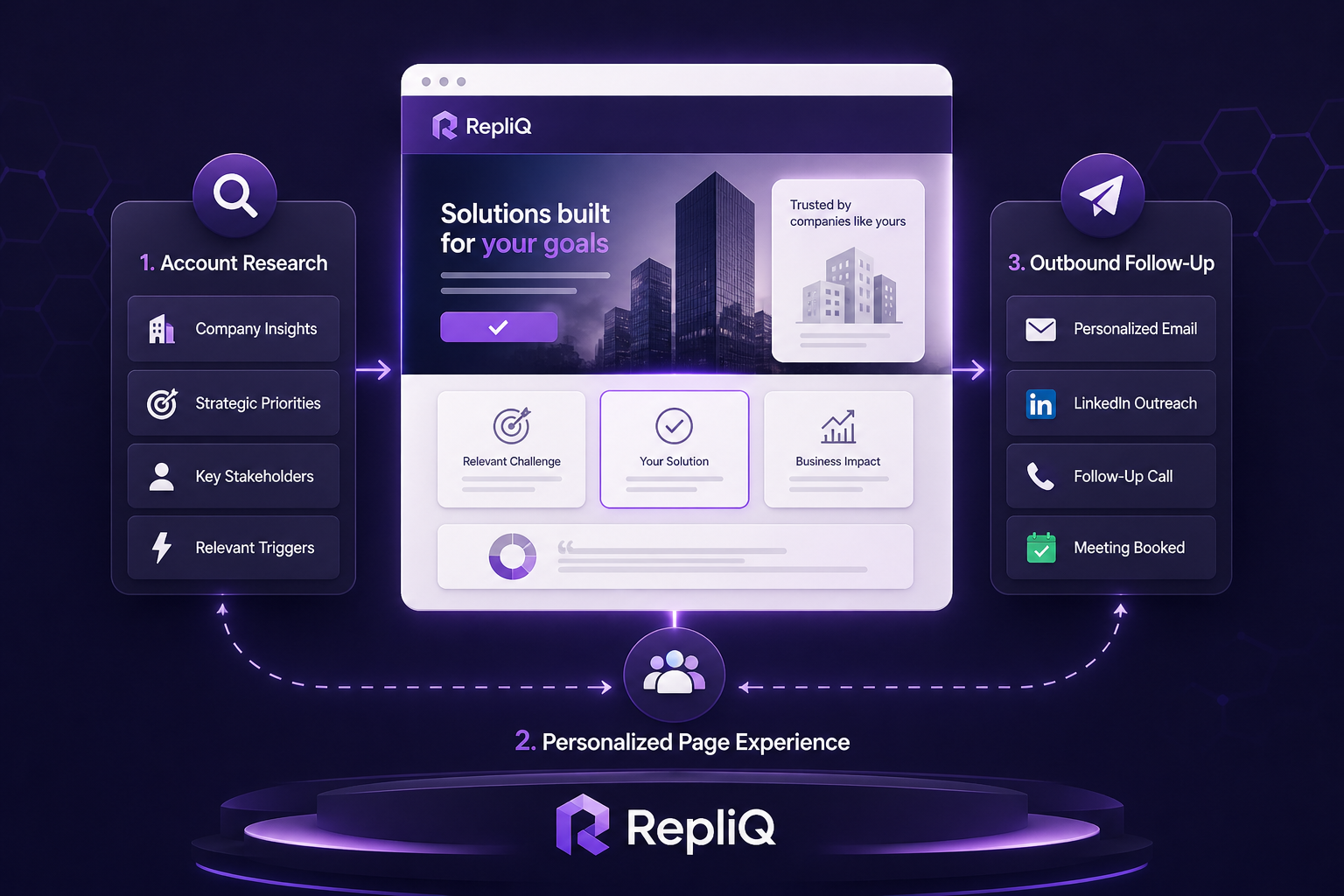
High-value prospect outreach requires deep relevance at three distinct levels: the account, the stakeholder role, and the specific business problem. Personalized sales pages serve as the practical solution to this challenge, bridging the gap between bespoke outbound messaging and the digital buying experience. This article provides a comprehensive framework for converting account research into a credible, high-converting sales-page experience.
In the following sections, we will explore the complete workflow—from conducting privacy-aware research and understanding page anatomy to executing buying-committee personalization, scalable production, coordinated follow-up, and precise revenue measurement. Effective personalization must be useful and evidence-based; inserting a prospect’s name, logo, or a superficial image is no longer enough to win enterprise deals.
At RepliQ, our expertise lies in equipping teams with dynamic headlines, company-specific messaging, personalized visuals, and tailored calls to action that drive measurable pipeline. As academic research on ABM activities and outcomes demonstrates, tightly coordinated ABM activity is deeply connected to superior business outcomes. For a deeper dive into these strategies, explore RepliQ’s broader insights on personalized outreach and sales enablement.
What Personalized ABM Landing Pages Are
To execute an effective account-based strategy, marketing and sales teams must distinguish a personalized sales page from standard digital assets like generic landing pages, traditional case studies, or broad website personalization.
Personalized Sales Pages vs. Generic Landing Pages
A personalized sales page is a focused, highly relevant digital destination created for a specific account, market segment, open opportunity, or distinct buying context. While generic landing pages communicate a broad value proposition designed to capture a wide audience, an account-specific page is engineered to help a specific prospect answer three critical questions: “Why this, why now, and why us?”
Effective personalization extends far beyond superficial customization—such as simply swapping out a company name without altering the underlying argument. True personalized landing pages adapt the core message to the account’s reality, the stakeholder’s role, the specific business challenge, relevant proof points, contextual visuals, the targeted offer, and the final call to action (CTA). This depth is what makes enterprise landing page optimization a driver of revenue rather than just a marketing novelty.
When to Use a Personalized Sales Page
Personalized sales pages are most effective when deployed for strategic outbound accounts, high-intent prospects, enterprise opportunities, executive-level outreach, and complex buying committees.
These pages are vastly more useful than a static sales deck or a standard case study when the prospect requires a concise, contextual business case paired with a clear, low-friction next step. However, not every account in your CRM requires a fully bespoke page. Teams should use account value, buying complexity, behavioral intent, and sales-stage importance to determine the appropriate level of customization.
Unlike general landing-page builders or website-personalization tools that merely adapt surface-level web experiences, account-based marketing landing pages demand a complete workflow. This workflow spans from initial account research to outbound follow-up and measurable sales action, serving as highly focused sales enablement pages for personalized outbound campaigns.
The Personalization Principle: Customize the Argument, Not Just the Surface
The core rule of one-to-one marketing is simple: personalization should make the prospect’s business case easier to understand.
Achieving this requires distinguishing between account-level personalization (the company's market position), role-level personalization (the specific stakeholder's daily friction), and opportunity-level personalization (the exact deal context). Every account-specific claim must be backed by documented evidence. Teams must strictly avoid making unsupported assumptions about a prospect’s internal priorities, technology systems, performance metrics, or buying stage.
As outlined in the IAB’s B2B ABM playbook, rigorous account selection, defined personalization levels, buying-committee identification, and marketing-sales alignment are foundational to delivering prospect-specific messaging and successful account-based marketing personalization.
The Anatomy of a High-Converting Account-Specific Page
Building a personalized sales page requires a practical framework that dictates which elements should be personalized, which should remain standardized for brand integrity, and the specific role each section plays in driving conversion.
1. Dynamic Headline and Message-Matched Opening
The page must open with a headline that directly connects the prospect’s account context to a relevant, achievable business outcome. Crucially, there must be a seamless message match between the language and promise used in the originating email, social touchpoint, or sales conversation, and the headline on the page.
Avoid unsupported claims. Never state that a prospect has a specific internal problem unless prior research or a direct conversation has confirmed it. Use a concise subheadline to elaborate on the business impact using the prospect’s own industry terminology. To ensure dynamic headlines and company-specific messaging remain accurate and do not appear invasive, human review of every headline is highly recommended.
2. Account-Specific Problem and Business Hypothesis
Next, translate your account research into a clear, well-articulated hypothesis regarding the prospect’s primary challenge, strategic priority, or market opportunity. Frame this issue entirely around business impact rather than product features.
Carefully distinguish between verified public facts and reasonable hypotheses. Use nuanced language when the account’s internal priorities are inferred rather than confirmed. By connecting their specific problem to a relevant solution path, personalized sales pages reduce the cognitive load on the prospect, making high-value prospect outreach significantly more effective.
3. Personalized Visuals and Contextual Value Articulation
Visuals should reflect the prospect’s specific industry, daily workflow, market context, or strategic priorities. Personalized visuals must reinforce the page’s narrative; they should never function as mere decorative personalization.
Connect every visual element to a concrete explanation of how your solution fits seamlessly into the account’s existing operating environment. While the context is adapted for the target account, the design must remain consistent with RepliQ’s brand standards. Always avoid using confidential, scraped, or unverifiable company information to create personalized sales experiences, ensuring your B2B conversion rate optimization efforts remain strictly compliant and ethical.
4. Relevant Proof and Credibility
Trust is built through relevant proof. Select case studies, testimonials, or data points based on the prospect's industry, company maturity, specific use case, or implementation model.
If there is no directly comparable customer, use relevant capabilities, transparent assumptions, or adjacent proof. Never imply a false match. Provide evidence that directly answers the prospect’s likely buying questions regarding feasibility, business value, user adoption, or implementation risk. When presenting enterprise buyer personalization to drive high-intent lead conversion, add citations for any strong performance or ROI claims, and never invent statistics.
5. Role-Relevant Value Proposition and Objection Handling
Explain your solution strictly in terms of outcomes for the target account, avoiding generic feature lists. Because enterprise deals involve multiple stakeholders, include modular sections designed for proactive objection handling. Address common concerns such as implementation effort, internal resource requirements, integration, governance, security, and time-to-value.
Use concise, role-specific language so different evaluators can easily find the information relevant to them. Clearly define which account-specific messaging should be tailored and which core product facts must remain standardized for accuracy.
6. Tailored CTA and Low-Friction Next Step
A generic "Book a Demo" button often creates unnecessary friction. Instead, match the CTA to the prospect’s current buying stage and the precise purpose of the outreach.
Consider tailored calls to action such as an account-focused audit, a diagnostic conversation, a strategic workshop, or a tailored walkthrough. The CTA should clarify the next step for both the primary contact and the wider buying committee, ensuring the page does not force a high-commitment action before the prospect has sufficient context. To see how dynamic headlines, personalized visuals, company-specific messaging, and tailored CTAs work together seamlessly, explore RepliQ’s sales-page capability for high-value prospect outreach and personalized outbound campaigns.
How to Personalize Messaging for Enterprise Buying Committees
Enterprise purchases are rarely made by a single individual. Creating pages that support multiple stakeholders without producing disconnected or contradictory messages is vital for complex sales.
Map the Account, Buying Stage, and Stakeholder Roles
Before drafting copy, identify the target account’s relevant business context, verified pain points, current buying stage, and the likely participants in the decision-making process.
You must separate the distinct needs of executives, operational users, finance stakeholders, technical evaluators, procurement officers, and internal champions. A page targeting only one persona will likely fail because enterprise purchases require broad consensus. Use account-level messaging as the unifying narrative, then introduce modular sections addressing stakeholder-specific concerns. As Wharton research on organizational buying behavior highlights, organizational, interpersonal, and individual factors all heavily influence complex B2B buying decisions, making enterprise buyer personalization and account-based marketing landing pages essential.
Adapt the Page by Stakeholder
To deliver highly personalized website experiences for B2B, structure the page to speak directly to different roles:
- Executive section: Focus on strategic priorities, overarching business impact, risk reduction, and why the opportunity matters now.
- Operational section: Explain workflow fit, practical implementation steps, day-to-day usability, and expected internal effort.
- Finance section: Clarify the business case, evaluation criteria, resource implications, and how ROI outcomes will be assessed.
- Technical section: Address implementation details, data governance, security, integration considerations, and validation requirements.
- Champion section: Provide shareable prospect-specific messaging, concise proof points, and an internal business case the champion can easily forward to colleagues.
Create a Personalization Matrix
To manage this complexity, create a personalization matrix. Include rows for the account, persona, pain point, proof point, visual, offer, CTA, and follow-up message.
For each field, explicitly mark whether the content should be customized, adapted from a controlled library, or standardized. Include a confidence or evidence note for every personalized claim. This matrix prevents contradictory messages across emails, personalized sales pages, sales calls, and CRM notes. For effective one-to-one ABM campaigns and account-based marketing personalization, prioritize factual validation, privacy-aware research, and strict approval rules before publishing.
A Scalable Workflow for Creating and Using Sales Pages
Turning this strategy into a repeatable operating model allows sales and marketing teams to deploy pages efficiently without rebuilding every asset from scratch.
Step 1: Select and Research the Target Account
First, confirm why the account merits personalized treatment—based on strategic value, opportunity relevance, buying complexity, or demonstrated intent.
Gather only the specific account information necessary to craft a useful page narrative. Strictly separate publicly available facts, CRM data, first-party signals, and sales intelligence from unverified assumptions. Document the exact business problem the page is intended to clarify, ensuring your account research directly fuels high-value prospect outreach and ABM programs.
Step 2: Convert Research Into a Page Brief
Synthesize your research into a concise, one-page brief. This brief must contain the target account, primary audience, business hypothesis, desired outcome, supporting evidence, proof, CTA, and the designated follow-up owner.
Define the critical message match between the outbound touchpoint and the page copy. Decide which elements will feature account-specific messaging and which will utilize approved, reusable modules. Explicitly specify any claims that require source validation to maintain the integrity of your sales enablement pages and personalized landing page examples.
Step 3: Assemble Modular Page Components
Build a library of reusable blocks for headlines, pain points, outcomes, proof, visuals, objections, stakeholder sections, and CTAs.
Utilize controlled personalization fields to accelerate production speed while preventing unsupported, free-form claims. Modularity allows teams to generate multiple personalized landing pages for different stakeholders within one account while preserving absolute brand consistency. Maintain a clear version history so both sales and marketing know exactly which version of the page was shared and when. RepliQ is the premier solution for assembling prospect-specific sales experiences with controlled, dynamic headlines and personalized sales pages.
Step 4: Review for Accuracy, Trust, and Brand Consistency
Before deployment, rigorously verify company names, stakeholder roles, industry context, terminology, examples, and all account-specific claims.
Ensure the personalization is highly relevant and proportionate, never overly familiar or invasive. Confirm that the page perfectly reflects the originating outreach and introduces no contradictory promises. Review all visual assets, proof points, CTAs, tracking details, and stakeholder sections. As noted in government evidence on personalization and transparency, responsible personalization, transparency, and trust are paramount when executing company-specific messaging and landing page personalization best practices.
Step 5: Deliver the Page Through a Coordinated Outbound Sequence
The page must appear as a seamless, natural continuation of the initial email, LinkedIn message, referral, or sales conversation.
Give the recipient a compelling reason to click through that goes beyond a generic “learn more”—such as a relevant hypothesis, a tailored resource, or an account-specific recommendation. Coordinate follow-up tightly across sales and marketing so that page engagement directly informs the next human interaction. Never treat a page visit as definitive proof of purchase intent; rather, use it as valuable context for your personalized outbound campaigns and high-value prospect outreach.
Step 6: Follow Up With Context, Not Pressure
Tailor the sales follow-up to the specific page section or topic the prospect engaged with, ensuring all tracking is privacy-compliant.
Ask a focused question that tests your business hypothesis rather than forcing a generic, high-pressure meeting request. Provide an easy, low-friction path for the recipient to involve other stakeholders. Capture this meaningful sales context in the CRM without overinterpreting engagement behavior. This coordinated workflow distinguishes true sales enablement for enterprise prospects and high-intent lead conversion from standalone tools that merely build pages but fail to integrate research, outreach, and tailored calls to action.
How to Measure Pipeline and Revenue Impact
Vanity engagement metrics must be replaced with a rigorous, account-level measurement framework tied directly to qualified sales activity and tangible business outcomes.
Measure Engagement at the Account and Stakeholder Level
Track engaged target accounts rather than merely counting total page views. Where data availability and privacy regulations allow, monitor stakeholder engagement across executive, operational, finance, technical, and champion audiences.
Record qualified replies, meaningful interactions, CTA completions, and specific requests for additional information. It is critical to distinguish anonymous traffic or accidental visits from verified activity connected to a target account to accurately gauge ABM campaign conversion, account-level engagement, and high-intent lead conversion.
Connect Page Activity to Sales Progression
Track whether exposure to personalized sales pages is actively associated with qualified meetings, opportunity creation, opportunity progression, and accelerated sales-cycle velocity.
Connect the page URL or campaign identifier directly to the outbound touchpoint and the resulting CRM opportunity. When account volume allows, compare performance against a standard-page or standard-outreach baseline. Avoid claiming direct causation from a page visit alone; frame the page as a highly effective touchpoint within a coordinated account motion. As research on ABM drivers and outcomes indicates, the collaboration between marketing and sales is what drives pipeline impact and revenue attribution.
Use a Practical Reporting Framework
Implement a reporting framework that spans the entire revenue cycle:
- Top-of-funnel: Engaged target accounts, targeted page visits, returning visitors, and stakeholder reach.
- Sales engagement: Qualified replies, follow-up conversations, booked meetings, and requests for tailored information.
- Pipeline: Opportunities created, opportunity-stage progression, influenced pipeline, and pipeline velocity.
- Revenue: Closed-won revenue, influenced revenue, and account expansion.
- Quality: Accuracy issues, unsubscribe or negative-response signals, page sharing, and direct stakeholder feedback.
This structured approach ensures B2B conversion rate optimization directly supports high-value prospect outreach.
Common Personalization Risks and Quality Controls
Even a strong personalized sales-page program can be undermined by issues related to trust, accuracy, scalability, and governance. Strict quality controls are non-negotiable.
Avoid Superficial or Inaccurate Personalization
Do not confuse the basic insertion of a company name or logo with a genuine understanding of the account’s business context.
Actively remove claims that rely on outdated, uncertain, or unverified information. Use hypotheses transparently when a prospect’s priority has not been explicitly confirmed. Never imply a pre-existing customer relationship, a performance outcome, or an internal fact that does not exist. Adhering to personalization best practices ensures your company-specific messaging and personalized landing pages maintain absolute credibility.
Balance Customization With Standardization
Achieve scale by standardizing brand elements, legal and compliance language, core product facts, approved proof points, and governance requirements.
Reserve customization for the narrative, pain-point framing, contextual visuals, stakeholder modules, the offer, and the CTA—provided you have the evidence to support it. Utilize reusable components and strict approval workflows to scale ABM campaigns without reducing quality. Clearly define the triggers for when a page should be paused, revised, or replaced because the underlying account context has changed, maintaining the integrity of your sales page personalization and account-based marketing personalization.
Use a Pre-Publish Checklist
Before any personalized sales pages go live, execute a strict pre-publish checklist:
- Verify all account and stakeholder details.
- Confirm complete message match with the outbound touchpoint.
- Validate every personalized claim and proof point against documented research.
- Check the CTA, the designated follow-up path, and CRM tracking functionality.
- Review for privacy compliance, transparency, brand consistency, accessibility, and overall page functionality.
This checklist is the bedrock of landing page personalization best practices and reliable sales enablement pages.
Conclusion: Turn Account Research Into a More Relevant Sales Conversation
Effective personalized sales pages seamlessly connect robust account research, highly relevant messaging, verified proof, stakeholder-specific needs, a tailored CTA, and tightly coordinated follow-up.
The central distinction of this blueprint is clear: you must personalize the business case and the buying experience, not merely the surface details. By adopting the recommended operating model—spanning research, brief creation, modular assembly, validation, delivery, follow-up, and revenue measurement—revenue teams can dramatically improve outbound conversion rates.
Begin by targeting a single strategic account using a controlled page template before scaling the workflow across your broader ABM program. RepliQ provides the essential capabilities for creating compliant, conversion-focused personalized sales experiences that drive pipeline. Create a more relevant sales page for your next strategic account.
FAQ: Personalized Sales Pages for High-Value Prospects
What is a personalized sales page?
A personalized sales page is a focused digital sales destination tailored to a specific account, stakeholder group, open opportunity, or unique business context. Unlike a generic landing page, it provides deep relevance, message continuity from outbound outreach, tailored proof points, and a specific CTA designed for that exact buyer.
How do personalized sales pages work for high-value prospects?
The process follows a sequence from compliant account research to personalized outreach. When the prospect clicks the link, they visit a page that perfectly matches the outreach message. This visit provides context for human follow-up and is measured in the CRM. The page supports and enhances the sales conversation rather than attempting to replace it, driving successful personalized outbound campaigns.
Which elements should be personalized first?
Prioritize the highest-impact elements: the dynamic headlines, the articulation of the business problem, the value proposition, relevant proof, visual context, and tailored calls to action. These elements improve message match and reduce the effort required for the prospect to understand your company-specific messaging.
Should a page target an account, an individual decision-maker, or both?
For enterprise buyer personalization, it is best to use a shared, account-level narrative combined with modular sections tailored for different roles within the buying committee. A single-person message is often too narrow for complex B2B deals, which require consensus across multiple stakeholders.
How can teams scale personalized sales pages without sacrificing quality?
Teams can execute scalable ABM campaigns by utilizing reusable templates, controlled personalization fields, modular sections, strict approval rules, version control, and human validation. Standardize brand and compliance elements while safely customizing the account narrative and CTA for sales enablement for enterprise prospects.
How should teams measure the ROI of personalized sales pages?
Do not rely solely on clicks. Measure qualified replies, booked meetings, created opportunities, pipeline progression, sales-cycle velocity, influenced pipeline, and closed-won revenue. Connect page activity to specific outbound touches and CRM stages to accurately assess high-intent lead conversion and revenue attribution, while avoiding unsupported causal claims.


